Total Pageviews

Wednesday, 7 August 2013

Back to Bunbury.

We were getting ready to leave when another boat passed us. As there are several locks today it was good that we had another boat to share with otherwise it would have been hard work. We shared the locks with 'Sundancer' and we had a good chat on the boat and ashore so the time passed amiably.

As we approached Beeston Locks I saw the WWII oil storage tank area again and this time also saw the herd of deer that live there. They are captive breed I understand and the stag seemed to have  a many pointed set of antlers.


Deer on the Beeston Oil Storage tanks. I expect that the concrete wartime structure will be for the vent for the tank below.

In a previous blog I speculated as to what they were doing with them and on passing this time could see that they appear to be breaking up, at least some of the tanks as can be seen in the photograph.


Oil storage tank at Beeston having being exposed appears to have been broken up for scrap.

Just after the Oil Storage Tanks are the Beeston Locks. The first is a normal brick/stone lock but the second is a cast iron one. This was because of the sandy soil causing the original lock walls to fail. There is a warning at the lock stating that it is advised to have one boat only in the lock as the iron walls of the lock have bowed over the years and boats can get jammed in them. This causes a bottle neck as all the others can get two boats in. It wasn't helped with a hire boat looking like it was waiting to lock down as it was on the landing area, but was actually be cleaned!


Beeston Iron Lock showing the plates that were designed by Thomas Telford and similar to his Llangollen Canal Pontcysyllte aqueduct.

A little further on is the Wild Boar Hotel in the distance. This looks like a very old building but it appears that it was built by a John Taylor in 1886. He was a timber merchant from Warrington. Interestingly John and his brother Robert carried out the first recorded walk of Lands End to John O'Groats in 1871. It took the nine weeeks. There have been wings added on to the main building, especially when a Mrs Gadd bought to building to convert it to a 150 place girls school. It now has a first class restaurant and luxury accommodation.

Wild Boar Hotel, Beeston.

After Beeston Locks is Tilstone Lock and then the two lock staircase at the Anglo Welsh base. There were fewer boats tied up this time passing so the hire season must have picked up now. On the north face of the old stable block, see previous blog, there is a big ghost sign. These are old hand painted signs on buildings that have been left despite them now being redundant. This ghost sign was obviously painted once the Shropshire Union Canal Company had amalgamated with the rail company. The railway is close to the staircase lock so this may have been a transhipment point between the two forms of transport.


Ghost sign on the Stable Block gable, Bunbury.

Last night I bottled the Cheery Brandy that had been sitting for about ten days. I stoned the black cherries and was loath to throw them away. I had bought some chocolate and decided to sandwich some of them between it as the cherries will be like liqueur cherries. 


Back row, left to right; red currant jelly, blackcurrant vinegar, cherry brandy, elder flower cordial.
Middle row, left to right; cherry and apple jam, cherry brandy, cherry and apple jam, red currant jelly.
Cherry liqueur chocolate bar.

Tuesday, 6 August 2013

Back to Beeston.

We set off up the three lock staircase on our own and including having to set the chambers, having the bottom one empty and the other two full, it took us 50 mins to get to the top. After another 15 mins we moored up again near where we hade been before so that we could pay a visit to Tesco.


Helen moving clear of the bottom gates.


There is a bend in the rock cut channel by the City Walls and the years of wear of the horse towed boats have left there mark in the sandstone.

Whilst being moored at Chester the dining boat from the Mill Hotel passed several times. It is a wide beam boat and , lets say, her tick over isn't that slow. It doesn't have to wind as it appears to have a rudder and propeller at each end, but is only driven from one end. It seems to be very popular but they don't seem to go anywhere other than to the top off the staircase lock and back.


The Mill Hotel dining boat.

We went up one lock on our own and then tied up alongside the Water Works to take water. There was another boat there so we got lunch ready before they had finished. The threaded connection was peened over so had to result to the push on and Jubilee clip. When we had finished we set off to the lock as another boat came along so we were able to share the rest of the locks of the day. Following tyhe locks and the Christleton pubs, and then Egg Bridge there is the drudgery of two miles of linear moorings that is just boring. As it happens we also met lots of boats and there isn't too much room to pass, so breaking the tedium.


Just a short section of the linear moorings.

We kept going until Bates Mill and moored near the scenery of our leveret rescue again. I didn't see one floating in the water so we like to think we were successful in our pet rescue. Tied up for 1700.

Monday, 5 August 2013

Back to Chester.

It seemed to rain all night but when we got ready to leave it stopped and the trip back to Chester was carried out in dry weather. We only passed two moving boats today and only one moored boat not on a permanent mooring so it is a very quiet stretch of canal. Near to Ellesmere Port motorways cross the canal several times and run alongside it too. It was a relief to move away into the countryside. However the skyline is full of oil refinery chimneys and cracking towers for a lot longer.

Old and meets new. The original canal bridge next to the motorway crossing and a sculpture too.

As we were about half way, passing Stoak, I thought I heard the whistle on the kettle sounding. As Helen was inside doing the ironing I thought she had taken pity on me and made a cup of coffee. It kept going so I was then wondering what she was doing instead of turning it off. The noise changed and got louder and as I looked round I saw this very low aircraft coming past.


It is an Airbus A300-600 wide bodied jet! It's offical name is a Super Transporter  but is better known as a Beluga for obvious reasons. Airbus planes are made of components made in several countries and assembled in France. originally the parts were brought by ship and road and then by Boeing Aircraft. This was thought of as bad to use competitors planes so they designed there own to carry the parts, including fuselages too. The Airbus wings are fabricated in Boughton near Chester and the plane was obviously landing at Hawarden Airfield to pick up some more to transport to Toulouse.

We arrived back at Tower Wharf in Chester and found a berth opposite Taylor's Yard which seemed to be the last available. After lunch we went into the City to look round the Grosvenor Museum. On the way in we saw this doorway. It had two doors in the porch and was for use of sedan chairs so the occupant could dismount under cover. I had never seen one like it before.


Sedan House porch on Nuns Road, Chester.


Holderness moored at Tower Wharf opposite Taylor's Yard, Chester.

The Grosvenor Museum had a very good collection of Roman Artifacts and some very fine Silverware. Chester was an assay city for along time and the silver was beautiful. It also was linked with an old house that had been turned into a museum to with the rooms done up at various stages of history. Whilst we were in the museum it was raining but after a few hours when we had finished it wasn't so we managed to stay dry again.


The Old Rectory on St. Mary's Hill, Chester.


Chester is alone in having the two story shopping streets known as the rows. They originated in the 1200's but really developed in the Georgian era.


Helen is standing by Bonewaldersthorn's Tower at the NW corner of the City Walls. It overlooked the original wharf but when the river moved away the Water Tower was constructed out into the river and connected by a rampart so as to be able to protect the quay. Eventually the river continued moving away and left the Water Tower high and dry. The Water Tower can be seen in the background.

Sunday, 4 August 2013

Ellesmere Port.

We got to Ellesmere Port about 1200. We set off a little earlier as the morning was set to be fair. We got to the National Waterways Museum entrance and there was no where to moor to make inquiries as there was a load of folk with radio controlled model tugs. There were people around in the museum dressed in Victorian costume and the sound of barrel organs playing. In the end we winded and found somewhere close by. There was plenty of rubbish about and the moorings had several very shallow bits. Not exactly very inviting. We walked into the old Ellesmere Port centre to by a paper. It was through an underpass under several roads and a motorway!

After lunch we walked back to the Museum and paid our £7 entrance each. Ellesmere Port was actually a port that was created at a village called Netherpool. The original canal was built through to Chester and goods were transhipped from the river. It wasn't until the canal at Chester was connected with the rest of the system when Shropshire Union canal was pushed through to Chester and then it boomed. It received another boom when the Manchester Ship Canal was built and also connected. The museum is really about the Port rather than the canals and it is great that it was preserved. It holds a collection of narrow and wide craft in various states of preservation and is a centre for heritage crafts to restore them. I would have paid the entrance fee for the videos of the Manchester Ship Canal as it took me right back to when I started at sea and sailed on ships just like those pictured. The work in the ports was also almost the same too, pre-containerisation.


Modern Ellesmere Port on the Manchester Ship Canal with vessels working on a Sunday!


Narrow and wide locks from the Upper Basin to the Lower Basin. To the right there used to be a covered warehouse where goods were passed from one level to the other or stored.


'Cuddington'. This one of the last of the Brunner Fleet that worked on the River Weaver for ICI. She was built in 1948 and carried 300t of cargo on the Weaver and Mersey. She was bought by the Museum in 1981 for £1.


'Cuddington' in the background and Basuti in the foreground. Basuto was built in 1902 in Glasgow and is a Clyde puffer. She had a varied career and latterly was working on the Manchester Ship Canal for a ship repair company to take tools and equipment to vessels in the docks requiring their services. She could carry 80t.


'Mossdale' is a wooden Mersey Flat that was built about 1860. She was oak framed with pitch pine planking. She worked on the Mersey and Manchester ship canal carrying all sorts of cargoes. She could carry 54t of general cargo or 70t of bulk at a draft of 4'6". She was bought by the Museum in 1978 and has undergone a fair bit of preservation.


On the left is the narrow boat Gifford. She was built in 1926 and was a specialised carrier of gas tar from gas works to refiners. She carried about 25t in tanks below dock. She latter carried fuel from Ellesmere Port refineries to the Midlands. She was built in Braunston for Thomas Clayton. She had a baby born aboard here and a 13 year old die in her fore cabin being overcome by fumes from the stove. She worked up until 1963 and finally came to the museum being one of the first of the collection in 1976.

The Dock was almost self sufficient and there is even a row of original workers cottages which are set up in eras through out their life. There is a big blacksmiths shop and the machinery of the port was run by hydraulics that were all in house. It was a fascinating few hours and interesting to see the various exhibits too. It is a longtime since I have been here, or the Museums at Gloucester and Stoke Bruerne and it will be interesting to compare them all.

Saturday, 3 August 2013

Out of Chester.

Last night was a good evening. The theatre was in the park and held about 300 or so. The seating has just a couple of tiers of blocks and others where on deck chairs or just on rugs. There was minimal scenery and it was all in the round. I can't really remember going to see Shakespeare before but I may have done when I was a lot younger. I don't think I have deliberately avoided it but opportunities have been limited. I must say that Othello was gripping and made me think of a soap opera due to the stupid things that were done when most would have taken a different course. We took a picnic and scoffed more cake than was strictly necessary and washed it all down with Prosecco. It was a lovely warm evening and not even a shower. It was a great night and just 10 mins back to the boat.


The theatre in Grosvenor Park, Chester.

Before we got underway I popped to Tesco just round the corner for some milk and then we were off. We had waited for a while but nobody seemed to be making moves to leave and join us in the lock. Just past out mooring is the winding hole and then a corner under a bridge and then you are straight into the 'moat'. This was the moat in the past and is through solid rock. You could see several places where the tow lines had gouged out the sandstone as it rubbed round the slight bends.


The 'Bridge of Sighs' Upper Northgate Street Bridge.


This is the same part of the City Wall as taken yesterday but from the canal level. You can see the Roman Wall top left.


Lock No.2, or the middle of a staircase of three locks at Northgate Staircase Lock. 

The locks were cut through the solid sandstone. There were five locks originally. There are only single paddles to fill the locks so takes a while. There were plenty of Gongozzlers passing and their explanations of how ,locks worked seemed to be very varied and often impossible! I liked the Lock Keepers shelter on the right. The rubbish disposal is at the top lock and we had a fair bit to get rid of. Once the locks had been set it didn't take too long to pen down. A passer by told me that there was somebody waiting at the bottom as nobody had come up from them. Once out of the lock there is railway bridge to pass under, a little waiting area and then a sharp turn under a road bridge and then you enter Tower Wharf. The first thing you come to is the Telford Warehouse with it's undercroft for unloading boats. It is now a pub.


Telford's Warehouse, Tower Wharf, Chester.

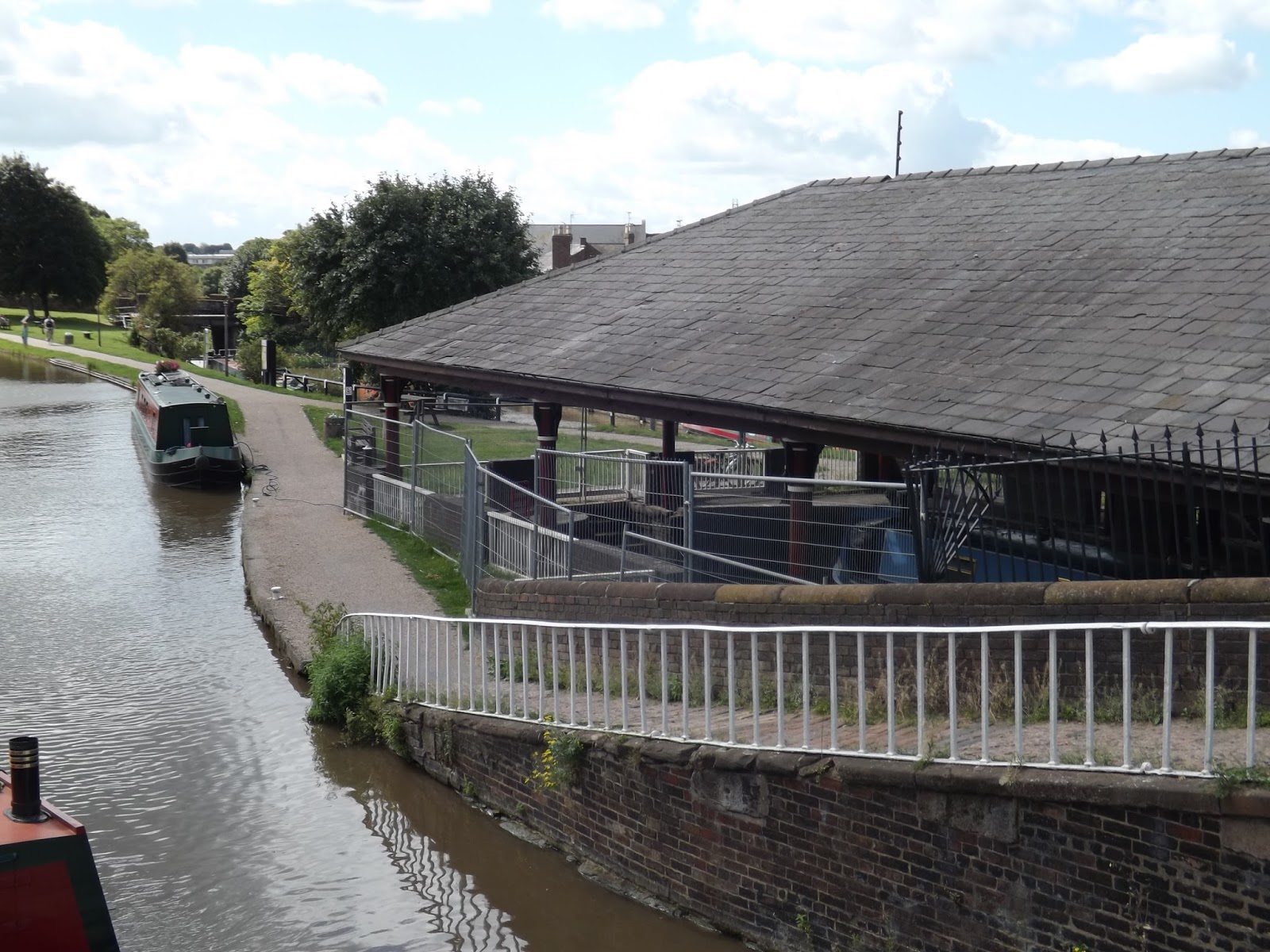
There is an arm that descends through three locks to the River Dee. I think it is closed at the moment due to silting etc, but it is funny to see narrow boats at a lower level right next to you. It must have been a hive of activity when in its heyday. There was another small basin that had been filled in but has been re-dug and is in water with new flats etc around it. I'm not sure whether it will be permanent moorings or what. There is a metal turn over bridge next to a dry dock and then there is Taylor's Boat yard that was once busy building and repairing the Shropshire Unions fleet.


Taylor's Boat yard with canal workers cottages adjacent. Tower Wharf, Chester.


The Covered dry dock with Holderness taking water taken from the turn over bridge. There is a memorial to L.T.C. Rolt who was born in Chester on the bridge.


Helen enjoying the sunshine and checking up where we have been, or maybe where we are going

We had had the washing on as we went and as it was such a good drying day we decided to do two loads and then moor up near to the Chester Zoo and get it dry. It will also let Macy have a roam about as she has been confined to the boat with the Chester moorings right next to a road and very busy too.

Friday, 2 August 2013

A Happy Birthday Girl.

Another special day has come round for my wonderful wife but I can't understand it really as she seems to be getting younger all the on her own woth out me  time. I made a bit of an effort Flowers from Tesco (date expiring) 90p, manicure £22, small chocolate cake £2-49, cup of tea in bed everyday of the year priceless!!

Helen went off for a manicure round the corner where nobody spoke English? and then had a few hours wandering round the shops on her own before coming back for lunch. We then went out together to finish our walk round the walls that we started last night. We found a couple of pubs last night and then came back to the boat via the walls. In the Roman Gardens they are having an outdoor cinema through the summer and it was fun trying to identify the film. We failed!


East Gate Clock.


East Gate, Chester from the Clock above the gate.


Tower Basin of the canal with the dry dock. Here there is an arm that descends down to the River Dee. There are Warehouses etc built by Telford here too.


The Water Tower on the NE corner of the City Walls.


The final straight at Chester Race Course, on the Roodee ground. On the bottom left can bee seen the old river wall where from Roman times the ships were worked that made Chester the most important port in the North of the country. However the course of the river shifted and the land of the race course was left. The first race was in 1539 when there was a race from the Water Tower to the Castle. The race was started as they wanted to discourage the sport of football, or mass brawl as it was in those days. This is said to make Chester the oldest racecourse in the country. The Mayor of the at the time was one Henry Gee and this is also to be thought why we, or rather small children, call horses Gee Gee's. I had often wondered about that.


Birthday portrait of Helen taken in Grosvenor Park in Chester.


Not such a good Birthday Portrait!


We then cut back into the city and went to have a look round the Cathedral. The Original cathedral was St John The Baptist Church which is now a Parish Church and has been a church since 689!! The present Cathedral was first the church of a Benedictine Monastery and was made a Cathedral in 1541 by Henry VIII. The organ was playing when we went in and the cloisters were intact and special. There were many monuments on the walls and it was very interesting to read them. I would like to have a monument to me but with some interesting text about my good and bad points, if anybody could find any that is, and not just the dates etc.


Chester Town Hall wouldn't look out of place in an industrial city in Lancashire of Yorkshire.

We found an ice cream shop and licked away as we wandered back to the boat. The quickest was was back to the walls.


This is the Shropshire Union Canal, as is now, running at the foot of the walls acting as a moat. You can see some of the original Roman Wall built by the Roman legionaires to protect the fort the constructed at Deva (pronounced Dewa) started in 79AD! It is the part of the wall on the right of the photograph with the 'jutty out' bit half way up it.

We are making a picnic and cooling a bottle of fizz to take with us for an open air rendition of Othello in the park. I'm hoping that the rain holds off.

Chester Day 1.

JUST TO LET YOU KNOW THAT THE LAST TWO POSTS WERE IN THE WRONG ORDER!!!

We left Egg Bridge about 0845 as we had an appointment at a vets in Chester to get Macy her annual booster injections. Before the first lock at Christleton we stopped for water and then eased down the lock. We thought we would have somebody to share with but they stopped for water too. There was a slight delay at Greenfield Lock as the C&RT guys were replacing a dislodged stone. We then passed down Tarvin Lock and found a mooring.


Helen watching the water.

I did the first lock but Helen then took over and made a good job of it again. We moored between Tarvin and Chemistry Locks in good time and so was had plenty of time to get to the Vets. I had looked on line for the nearest to the canal and Storrar Vets was selected. We were then in good time and after a bit of ohh'ing and aar'ing over Macy and a good examination the jabs were given and I paid my £29 which is cheaper than at home. Macy knew something was up as she went to hide first thing this morning, but she was as good as gold. After a cup of tea we left again and headed down Chemistry Lock and Hoole Lane Locks and made for the moorings just outside the city walls.


Old warehouse between Tarvin and Chemistry Locks.

This part of the canal runs through the part of Chester called Boughton. The Romans who founded Chester by building a fort here piped water from a well here directly into their castle by lead pipe. There is still a water works on the site that is owned and run by the Dee Valley Water Company. The water tower is a real landmark. Strangely the area was also home to a lead works. One of the leads uses was to make lead shot and a tower was constructed to make the process easier. Previously with wider bore muskets they poured the lead into moulds which took a long time and the balls were not very round. The tower was constructed so that molten lead was passed through a sieve at the top. This formed droplets that surface tension made round. By the time they had fallen to the bottom they had solidified and fell into water. The tower was constructed in 1800 and made shot for fighting Napoleon. It only went out of use in 2001. There is one in Hull that is more modern but as far as I know it may not be ass lead shot on gun cartridges has now been banned. The lead works at the foot of the tower has started to be converted to housing.


Dee Valley Water works Tower to the left and the Lead Tower to the right.


Helen making sure that the stern is clear of the cill at the stern so as not to get 'hung up' on it.


A lovely old terrace facing the canal with the railway behind.


Tony at Hoole Lane Lock. I haven't abandoned shorts, it was just that I wore long trousers to go to the Vets. One has standards.


Helen checking out the Shot Tower.


The Steam Mill that seems to have been happily converted to apartments with coffee shops and bars on street level.

We were moored up on Canal Side just outside the walls of the city. After lunch we wandered into town to find the Visitor Centre as they were holding some tickets for us. We then had a wander about the shops and purchased some stuff for the boat which we took back to the boat. We then went back to Tesco just near the boat and filled up with stuff as it is so close. There was an offer on 25% off over 6 bottles of wine. As the wine we liked was half price anyway we filled our boots. After eating we will venture back into town and take some more pictures whilst the crowds are less. I think we may find a few pubs to try too. Just to wet the whistle here is the East Gate Clock.


East Gate marks the east entrance to the town. The present gateway dates from 1768. The clock was added in 1899 for the Diamond Jubilee of Queen Victoria. As you can see people can walk all round the city walls.