Total Pageviews

Friday, 12 August 2022

The Steady Rise to Bratch.

 After our dash to the pub yesterday, as our friend was driving he couldn't stay for a second pint so I felt it only right that I should mark the occasion with another before heading back to the boat.

The church perched above the town of Kinver makes a nice picture with some of the nice buildings too.

The next morning Helen wanted to do a little shopping so I suggested that she should walk up to have her retail therapy and I would bring the boat up and do some little jobs on the boat whilst I waited for her. It all worked well and we were coming up the lock outside the Vine at about 11:00.

Dunsley Tunnel is only 25 yards long! Possibly the shortest tunnel, that is not a bridge, and has laid claim to been the oldest tunnel on the canal system surviving today as it was built around 1769/70. It is cut through the sandstone and not lined.

Stwepony Lock is under the main road. There is the octagonal toll house and this house by the lock. It looks to me as if the house was either a mill or warehouse at one time. Bu April 1771 the Staffs. and Worcs. Canal was only open between Stourport and Compton Lock but was open for cargoes. The general toll for non perishable toll for goods was 2.5p per mile per ton. For nails and clay from Stewpony to Stourport the toll was a 2s per ton. The name Stewpony is said to be after 'stipeny' that was two pennies. This was the cost of a glass of beer at a certain class of hotel found along the turnpikes and there was the was the Stewpony and Foley Arms by the lock that catered for the coach traffic.

Before and after the lock you get glimpses of Stourton Castle (pronounced Stower, Stir or Store 'ton). It was first a proper castle built in about 1132 and passed between several families and royalty including the Duke of Clarence, Tewkesbury Abbey and Henry VIII. Parts of the surviving building, apart from the original Medieval gatehouse of the castle, was probably built in 1580's by a Thomas Whorwood. In 1832/33 when the remodeled and partly rebuilt The gatehouse and three wings were incorporated into the new building with a new front completing the four sides. The courtyard was covered over.

We had stopped for water at Kinver, as it was free, and so continued on past the tap after Stewpony Lock and straight on past Stourton Junction, We do like the Stourbridge Canal and then on to Brum, but not this time.

This picture with the mature trees lining the tow path reminds me of the French roads where trees were planted supposedly to give shade to marching troops. Nobody marching today.
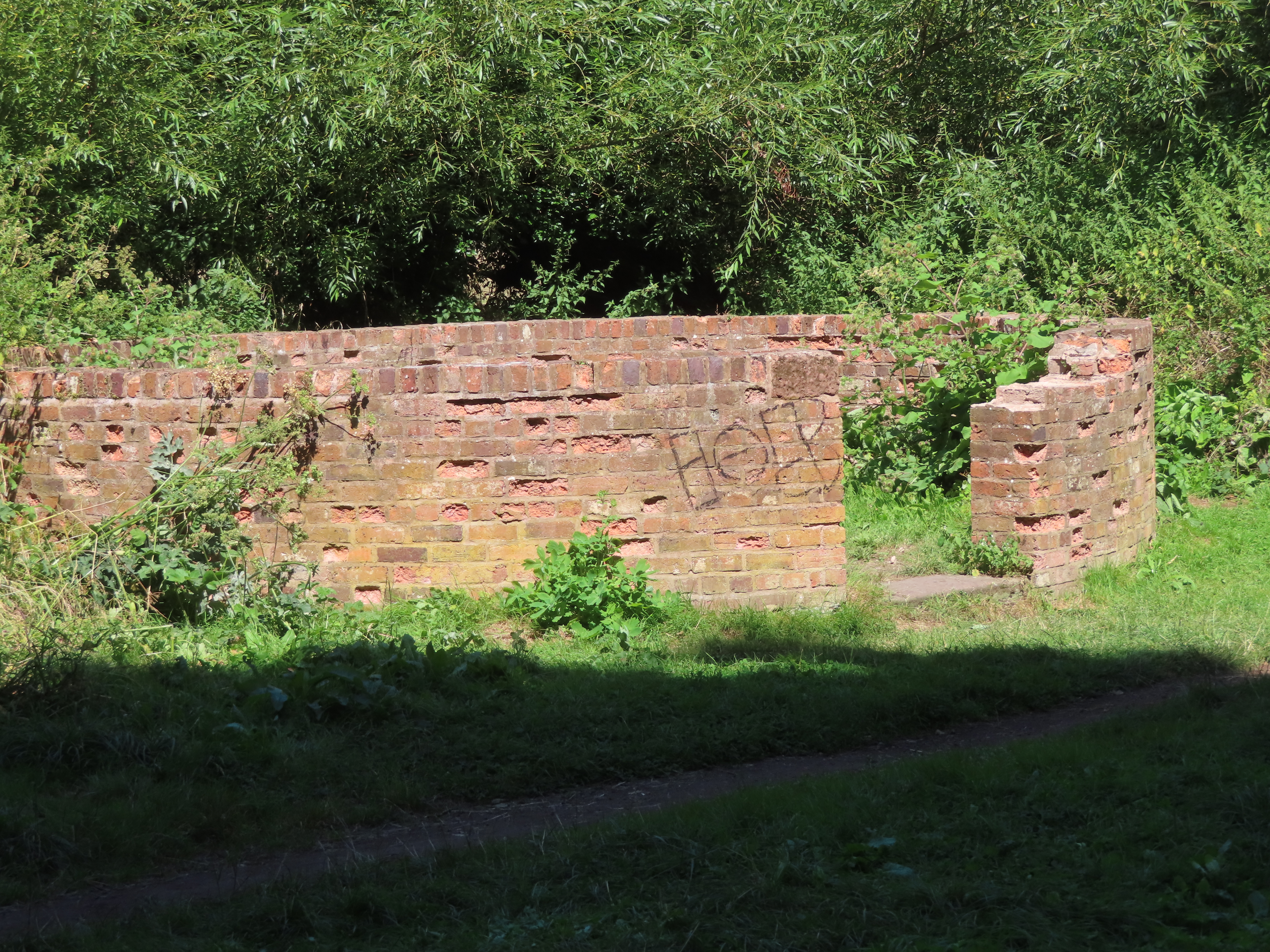
This is all that remains of the Gothersley Round House that was similar to the one at Gailey. It was damaged in 1991 by storm and has come to this. It marked a wharf that served an extremely busy Gothersley Ironworks, that has disappeared completely.
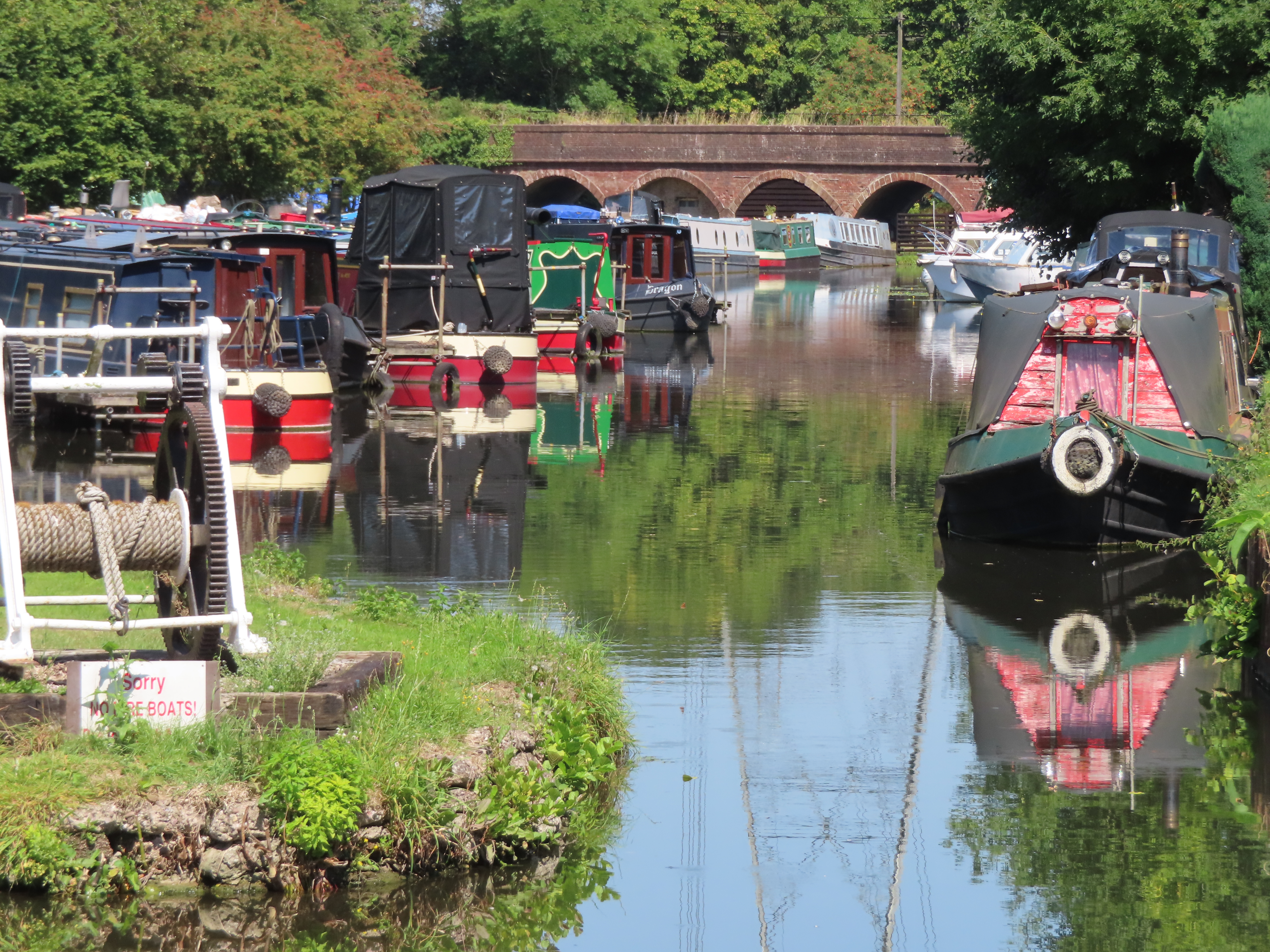
Ashwood Basin was a busy centre of traffic, especially coal for the canals. In 1827 James Foster for the John Bradley Co and the Earl of Dudley agreed to build a 3.5 mile railway from the basin to Shut End on Pensett Chase to bring coal to the basin. It opened in 1829 and eventually stretched from Ashwood to Baggeridge and Netherton, including the Round Oak steel works. It was known as the Pensett Railway. The last traffic to the basin was in 1949, but some of the lines survived until 1966. It was rediscovered in the mid 50's and slowly a marina was born. I love the old windlass on the corner. I wonder if it was the original to heave the boats in and out of the basin?

The pumping station at Hinksford is rater shy and hides its face from the canal. It was built for the South Staffordshire Water Co in 1900/01. As it appears on the 1900 25 inch OS map it must have been largely completed by then. It is not as ornate as the one at Bratch but they still put plenty of detail into the brickwork.

I love this lock house at Bumblehole Lock. It just looks solid and purposeful. I love the iron windows and stops and it must be original with the canal. It is Listed as Grade II.

We arrived at the bottom of Bratch Locks at about 16:30 and there was a minor revolt from Helen who didn't fancy even more locks today. I wanted to have the tow path on the st'bd side as I had some work to do, but the old wharf that fed the Bratch pumping station with coal was free, and so I had st'bd side access, and the mutiny was cancelled.

Once tied up I set to sanding the very poor parts of the boot topping and managed to get a lot of it done by 18:00. I quickly put a coat of Feratan on and called it a night. I had been watched by several groups of twenty somethings that came to sit at the bench and drink and smoke weed, but I think the noise of the sander caused them to move on. We both slept well!!


Thursday, 11 August 2022

A long day, but worth it


As we came up through York Street Lock last night I took this photo of the tolls house below it.

Before getting to Gilgal Bridge you pass this building, the rear of it shows its relationship with the canal.It was the Baldwin Foundry. Thomas Baldwin from Shropshire and worked in iron. He came to work here and by 1814 had bought the business. The foundry specialised in hinges and they were known as Baldwin's Best Butts! He was so successful that he started buying up the local mills. The business employed many locals for 5 generations and they were so busy that the furnace worked day and night. In later generations the family supplied two Prime Ministers in Alfred and Stanley Baldwin!

There is the random roller seen in the top photo, but is next to the basin, lower photo on the off side. This was old Severn Valley Railway transhipment basin, later Great Western Railway. The railway wagons were lowered down to the basin via an inclined plane. The main cargo was iron ans steel bars from Wales that were taken to Pratts Wharf, on the Stour, (see later). They must have received coal and sand too. The basin must have been built in the late 1880's as it doesn't appear on the 1883 map but it does on the 1891 map.

There is another old warehouse that has been converted to a nice house at Upper Milton outside Stourport.

This the arm down to the River Stour and Pratt's Wharf. The raw materials for the Wilden Ironworks were transshipped to smaller vessels to take the cargo down the river. The large Wilden Pool was used to flood the river to a suitable depth when the traffic was working. By 1948 the ironworks had become a tinplate works and was closed when Baldwin's amalgamated with Richard Thomas Co. Ltd and the factory was closed. 

This is the Severn Valley Railway Bridge. The railway started as the Shrewsbury to Hartlebury railway and had 15 stations, but no Bewdley and Kidderminster stations until a loop was built, this line, in 1878. It had always been a quiet line and in the end it closed in 1963. Two years later plans were made to purchase the line. In 1966 a new society paid £25,000 to buy it and it has gone from strength to strength and has increased in its original length.

Caldwall Lock is quite picturesque and a volunteer was painting it on his own. He seems start at one lock and finish them and starts again! A cyclist stopped and asked if he could watch as he had never seen a boat going through a lock. He was cycling from Lands End to John O'Groats!

Some of the buildings on the canal side in Kidderminster have been preserved. They are beautiful brick buildidngs and well made chimney. In the distance, on the left side of the canal is an old corn mill. The first over bridge was to an arm to the Slingfield Spinning Mill. The site of the Weavers Wharf development has saved the buildings that were latterly part of the Brinton carpet works.

As you come up from under the main road into Kidderminster Lock you get a great view of St. Mary's and All Saints Church. at the foot of the church was a canal wharf and an arm heading off down to the right, so it would have been a busy place.

It seems that there has been a church here at Wolverley since the Domesday Book in 1086. This building was erected in 1772 attached to an older tower. It stands on a knoll and can be seen for miles. It was quite a rich congregations as the local charcoal and, mill owners and iron masters were generous.

The trees gave nice cool shade and made a very attractive picture as the spots of light and dark bring jungle clearings to mind. 

The cave at Debdale Lock is Grade II listed and was constructed at the same time as the lock, about 1770. It is 9m x 3m and is up to 2.5m high with a bench around the wall. The lock and the lock house are also Listed Grade II. We had some help from a family with young children who were familiar with canals and loved to work the locks. Helen wasn't going to be arguing as it had been a long day.

This is another spot on this canal where you aren't quite sure which way to go, as it looks like you should be going under the bridge, but that is an old arm to Cookley Iron works. It seems that there was a finery mill here, this is where wrought iron is made from pig iron. There was a slitting mill here in 1639. This was a mill that split bars of iron into rods so that they could be used to make nails etc. There had also been a corn mill on the site. A forge appeared in the 1670's and in 1690's an iron works. It passed to the Knight family and they became rich and the main employer of the area. They benefited from the canal, and the arm built into the works, but by 1886, into the railway age they were missing out in not having a rail link and moved their plant to Brierley Hill. Iron and steel working still carried on here and steel wheels are still made here.

Cookley Tunnel is only 25 yds long and as always got me wondering when is it a tunnel and when is it a bridge? I came to the conclusion that if there is something other than a road or railway over the canal it becomes a tunnel. What do you think? There are lot longer bridges than this.

We were 'rushing' to meet up with a friend of ours, and to have a pint of Batham's with him at the Plough and Harrow in Kinver. As we passed through the Whittington Horse Bridge, the last before Kinver, we decided not to risk all the moorings below the lock being full, and to moor up a little further out of town which we duly did, and ended up only being 10 mins late. The beer was as good as always, and it was great to catch up with Chris. I hope Cyd gets well soon and we see you both again soon. I think it was called the Horse Bridge as it has just a bridleway over it. In the early 1900's it linked the Anchor to the left and the Whittington Inn's to the right that was close to Whittington Hall.

It had been another long day in the sun but well worth it for a pint and a catch up. Everybody seems to stay moored up so not a bad trip, and quiet on the canal.


Wednesday, 10 August 2022

Big, Wide and Narrow Locks today.

 We went for a walk after out tea in the cooling heat of the evening. We went to the Talbot on High Street for a wet and tried a couple of Craddock's of Stourbridge beers, Crazy Sheep and Monarchs Way, which I preferred. A nice old pub with a chatty crowd in. We went to Gardener's on the other side of Vine Park on the way home. I wish we hadn't. They only had one beer on, Wainwright, and that was awful.
We walked up to Morrison's from the basin in the morning and once back we set off, but not far, just to the water point on the outside of the basin. Helen was getting worried that we would have to moor next to the boat in the picture. It hadn't got a mark on it. I reckon they must just get a crane and lift it out and then back in the water where they are going and repeat. Either that or be neurotic about not getting a scratch on it all the time. The Church in the distance is St. Augustine's.

As we were taking water two boats passed and one left the basin to head towards the Severn. We thought that the first two would pair up on the double locks and we hoped that the boat in front would go down all the way too, but it was the charity boat Pamela May II and was only going to the first lock and back. It was breaking no records and the reeds, which are plentiful on the barge canal mean't that the views are limited.

There are eight locks between Droiteich and the River Severn and they are double to take the Severn Trows that traded up to the town for salt. They are quite heavy and long to work on your own, but it was a lovely day. This was quite a picturesque one too.

Only occasionally did the views open up, but to be honest the shade from the trees was very pleasant.

This is Linacre bridge and one of the only original bridges built by James Brindley. The barge canal was opened in 1771, but the Junction canal, from Droitwich to Hanbury Junction not until 1852. The bridge is quite graceful I think, partly I suppose as it wide beam width.

It took longer to get to the river than we had thought, but it was a lovely day to be on the Severn. Here we are just leaving the Hawford Junction locks and heading north on a very quiet river.

It was a pleasure to be messing about on a boat on the river on a day like today. Little shade mind, but plenty of drinks and watch the world go by.

The tower of Holt Castle peeps over the trees. There was a castle here built by the Normans and in the Domeday Book of 1086. This tower replaces that older building in the late 14th Century. It was more a fortified manor house then. It eventually came to the Beauchamp Family that became the Earls of Warwick. At the same time a little chapel of St. Martins was built nearby. It is still a private residence.

There soon follows Holt Lock with the road bridge. Just before it is the Holt Fleet pub that was doing good business. We had caught up with these old fellers on the boat that were enjoying their trip and life aboard their boat. A bit different to Sheffield where they were from.

A little further on I saw some ribs in the water and as we passed the sun meant that I could see that it looked like the stern of an old Severn trow as it was wide and broad.

Next was Lincombe Lock and again we shared with the same boat again. This time we were on the outside so we were away first and first at the Stourport double staircase. 

Coming up to Stourport Marina I saw the stern of an old ship that could only war built. It has had a lot of work done to ruin it (make it more useful for the owner). At the bow was the real name. Vic boats were built in large numbers in WWII as work a day boats for supplying fleets in port etc (VIC for victualing). VIC 99 was actually built by Harkers inland at Knottingley on the Aire and Calder Canal in 1945. It was fitted out down in Hull before being completed in July 1945 and went to work around Scottish Ports. In 1946 it was transferred to the reserve list and stayed in Rosyth. By 1968 it was sold off and was bought for scrap, but before it happened it was sold on to become a restaurant in Stourport. In 1977 it was set ablaze by arsonists and severely damaged. It was sold again in 1980 but nothing happened and in 1984 it was sold by the Admiralty Marshal to get dues recovered. At this time the the engine and boiler were removed and later on cabins were built in the hold and then this ugly top hamper was added. You may know VIC boats better as Clyde Puffers that worked around the coast, canals and islands of Scotland.

As we left the last lock first we were at the double staircase narrow locks at Stourport first. I dropped Helen on the pontoon and we were soon swinging into the entrance. Easy today with little current.

The pound between the two pairs of double locks is always a test as they managed to make sure it was just about impossible for a 70 footer to get round. I assume they put the bow in the lock tails and pulled the stern around as the easiest and quickest way of getting the job done.

The journey through the basins is always fun, and I always think I have gone the wrong way! And of course with it being about 18:00 there was nowhere to moor down there so despite a near mutiny from Helen after a long day we went up one more lock. Helen thought there was a flight of six she would have to do, but no, just one. We were soon moored up and had our tea before heading to the Dark Star pub just down the towpath and replaced a few milliliters of fluids. I had a lovely Wye Valley Stout and a very refreshing Three Tuns Ginger beer. Back to the boat and watched the end of the Commonwealth Games. Ossie Osbourne looked like he had come back from the dead, which I suppose is apt for the genre. All in all it seems that the whole 11 days have been a great success.


Tuesday, 9 August 2022

Down to Droitwich.

 We slept well last night and I don't know what time the pub went quiet as I was asleep straight away. A few boats passed us before, in both directions, we got away,

The weather was once again stupendous. It is getting a bit like being abroad at the moment, isn't it! We were soon at Stoke Top Lock

This blue brick was seen at one of the Stoke Locks, Wood and Ivery, Albion Works, West Bromwich. George Wood started his business in 1861 and went into partnership with Ivery in 1872 and by 1890 were producing 200,000 to 300,000 blue bricks a week. They continued in business together until 1904.

Tere is a lovely line of cottages with a blue coping stone capped wall around them, obviously canal workers cottages.

The tow path is largely overgrown. I understand the cutting policy to save money and to promote wildlife etc, and I think so long as you can get ashore there is still no reason for you not to moor in these areas. You can trample of cut a space for you to get off and on the boat. The Kennet and Avon seemed to be mostly like this and doesn't stop folk mooring as all the other places are taken. 

This was the entrance to the Stoke Works Salt works. John Corbett was the son of a farmer who moved to Birmingham and set up a canal carrying business. John set about leading the boat horse but eventually became a boat captain. We really wanted to be an engineer, and realised that the company's main cargo was salt. He did his book learning and got taken on for a 5 year apprenticeship at a Stourbridge ironworks. He then went to work at the Stoke Prior Salt Works. He started as an engine driver, outrider and a cashier, learning the business at all levels. In 1852 the company went bust. John managed to convince the bank to allow him to get the lease in 1852. At that time the production was 26,000 tons a year. John put all his practical skills into practice and by 1876 it was up to 200,000 tons and in 1886 it was 300,000 tons a year. This was not the end of the story, but this was the entrance to the works and alongside the canal were many moorings too.

I intended to see if I could find anything out about this little cottage that was looking lovely in the sun, but no time today unfortunately, so you will have to make do with the picture.

This brick was found on one of the Atwood Locks. Joseph Hamblet was trading from the Oak Road, West Browich from around 1851 when he acquired the J.E Piercy's estate. He ran the brick works with a Mr. Parkes into the 1860's before the partnership was dissolved and Hamblet ran it by himself. In the 1880's and 90's they were making every kind of brick but specialised in the blue bricks. 1894 was the year that J. Hamblet died. In 1898 the company became a limited company and became the Hamblet Blue Brick Co. The company was still working in Walsall in 1961!

At the bottom of the Astwood Flight you get a view of the Transmitter masts at Droitwich Transmitters. It was set up in 1934 and you could always find it on the old fashioned tuner dial. In WWII it transmitted those cryptic/coded messages to the French Resistance, and also announce the start of the D Day landings to the Resistance. Now a days it is the main long wave transmitter for the BBC and transmits Radio 4 LW. It also transmits Radio 5 Live MW to the East Midlands and Wales.

We trundled on until we got to Hanbury Junction. There seemed to be several boats alongside with ropes being held as though they were waiting to go down the Droitwich canal, but they were just all getting ready to leave at the same time. We turned down the Droitwich Arm.

The volunteer lock keepers scattered from below their gazebo to usher us down the locks. These have side pounds and the bloke is working us down saving some water as we go. We had a slight delay as there was a boat coming up.

down the three locks, past the marina and up to the Rugby Club Bridge. The angle of the bridge abutments has meant that for the bridge, and boats, require these serious fenders to prevent damage to both.

There is a staircase lock and another single lock before we get ready to duck under the M5 Motorway. Other than leveling out the solar panels we fitted with a few centimeters clearance. 

Not the best photo but it is pleasing to me to see that embossing bricks is not dead. Although the date is 2008, which was when the lock was rebuilt, the canal was opened between the Worcester and Birmingham Canal and the River Severn in 2011.

The canal now pens down into the river Salwarpe for the rest of the trip to Droitwich. There is then a lock at the start of Vines Park and then a series of swing bridges, 3 of which have to be unlocked and opened, before arriving at Netherwich Basin where we moored for the night.