Total Pageviews

Friday, 9 October 2020

Junction after Junction.

 It had rained right through the night and with the gloom it seemed not to get light until well after 07:00. Welcome the autumn for real. It was drizzle interspersed with showers until around 10:00, when the sun came out. So we let go and were off.

The sun lit up the trees along the cut towards Dinningsdale Bridge. Another view of autumn was the fire still going this moring.

By Dimmingsdale Bridge is a little moorings set off the main line. There was been a wharf her for a long time to cater for the local villages and farms, but the cut is actually behind the wharf and is modern taking advantage of an area of swampy land as indicated on old maps.

Just before the third lock of the day is Compton Bridge. Where the blue boat is moored was an old wharf that served some lime kilns just set back from the canal. By 1885 it was finished, but the wharf continued. When we first came down this way there was a chandlers called Limekilns trading here.

I thought I had better take a picture of one of the circular by-washes that are a feature of the Staffs. and Worcs. I have resisted long enough. I suppose you are able to have a greater length of  weir for a smaller area.

Helen enjoying the sunshine at Compton Lock. It seems that research has found that this was the first narrow lock that James Brindley ever built. It was rebuilt in 1986 though.

On the left is the bridge over the entrance to Double Pennant Basin. This didn't appear until around 1900 and seems to be a nice secluded mooring these days with room for a couple of boats.

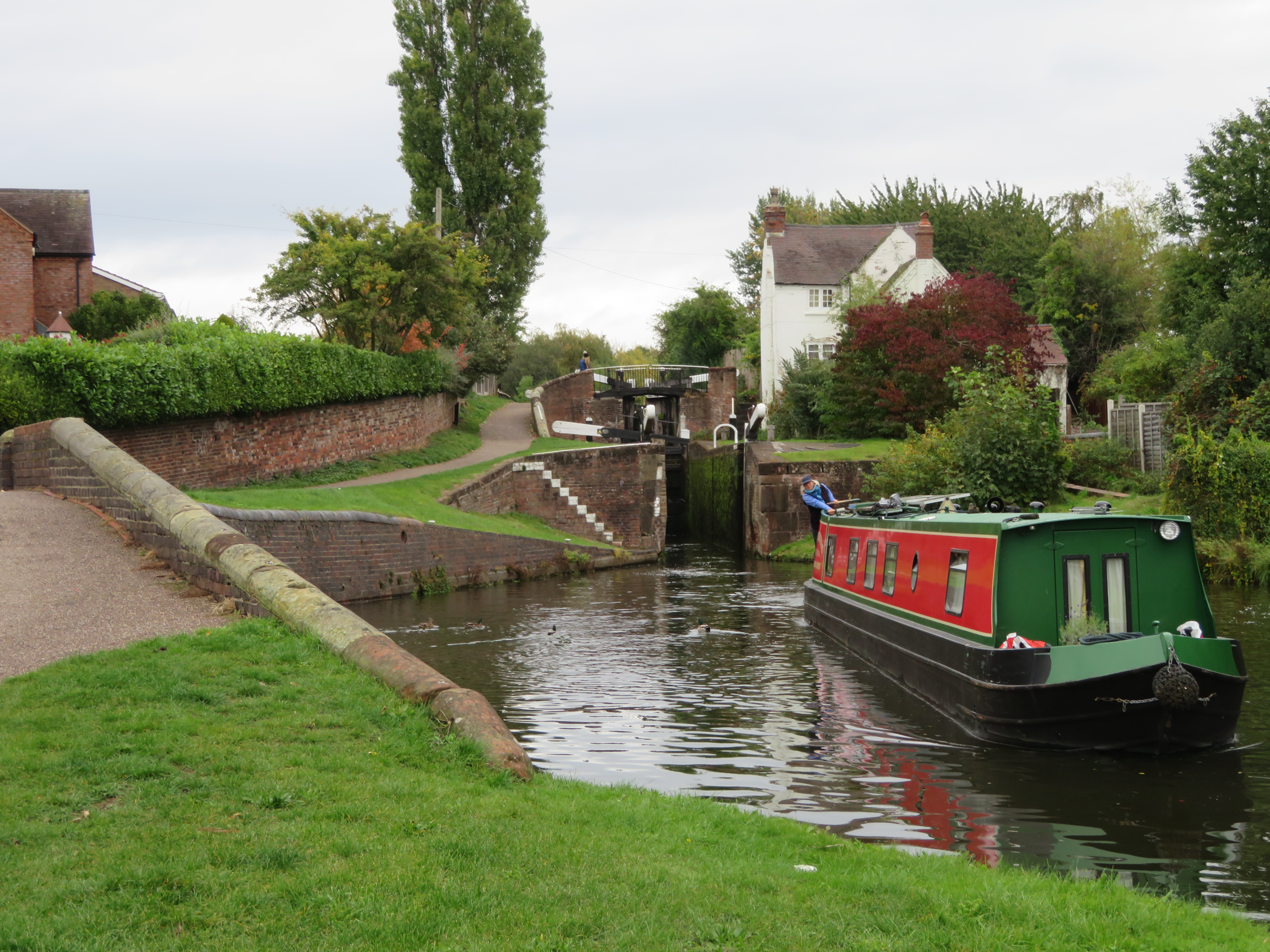
The bottom lock of the Wolverhampton 21 seems quite inviting and countrified but is the start of a hard slog up to the Birmingham Canals. It was opened in 1772 a few months after the Staffs. and Worcs. had opened. In the Parliamentary Act for the construction of the Birmingham Canal to the other canal there was a clause that the S&W could build the lock here if the BCN were slow, and Bill the BCN anyway. They nearly had to in the end.

The sun shining on the Aldersley Bridge and its reflection make a very picturesque view and much relief for those coming down the 21 locks I should think. 

There is a plethora of bridges between Aldersley and Autherley  Junctions. The first two are railway bridge. The first was a link line to join the Kingswinford Line to the GWR that seems to have built during WWII. The 2nd is the Shrewsbury and Birmingham Line that was much earlier. Next is a modern road bridge and then a couple of sets of pipelines. I notice that they are enclosed. I never look up when passing under them as they are carrying the raw material to the works on the left bank. The sewage farm. Then there is Oxley Moor Bridge.

I wonder if Dulux, or other paint company, would sponsor the painting of the Autherley Junction Bridge white once again. It would certainly make it more of a feature to augment the lovely finger post at the junction.

Helen had just been saying that she hadn't seen any heron's, ducks, coots or moorhens, or a kingfisher for a long time. Almost as soon as she said it we were quickly ticking her list off as we spotted them just before and after the junction. Last on the list was the kingfisher that followed us for a while, even allowing us to get a photo of sorts.

Pendleford Rockin' narrows making an interesting part of the trip as the canal cuts through a bed of sandstone. It is very shallow and narrow, and there is no hurrying through. Passing places are provided along it as there is no room for two to pass otherwise. I wonder why they saved money here, only cutting it narrowly when further south when passing through the same sandstone they carved a double channel and locks out of it?

We went under the M54 and carried on until Cross Green where we anchored up near the pub of the same name. It had got very dark and cool and looked like it was going to bucket it down. But it didn't.


Thursday, 8 October 2020

Bumbling up Botterham and Bratch.

 We were a little late setting off as Helen was online buying tickets to see Gary Barlow in a concert next June. I would hope that there should be concerts by then or we will all be suffering real hardships. All except Gary Barlow that is as he will have sold out his concerts, and made a mint on his new album that if you buy you get priority for tickets for the concerts! Maybe he should be running the country with Dishy Rishi.

Our first lock was Swindon Lock. The towpath changes sides here as the Swindon Iron Works was next to the canal here. There had been a fulling mill followed by a corn mill that belonged to Halesowen Abbey.n It became a finery forge in 1620's. This is where the pig iron is made into wrought iron. It expanded in 19th century so there were 13 furnaces. In 1860 the works were leased by the Baldwin family of Wilden Iron Works (Stanley Baldwin, the politician's family.). When the iron and steel works were Nationalised it was incorporated in the British Steel Corportaion, but it was closed in 1976 and demolished in the 1980's. The housing estate built on the site has a very large community hall that was the old canteen. On the gardens that back on to the canal from the former site you can see where the wharf was as there are these non-slip coping stones that edge it.

I don't remember noticing a sign like this before, but it looks like it has been there for a while. This is the Robert Cox, contemporary wood sculpture who is still working as on his website he says that he did work for the Staffs. and Worcs. as well as British Waterways. The name boards really add to the scenescape of the locks, and it good to see they are all in place.

After Marsh Lock where the tow path swings back to the other side you come out into the country that is very pleasant with rolling hills. There were a lot of fishermen out today, one lot in a match. There were also the usually many cyclists of a certain age. People have certainly 'got on their bikes' as it was put all those years ago.

We passed under these two big pipelines passing over the canal just before Botterham Staircase Locks. I wondered if they were the water from the Elan Valley, but it doesn't seem to be that. I then wondered if it was the strategic oil pipeline system, but it doesn't seem to correspond with that either. I drew a blank, so if anybody know's let me know.

There was somebody at the top of Botterham Staircase so I went up to give them a hand. This view of the old house gives a good background.

The locks are pretty, and I like the furniture around the locks. The majority of the locks in this area seem to be between 9 and 10 foot, so a pair of them does seem quite high.

After the staircase locks there was this massive shed. It just looks out of character for the place. It is a warehouse for Spectrum Brands, and American Company, that has many of the pet care, home improvements and hardware, home and garden and home and personal care appliances that you may have heard of.

The approach to Bumble Hole Lock form below is on a bend so is a bit of a jiggle about. The viginia creeper really does bring colour though.

We then arrived a Bratch Locks just as another boat was starting down. They do them in batches of three so if anybody else arrived at the top we would have to wait. As it was we went straight up. They are very scenic and attract lots of people gongoozling. Go up seems to be much easier than down as you just use the paddles as normal locks.

The octagonal lock shed is very scenic and had a few bits and pieces for sale. Helen got some postcards for sending. Just to the left you can see the towers of the gothic Victorian waterworks pumping station that was built in 1896. It had the Kingswinford Railway next to it so I doubt that the received coal to run the steam engines that were used until 1960.

Helen taking it easy as we come up Awbridge Lock. This is thought to be the James Brindley's first attempt at building a lock with a road bridge at the foot. It has also been the site of an accident where a lad died after falling of the tail bridge (for crossing from one bottom gate to the other. The bridge had no hand rail and despite being listed H and S insisted that protection was added. An handrail has been added, attached to the lock wall, not the bridge and somewhat in-keeping with original iron work.

These are the signs that R. Cox craved that I was talking about in an earlier photo, I just forgot to take a photo earlier. I wonder if he did the finger posts too?

I also noticed that the paddle gear had old BCN equipment.  The Staffs. and Worcs. never was part of the BCN. In fact they were antogonists as when new canals took a lot of the trade from the Staffs and Worcs other than the short length between Aldersley and Autherley junctions they put there tolls sky high to recoup. The BCN then sort an Act of Parliament to build a high level canal across the Staffs. and Worcs. It worked and they had to drop their tolls. We must be grateful that in 1959 the British Transport Commission were not allowed to close this beautiful canal.

The last lock of the day was Dimmingsdale Lock where some characters from Last of the Summer Wine were having a rest. Helen was amazed to hear that they had cycled from Merry Hill. It had taken us three days to get here, but in a big circle! We moored up at the top of the locks on the offside. A nice quiet mooring. With luck we may get to see some of the Orionid meteor shower. The peak is not until 20th/21st October.


Wednesday, 7 October 2020

Stunning Stour and Smestow.

The hire boats started past at just after 08:00. They must have been at the bottom of the locks after am late finish. It is a nice feeling not to have to get up early to be off again.
We left about 09:30 after a slight shower. All day we had frequent little drizzle interludes, but I never needed to put a waterproof on.

I think we maybe a week or two too early for the best colour of the trees, od which this canal is blessed with many lively mature trees. Lots of old oaks, sweet chestnuts etc.

Anyone looking for a project could pick this up nice and cheap I feel. Does anybody have any idea of its history. It has been here every time we have passed. I would have thought it would be worth somebody lifting just for the firewood now.

First lock of the day it Stourton Top lock. The gardens in the next pound are definitely competing for top garden as there are some stunners.

As the canal ducks under the main road at Four Locks Bridge the split bridge and the road bridge make a nice frame for Helen driving the boat.

I had great difficulty getting the bottom gates to stay shut. Maybe they should be fitted with the stay poles that are used on the bottom lock of the Stourbridge flight, and elsewhere.

This must have been a busy junction at the height of the canals. The Stourbridge Canal was opened all its length in 1779 and coal iron ore limestone etc, and then the finished products moved away too.

This is the site of the Gothersley Round House. It was similar to that at Gailey and was built in about 1805 and would have been similar to that at Gailey. It was the wharf managers office for the iron works that was just to the west. The works had closed by 1880. The ruins of the round house collapsed in 1990 and were rebuilt as this picnic area.

The sun made a valiant effort of lighting the canal through the trees and made it a lovely trip up the canal.

The canal was opened in 1772 and they must have had a time cutting through the sandstone ridges as they made their way down to Stourport. It does make for a very photogenic canal. Helen isn't feeling the heat yet!

Ashwood Basin was opened in 1829 after a local iron master agreed with Lord Dudley to build a railway between Ashwood and Shutt End on Pensnett Chase taking in several cola mines. The railway was transferred to canal boats later to take down to Stourport Power station. This trade finished around 1953 and the rail lines completely in 1966. The owner found the abandoned basin a few years later when on a canoeing trip with his scouts. In 1959 he bought it and developed it to where it is today. Interestingly it has a road bridge on eleven arches passing right over the basin splitting it two. The railway had grown to cover Ashwood to the west, Baggeridge Mine to the north and the Round Oak iron works at Netherton.

We stopped for water at Greensforge and were sorely tempted by the Navigation by the bridge but resisted and continued on our way past more lovely rock walls. 

I had noticed that the iron of the gate fiitings, along with the year of construction, also had a letter on them. As we passed up the locks I could see that they corresponded with the name of the lock. This one is for Hinksford where on the west side was a large mill pond from the Smestow Brook that drove a large corn mill.

We moored up before Swindon Lock and were inside by the time a very heavy shower dropped out of the heavens with a mighty gust of wind. The boat is covered in ash leaves, but we remained dry. When the sun came out again we had a wander up the road to buy some oddments, before settling in for the night.


Tuesday, 6 October 2020

145 feet of fun.

 It rained this morning, but once again by the time we were ready to leave it was once again dry. We had a lovely quiet night, no road noise, and little light too.


There was no wind when we backed out of the arm to the main Fens Branch. As I was going under the bridge a bloke on a bike stopped and said how pleased he was to see a boat up here. It turns out he is a C&RT Volunteer. Hopefully there will be more folk using it if it is just tided up a little. Having looked again at the old maps I can see that just through the bridge to the Stourbridge Extension canal there was an arm off just by the bridge that went and opened out into a large wharf that extended past Britannia Bridge, and was serving an Iron Works.

There was also another basin to the same iron works that was very close to the other one and this are what is left of that one.. They were both bringing raw materials as the wharves were served by trackways that took material to the blast furnaces and not slag to spoil heaps.

After a quick look I can't really find out anything about this producer of a one of the bricks near the top lock of the Stourbridge flight. There was a Richard North also producing bricks about 1885, maybe the son of E.P. It shows the carbon footprint of the bricks was much lower then, other than using coal to fire them that is.

The top lock was empty so it didn't bode well for a fast passage down the picturesque locks.

We had a couple of hire boats come up after about lock 3 or 4 so they were most welcome. They had started at the bottom at 0800. Those were the days

As we approached lock No.6 there seemed to be evidence of a little arm of the short pound. It seems like there was a lime kiln on the short arm.

When you get to Lock 9 you are gifted with the view down the flight that takes in the bottle kiln at Stewart Crystal as well as Dadford's and the Dock store.

The view back to Lock 10 shows just how close No.9 and 10 are. There is a tiny pound between them as at the Bratch Locks. The views are so good everywhere you look. Just a shame the sun isn't shining today.

The Stewart Crystal Factory shop.museum was open but we didn't stop today.

When we first came down here on 'Holderness' we cheekily asked the blokes building the houses next to this old flour mill if they had a spare scaffold board for a gang plank. They obliged and we still use it. I must say the new buildings are styled well to fit in with these buildings the original. Close to the bridge was another glass  works and close to the camera is the flour mill.

I had forgotten to check my watch at the top and bottom of the flight so can only say that it was around two hours to come down the 16 locks that are always a pleasure. That is a drop of 145 feet and had great fun too. This year we did not turn into the Stourbridge Arm but continued a little way further.

I thought that Helen was leaving me as she was speeding away after the last lock, but just as I took the picture she came astern to wait for me under the bridge.

The River Stour was crossed by this aqueduct close to Wordsley Junction and it was pretty muddy after the recent rain. It is hard to imagine that it was literally the driving force for a large part of the industrialisation of the area.

We didn't go too much further, just until we saw a short length of armco opposite Primrose Hill and not under trees for the leaves to build up and the acorns to beat down on the roof at the slightest wind through the night.