Total Pageviews

Thursday, 21 June 2018

Choice Chester.

We had a day in Chester and decided to go on one of the many walks that are available. We have been to Chester before and hoped we would get a little more insight by going on the walk.

This place is known as God's Providence House. It was built in 1652. The last visit of the Black Death came to Chester in 1647/48 and around 2000 were killed. The story goes that the previous house on the site was the only one that escaped the Black Death and hence the 'God's Providence is mine inheritance'. The owner wished to demolish it in 1860 but there was uproar from the locals and it was refurbished, and much embelished. Some of the original timbers were used but the pargetting in the plaster work was also added

From the upper deck of the rows you get a good view of the cross. This is placed at the cross roads of the original Roman Fort road layout, and the the centre of the then town. The first cross originated in the 14th Century and was replaced in 1476. During the Civil War Chester was Royalist but when it fell to the Parliamentarians in 1646 it was broken up. Some of the pieces were rediscovered in the 19th Century and these parts were used when it was re-erected close to its old position in 1975. The new bit is the central column. The cross in Grade II Listed.

Like much of the 'Black and White' architecture in Chester it is not original and was added to maintain the character of the city in the Victorian age. The rows were built originally due to the slopes on either side and the desire not to waste space, although other reasons for them exist too. Most of them are not original buildings and the long runs of them have been broken up by infill buildings and alterations. They do make an attractive shopping experience but, like most places we pass through, but unexpectedly for a tourist rich town like Chester, there are many empty shops to be seen among them.

This is another of those buildings that went to great lengths to make it appear Tudor in origin but went too far. In fact it was built in 1889 as an Art Gallery for a David Sherratt, whose name you can see over the small centre arch on the rows level, along with 'Art Gallery', above the statue of the King. It is odd that the iscription 'To God my King my Country' as it was built during the reign of Queen Victoria? This may explain why the statue of the King is jammed in the niche. Apparently the statue was ordered sperartely from the building and it and the niche did not match in height. Expediance led to them chopping a bit off his legs so that he would just fit!

On the corner of the street is the Falcon Inn. This is just half of the original 13th Century House. The front of the building was once set up as the Rows further up the street but during the Civil War Sir Richard Grosvener the family to later become the Dukes of Westminster, moved into the town from they family seat in the country for safety. In 1643 he got permission to close it in as he he claimed that he needed the space for all his family and that when open the building was 'too moist'. It was much 'restored' in the 1800's and at one time was a Temperance Cocoa House. By the 1970's it was just about derelict but a trust was set up to protect it and between 1979 and it was restored to what you see today.

The East Gate Clock was erected to celebrate Queen Victoria's Diamond Jubilee in 1896. As you can see the date on the clock is 1897. The actual clock was paid for by a local solicitor and Freeman of the the City, Edward Evans-Lloyd and the tower by public subscription The clock was made by Joyce of Whitchurch and until 1975 sent  a technician every week to wind id it up and check it over. The inscriptions were made in cast iron in Coalbrookdale.
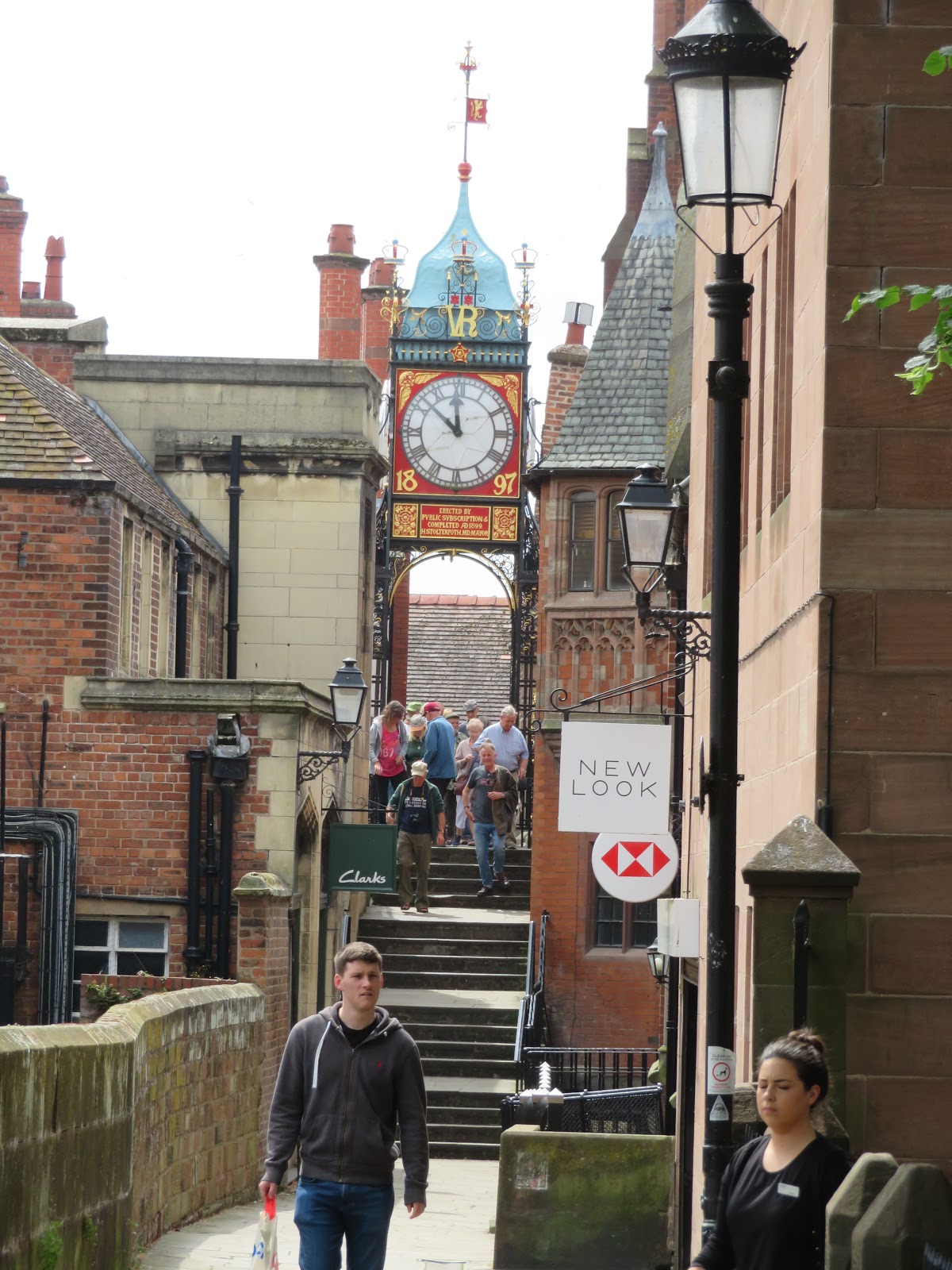
The Eastgate was the main entrance into the Roman Fort but this three arch gate was erected in 1768. Apparently the date set for the opening of the Eastgate Clock was 1897 but everything was not ready so they continued with the ceremony but substituted the real thing with a painted back cloth. This would explain the date of opening on the other face of the clock, (small inscription), as 1899!

The Kaleyard postern gate was looking lovely in the sunshine. The monks at the nearby Abbe, now the Cathedral, had a garden outside the walls of the town and had to walk a fair distance backwards and forwards to it each day. In 1275 the petitioned Edward I to be allowed to put a postern gate in the wall so that the journey was shortened. He eventually agreed with several conditions, one of which was that it had to be small in height so that a man on horse back had to dismount as a security thing. Another was that it had to be closed at nine o'clock every day. Right up to the present time a bell is rung just before nine to alert everybody that the gate is about to be shut.

Chester Cathedral is a beautiful building and in commone with many cathedrals and churches there have been many stages in its development. There may have been a Christian shrine here during Roman times. In 907 a Minster was founded and the remains of  Saint Werburgh were brought here. The Abbey was disbanded by Henry VIII but was reconsecrated in 1541 as a Cathedral for the new Church. There were great changes in the 16th Century and again in the 19th., but it is a joy to walk round and is on a manageable scale too.

In the Market Square, next to the Town Hall is the Westminster Coach and Motor Car Works. Unbelievably this is not a Listed Building! The site originally had two house on it that were built in 1773. At one time these became a school until taken over by Hewwitts Coach Works.

Hewwitts were taken over by J.A. Lawton in 1895. The original buildings suffered a fire in 1903 and again in 1910 and the site was rebuilt in 1914 with the current building that was closely modeled on the old building. It was a coach works, and continued as a motor car showroom until 1973. It was converted to the Central Library between 1981 and 1984 but retaining the frontage. Apparently the Library has moved out and it may well become a Market Hall in the future. Lawton's were coach builders that started in Liverpool but had factories in Chester, Manchester and Cricklewood. In WWI they mainly turned to constructing ambulances and fuselages for De Haviland DH4 aeroplanes.

The outstanding feature of the facade is the encaustic terracotta tiles. These were fabricated by the Ruabon Brick and Tile Works that was situated close to the Llangollen Canal. They created 'works of art' that can be seen on many buildings around the country to this day. From a distance this face looked like Stalin but it obviously isn't. However I can't match the face up with Joseph Alfred Lawton or any of the Duke's of Westminster, but I would love to know who it was. 

Tuesday, 19 June 2018

Planes, boats and claims.

I had a day of washing and polishing and the boat looked much better for doing it. After our hectic week or so we decided, as the weather was good, to not rush about but have a couple of days breather, doing little short hops, if moving at all.

We hadn't gone very far when we passed this caravan storage then a length of permanent mooring on the off side. I can't find anything about whether this was a working wharf/basin in the past or has been dug out more recently. It is close by Croughton Bridge that is Grade II Listed and was built with the canal in 1795.

On this stretch of canal the Airbus Beluga is often seen. It is based on the A300 plane and first flew in 1994. It doesn't look as though it should fly at all. There are five of them that link up the factories around Europe that fabricate various parts for Airbus. In the UK we make the under carriage and the the wings in Broughton. The plane uses Hawarden to load the wings. There are five of them shuttling about the factories. When they have other time available they have been used to transport aid following disasters as well as aerospace items, planes and helicopters and other items as the payload is 47 tonnes.

The latest plane from Airbus, the A380 has wings that are too big even for the Beluga and these are transported from the factory on a very low air draft barge to Mostyn where they are loaded on to a RoRo vessel that takes them to Bordeaux and onward by river to Toulouse where the assembly of the planes takes place. However they are developing a new plane based on the A340 is being developed. The new plane will be ready for 2019 and again they are expecting 5 to be built and will be called the Beluga XL!

This steam narrow boat was on the moorings it called 'Confidence' but I can't find out anything about it. It is obviously recently built and seems to have a very good scantling! There seems to be a fair few bits of salvaged items like the vents and winches etc. A labour of love by somebody.

We stopped round the back of Chester Zoo in full sunshine and used the early stop to carry one with some jobs. I replaced the forward button and then touched up the port side a little too.

I also did some splicing to make up some new centre ropes. I decided to use some of the old ones to make sacrificial parts as the wear comes on the rope where they pass through the deck edge fairlead.

The next day we were once again blessed with lovely weather and headed off towards Chester. The undulating countryside passed by pleasantly with several RN boats passing on their way to the meeting at Ellesmere Port.

I was quite taken by this way marker for the Mercian Way. It is a long distance cycle route of 230 miles that runs from Salisbury in Wiltshire through to Chester. It is called Mercian as the route passes through the ancient Anglo Saxon Kingdom of Mercia. Strangely it doesn't give the distance to Chester but Bewdley, on the River Severn near Ironbridge, is 101, so around half way. Apparently some walk it too, but if it is on roads I wouldn't think it would be much fun, even if they are country roads largely.

The aqueduct over the A5480 is called the Deva Aqueduct. as that is the name of the Roman Town that developed in Chester. Apparently it was the 2nd largest settlement in England at one time.

We arrived at Tower Wharf at the top of the River Dee arm and before going up the Northgate Staircase locks. We were met with a chug, chug, chugging as a group of RN enthusiast were moored, on their way to Ellesmere Port. We topped up with water and found a good spot in the sun. This is our first sight of the new logo etc being rolled out. I quite like it, so long as it is in context. I'm not sure I would have grasped the idea if I didn't know it was C&RT. I understand the need to engage people who are not boaters, and you have to admit that the majority of users are not boaters. With luck it may mean that less litter is dropped, more dogs cleaned up after, less speeding cyclists, more lengths of canal adopted and 'looked' after etc. I'm not sure how it will bring more money in, but it may well make bidding for grants etc much easier. As it was all done 'in house' too it will have kept the costs down.

Monday, 18 June 2018

Country break.

We had another last look around the Boat Museum to make sure we hadn't missed anything before we set off after lunch.

I think that this would be our first narrow lock of the year, but of course they weren't to last. The wide beam locks are right next to the narrow locks.

Helen had help from a family on a visit. We learned that despite having the cross over between the two pounds above the bottom locks you should ensure that the top gate of the bottom lock is closed before lifting the paddle of the top lock as the actual top of the coping stones is lower than that of the middle pound and it floods, despite the cross over being opened. You can see the paddle for the cross over between the two pound behind the right hand beam.

We wanted to fill up with water so we tied up alongside the trip boat as the tap is just inside the museum fence. It is accessible with a Waterways key. I suppose we could have spun it round and gone st'bd side to the wharf but it seemed easier to use the boat as a fender. The last rubbish was taken to the skip near the car park and we were off. It certainly seemed ages since we had been on a 'proper' canal.

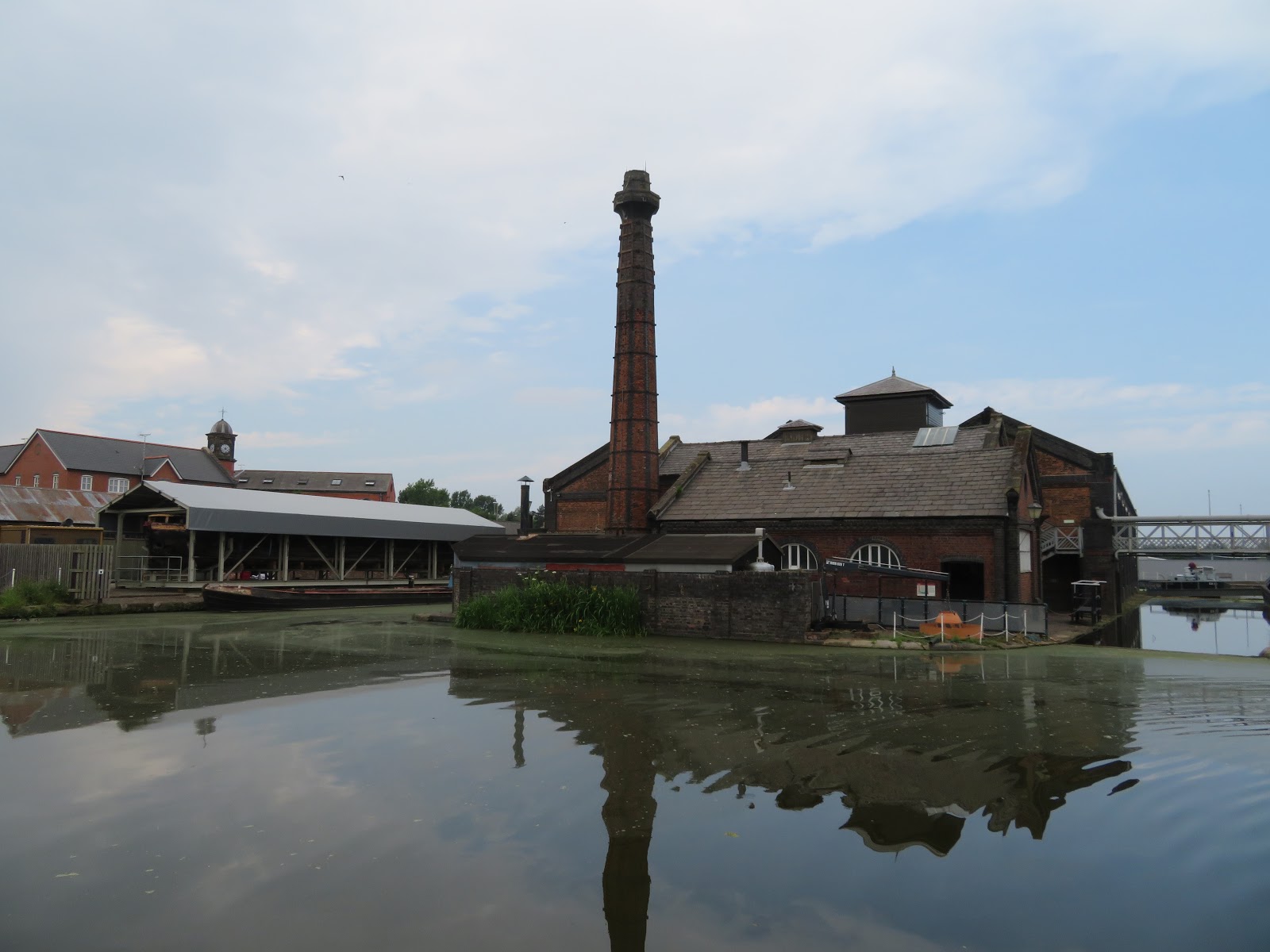
The chimney is part of the pump house and two boilers that worked the port when in action. Behind is the main exhibition space. Whilst it didn't seem to be too busy there was a steady stream of people looking round, and the cafe was busy with many cyclists using it as a stop over.

As we leave the Boat Museum we were pleased to see that the areas around the canal had been kept clean. The last time we were there we spent an afternoon cleaning up the rubbish immediately round the tow path and collected about 4 bags. It is seems to be in hand now. There was plenty of evidence of the industry that was supported by the dock and canal. I think there was a timber yard and a steel works close by as well as oil based chemical and additive producers. 

There is a view of Stanlow Oil Refinery from the canal and it is a large site, the second largest refinery in the UK, after Fawley, near Southampton. It first started in 1924 as a bitumen works and was developed by Shell who sold in in 2011 to Essar for £814 million. They plan to extend it. The crude oil comes to them from Tranmere jetties on the Mersey. It's products are distributed via road, rail and ship as well as via the pipeline system that covers the country.

Helen got excited when she heard a prop driven plane overhead and recognised the WWII fights Dakota. It obligingly turned and swooped over head again so I could get a photograph.

We moored up in the countryside with good views, close to Bunbury and got on with a few jobs that were outstanding. This pigeon settled on the gate opposite and was reluctant to move, even when approached. Is this one of the baby pigeons that people claim to never have seen? It certainly didn't seem to be a competent flier.

We were moored close to Stoak and had a view of St. Lawrence's Church. The present church dates from a rebuild in 1827, although a church had been built soon after the Norman Invasion. It was in ruins by the 14th Century. Despite the fabric of the church been fairly 'new' the parish records go back, but for a short break, to 1543 and the Churchwardens accounts as far as 1677. They also have some old bells in the tower too, 1615, 1631 and 1642! The Parish Name had been Stoke but this was altered in 2015 to the same as the name of the village and to avoid confusion with the parish of Stoke in East Cheshire.

The Bunbury Arms was a nice haven on a beautiful warm day. there was a good selection of beers and the food looked very good and sensibly priced too. Well worth a walk from the canal. There are many memorials to the Bunbury family in the church, hence the name. Bunbury, the village, is the other side of Chester so we will be coming to it forthwith.

Saturday, 16 June 2018

Boats galore.

When you stay in the Boat Museum you pay the entrance fee for the first night, which for us now we are over 60 was £8.50, and subsequent nights are just £4. So we decided to have another night and have a good look around the museum. We have been before but we hoped that there was something new to see.

Just across from our mooring is this ferro-concrete barge, I think FCB18. They were built in WWII to same the use of steel for more strategic items. Around 470 were built by companies such as Wates and many were built in Barrow in Furness. Steel mesh was concreted over to make panels and then they were bolted together. They were not ship builders and actually built houses using the same method. FCB 18 was built in 1944 and could carry 185t. It seems she is likely to have been used on the Manchester Ship Canal. There are several other similar barges among the Purton Hulks on the banks of the River Severn near Sheerness. It still looks in very good nick.

These are the Whitby Locks. The two sets of locks, one narrow, one wide, bring the canal up/down from the Lower Basin to the Upper Basin and the same level as the Shropshire Union Level. Apparently they are named not after the famous port of Whitby in North Yorkshire but after the name village that is now a southern suburb of Ellesmere Port. There are two locks with a short pound between and the wide and narrow pounds are linked to take excess water. Its seemed to be the onloy place in the museum that I could get a picture of the  Shropshire Union Canal, the Ship Canal and the River Mersey.

Down in the Lower Basin 'Holderness' strikes a colourful sight , but there are a couple of other more historic things. (And Helen isn't in the picture!). It is such a shame that the Straddle Warehouse that sit astride the water with columns on the strip islands providing covered moorings for wide and narrow craft. It was burned down in the 1970's. Of all the boats in the museum the one I would want is the 'MSC Pelican' a crane barge. It has a couple of towing bows and hook so could tow along a small barge etc. It's hold could be converted to accommodation and who wouldn't like to play with the crane, and you never know it may make you a bit of money too.

It is good to see that Helen has been recognised in a museum, especially here on Porter's Row. There used to be twelve cottages here now just the four survive. The Porter's in question are porters or dockers of the port. However it seems a family called Porter did live here too. They are furnished for different eras and it was surprising how many of the items we recognised from our Grand parents and parents homes. We are getting older.

Some may say the good old days!

The 'Worcester' is a beautiful boat and could well be another I would consider for my collection. She was built in 1912 at Queensferry, near Chester, for the Worcester and Birmingham Canal Co. for use as a tunnel tug. By 1950 just about all boats were motorised so she became an icebreaker. In 1968 she was abandoined up the Peak Forest Canal when in private hands, until she was raised by volunteers in 1972 and given to the museum

Mendip was 'Chocolate Charlie's' Josher hulled motor boat that was built in Northwich by Yarwoods in 1948. She was No.5 of 6 built as the last of the Josher style boats for FMC. She has coppered steel sides and a wooden bottom. Copper is added as a corrosion protector. Charlie used to collect chocolate crumb from the Cadbury's factory at Knighton near Market Drayton and take it to their Bournville south of Birmingham. There were 50 locks between and it took him 14 hours to carry the cargo. He fitted in two trips a week! When the job finished he kept it at Preston Brook where it remained until his death in 1981.

'Basuto' is a Clyde Puffer and was hidden away by the dry dock. She was built in 1902 by W. Jacks at Port Dundas. She went to Belfast in 1919 to run for Kelly's, a coal merchant. In the 1920's she came to Widness where she became a dumb barge just carrying sand and gravel. She was saved from this indignity when the Manchester Dry Dock Co. bought her and put her back into steam. She got a new boiler in 1961 and was bought by the Museum in 1981. She is needing a fair bit of attention now.

I love the riveted hull plate lines of the 'Cuddington', the way they create the lovely hull shape. 'Cuddington'. She was built at Yarwood's Yard, Northwich, on the River Weaver. She is called a Waever Packet and after launching in 1948 went to work for ICI. She was employed running chemicals, including soda ash, from Winnington on the Weaver to Liverpool. She  continued for them until she was laid off in the 1970's. She came to the canal in 1979.

The best bit of the museum to me are the old films that are played on a loop upstairs in the Warehouse museum. I love those old info-mercial films of the past. You get to see the workings of things, and to see the building of Queen Elizabeth Dock, Eastham, under construction and take a trip up the MSC when everything was busy and working is a real insight. I think about a dozen of the old vessels that were sitting in various stages of dilapidation were removed from the basins over the winter. There is still a couple of wrecks in the lower basin that do not fill the public with confidence that the exhibits are being looked after. I don't suppose all the dozen will be kept as it is cheap to acquire boats, but very expensive to keep them in tip top condition. However the basins do look a bit empty now.

Friday, 15 June 2018

Runcorn to Ellesmere Port.

Everything was going very nicely, and on time. To get from the Manchester Ship Canal (MSC) into the Ellesmere Port Boat Museum you have to liaise with the the Chester and West Cheshire Council as they have to open the swing bridge above the lock. It is hard enough to get through to them to organise anything but then they finish work at 1600 and you have to give them your ETA before you even start the trip. I had guessed that we would be there about 1530, and we were on track.

Just as we passed under the Silver Jubilee Road Bridge at Runcorn we heard from Eastham Port Control that a vessel ahead was ready to sail and two tugs were coming up to her and we had to stay behind her all the way to Ellesmere Port. Best Laid plans etc. The 'Iver Ability' was built in 2006 and is registered at Gibraltar. This is a flag of convenience and probably the only connection with the place is a brass plate office. It is an asphalt/bitumen carrier. A bit bigger than the FMC gas boats that carried bitumen from this part of the world to Birmingham. 

The larger ships are accompanied by a tug at each end to assist. Since 1989 Carmet Shipping, who own the four almost identical tugs MSC Viceroy, Victor (seen above) and Viking and Volant, have had the sole rights to working tugs on the MSC. They are twin screw with a bollard pull of 16 tonnes and were built at James W. Cook and Son of Wivenhoe in Essex (no longer active) between 1974 and 1976.

They were soon under way and starting to speed up a little. The stern tug travelled astern with two ropes so that a little alteration of course will quickly put weight on to assist the big vessel. These days the modern tugs can put as much weight in the line going astern or sideways so may be would have been pulled along stern first. The 'Royal Charter' had finished her work and was pushing to get past and heading home.

Just before the entrance of the River Weaver into the Ship Canal, and the Weston Marsh Lock, (now damaged and out of action for a good period it seems), there is Weston Mersey Lock that when the Ship Canal was built still allowed ships from the Weaver in to the Mersey. It is now disused.

There is quite a bend in the canal by the Weaver and the procession slowed and we could see the tugs assisting the 'Iver Ability' round the turn. You can see the yellow buoy that marks the shallows on the inside of the bend.

Looking out through the Weaver Sluices you can see there was no water in the Mersey at all, just in a very small river channel. It made me wonder how long the ship would have to wait at Eastham before penning out into the Mersey.

'Meander' was soaking up the sun and saving fuel as we puttered along behind the convoy. The delay meant that we definitely would not make the 1530 time for the swing bridge, and he said that he would have to go at 1600 for his other works. It looked like we were going to spend the night in the basin outside the Museum.

This light beacon made me think of the lights marking Skerries around the west coast of Scotland. There is an oyster catcher to the left of centre on the rock, if you look closely.

'Happy Bear' was sitting on the Ince Oil Berth as we passed. She is an Liquified Petroleum Gas carrier and looks in very good nick for having being built in 1996. She is registered in the UK with port of Registry of Douglas, Isle of Mann. It doesn't mean that there is anybody British onboard though. It is a long time ago that the stipulation of being British flag stated at least the Master and Chief Engineer have to be British.

It didn't seem anytime at all we were approaching Telford's Lighthouse at the entrance to Ellesmere Port Basin and 'Meander' started the turn into the dock.

We were lucky as the Bridge man was just setting off when he saw the 'Iver Ability' pass so he knew that we were just behind, so he came round and opened the bridge for us and in we went to the Lower Basin. Another safe arrival.