Total Pageviews

Monday, 22 August 2016

Better Late than Never.

Missed a few more blogs as I have popped back home for a couple of days. This blog is all about Friday last. We decided to go to the Science Museum as there were a few things we particularly wanted to see. We were meeting No.1 daughter there too.
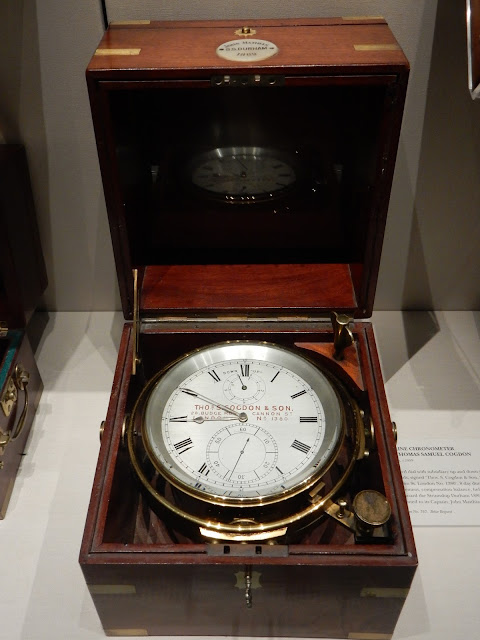
Whilst we were waiting for her we looked round the collection of the Worshipful Company of Watch and Clock Makers housed there. This ship's chronometer brought back many memories for me as all ships had to have one and it was the 2nd Mates job to pay homage to it. As you may know it is a vital piece of equipment for position fixing in the days prior to GPS and satellite technology. Every day it had to be checked. The Radio Officer would tune in to  a time signal and you would have to record the error along with the temerature. This was you could check any trends and see if it was developing a fault. The error would then be applied to all your calculations for better accuracy. It had to be would every so often too. On Merchant ships in the later years crews were minimal so where as you would have had a second person to record the actual times you took your sights we had to do it ourselves and once you brought the star or sun, planet of moons; reflection down to the horizon using the sextant to measure its altitude you would pace into the chart room whispering 'one elephant, two elephant etc' until you could read the chronometer, then take off the number of elephants and also apply the error to get the accurate time you took the sight.

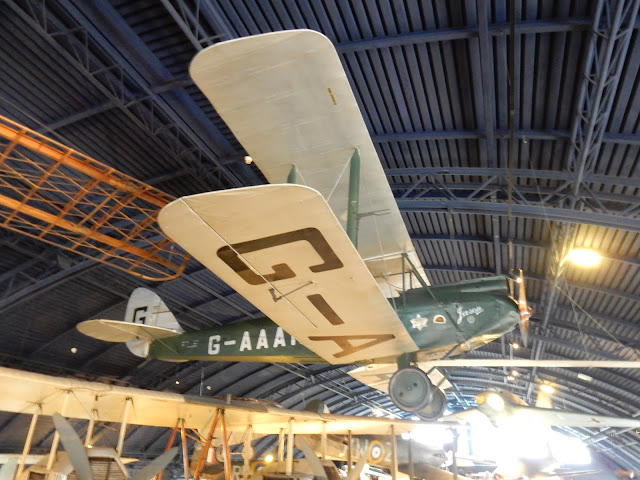
The main thing we had come to see was this aeroplane called Jason. It is the DH60 Gypsy Moth aircraft that Amy Johnson made her record breaking flight to Australia in 1930. It is tiny. There has been some recent dispute between Hull and the Science Museum as the Museum would not release the aircraft to be brought to Hull for the Amy Johnson festival held her this year. It would mean closing the Museum for a long time to get it from the third floor but they do get £20 million from the public purse and it does feel a bit of a kick in the teeth for us Northerns just to be refused point blank.

Beneath Jason is the Vickers Vimy plane that was developed as a bomber for WWI. Alcock and Brown. A prize had been offered for the first flight from America or Canada to Britain or Ireland in under 72 hours. They took their aircraft over in pieces to St. John's Newfoundland. Once they had assembled they waited a while for a period of good weather and set off on 14th June 1919. No trials to see that they had put it together correctly or anything! just under 16 hours later the crossed over Ireland and decided to land. Unfortunately they chose a peat bog to land in and crashed. They still won the £10000 prize plus a £2100 each from a tobacco company and another £100 each from a citizen just for being British and doing it first. A few days later they were also knighted. Not bad for 16 hours work.

Just to give you a little idea of the scale of how small these planes were this poor photo shows the section through a Jumbo jet through the 'hump' at the front. There is the cargo bay at the bottom, then the 'cattle class' with the seat and overhead lockers with the First Class above.

We decided to walk up to Kensington Gardens to eat our lunch. As we passed through Kensington Gore and the Albert Hall we saw there was a cafe in the Hall so we resolved to go in for a coffee our our 'pack up'. It is called Gore not as there was a bloody battle here or an abattoir, but after the Gore Estate that was here before Albert made plans for a cultural zone in the area. In fact gore mean a narrow triangular piece of land.

I had never seen this massive memorial before as normally you only the Hall from the side nearest the Albert Memorial. This monument was designed as a memorial to the Great Exhibition of 1851. It was supposed to have Brittania on the top but as Prince Albert died in 1851 Queen Victoria had Albert place up there so this is also a mini Albert memorial. He is of bronze as the the seated figure that represent four continetnt. It was unveiled in 1863 in the Royal Gardens on the site. It was moved to this place in 1893. It was removed for major works to the Hall in 1998 and unveiled once more in 2001.

Whilst waiting for our coffee we saw that there were tours of the hall taking palce and one was just about to get underway. We had planned to attend a performance of the Proms but that was not going to happen so decided to go on the tour. This is the gallery I think it was called and would be where I would watch from if I didn't have a seat, rather than standing in the middle in front of the orchestra. The only sell between 300 and 500 tickets for this area, depending on what is the attraction. It seems that right round the balustrade will take 300 so even with 500 up here there would be room to sit down and move about rather than being crowded in.

Soon after the Hall was completed they found that their was a 6 second echo through the building largely due to the domed roof. This must have made listening to music very confusing indeed. They first tried to fix it by spreading canvas across the roof soon after it opened in 1871. It wasn't entirely successful and in 1949 it was removed and the fluted aluminium panels like a fan were installed. This didn't work properly either ant it wasn't until 1969 that problem was solved by a German Company installing these fibreglass 'flying saucers'. They work by absorbing some sound and also reflecting it back down into the Hall. So for nearly a hundred years this place was a terrible place to listen to music!

We were told not to take pictures of the concert area as there were musicians practicing but this picture shows the steepness of the seats and the height above the platform level. 

We then walked through Hyde Park and found this curious building by the Serpentine gallery. It was a cafe and inside looked like an ice house, or one of those tunnels that run under a glazier. I different place to have a cup of tea and a bun.

Before we arrived at Park Lane we came across this monument erected to all the Cavalry Units of the Empire in WWI and later WWII. It was made from bronze guns captured in WWI and shows St George on his horse astride the slain dragon. on Portland stone with a bronze frieze around it. It was originaly placed by the Stanhope Gate to Hyde Park  opposite the Dorchester in 1924. When Park Lane was widened in 1960 it was moved to this site within the park. It was remounted on a granite plinth and the wall that surrounded the statue with the bronze frieze and the list of the 150 cavalry units remembered was altered with the frieze on the plinth.

I loved this art deco work on the building that is now part of Aspery the jewelers. They bought this building in 1859 and it means they now have an entrance an entrance on New Bond Street and Albemarl Street. It used to be the Alfred Club. The club was founded in 1808 and had been limited to 600 members who each had to pay an annual subscription of 8 guineas and 8 guineas a visit.

It wasn't just rich and expensive shops we passed bu the Royal Institute too. It was founded in 1799 and got it's royal patent the next year. It has always been based at this building and it is dedicated to difusing knowledge and demonstrations of mechanical matters along with philosophical and experimental science.

There were still more expensive shops to pass as we saw the Burlington Arcade and passed through this one the Royal Arcade that connects Old Bond Street with Albermarle Street. It was just the 'Arcade' until the shirt maker H.W. Brettell won a Royal Patent from Queen Victoria. It was constructed in 1879.

We were heading to the Royal Academy to see the new David Hockney exhibition of portraits. It was founded in 1768 by King George III to promote British arts and designs. It moved Burlington House its current location in 1868 one hundred years later. It is unique in that it is run and funded by artists themselves although the Government own the building it is give to the RA rent free. the exhibition was good. All the portraits are on the same size canvas using the same setting and carried out roughly over a year in Los Angeles last year and the start of this year. He does seem to be able to grab something in his paintings and you feel that he does get 'meaning' into the faces without going on too much.

Whilst we were waiting for our time slot Helen couldn't resist popping over the road to Fortnum and Mason's. It was established here in 1707 and is still going strong selling luxury products. We came away with a tube of biscuits, because Helen liked the tin!!

Friday, 19 August 2016

Looking at London again.

I hope that you haven't missed me too much but I have been busy and getting back to the boat too late to get the blog written up. On Tuesday we went to visit my daughters new flat and of course got involved in cleaning and odd jobs to rectify small problems and then sorting out utilities etc etc. On Wednesday we met a friend from Sri Lanka and we had a great catch up over coffee a,d meals etc etc so didn't move much. Yesterday,  Thursday, we went for a walk whilst the fine weather lasted but got back so late it was straight to bed.

We met up at Embankment Tube and then headed for Whitehall. There were plenty of folks admiring the horses at Horse Guards and we arrived just as they were swapping over. The Horse Guards were established here to protect the entrance to the massive Palace of Whitehall. This Palace became the main residence when Henry VIII moved out of the Palace of Westminster down the road. At It's peak it covered 23 acres and had 1500 rooms. It burned down in 1698

One part of the Palace that survived the fire was the Banqueting House that was built for James I bu Inigo Jones in 1622. It may well have been from this very window that Charles I walked on to the elevated scaffold for his beheading in 1649.

North of the Cenotaph on Whitehall is this monument to the Women of WWII. It was unveiled in 2005 and it was carried out by Queen Elizabeth II. It was created by sculptor John Mills. It is a very moving sculpture to me.

As always I spend a lot of my time looking upwards and the reliefs on the buildings are amazing. I loved these on the Foreign and Commonwealth Office. There were the continents and of the industries.

This is a very poor photo but it does show Westminster Hall which is arguably the birth place of English democracy. It was built in 1097 and is almost the only bit of the Palace of Westminster that survives. The first parliament was held here and it was used as a law court for many years. It is a huge place and must have been a wonder of the world when it was built. The reason that the photo is like this is I wanted to show Parliament Square. It just looks like a poorly maintained green of grass but actually you are looking at the first official roundabout in the country that opened in the 1926!

Just off the Square is the Jewel Tower. This is also a survivor from the fire of the Palace of Westminster. It was completed in 1366 and was built to house Edward III's treasure. It had a moat round it that was linked to the Thames. The fire meant that Henry VIII moved to the Palace of Whitehall. The tower then became the store for the records of the House of Lords and other parliamentary archives until another massive fire in 1834 destroyed the buildings all a round. It then became the HQ of the Weights and Measure until 1938.

We sat and had our lunch in Vitoria Tower Gardens watching the traffic on the river and then progressed up Millbank to the Tate Britain. The Tate was built on the site of the Millbank Penitentiary that was built in 1821. It was from this prison that most of those that were deported to Australia left the UK via hulks on the Thames. We did have a look round the free galleries and there is a route showing British art through the ages that was quite informative.

Where as most of the art on display is what some may call 'real art' this stair well has certainly been brightened up by a modern scheme.

You don't seem to see many crests for Edward VII around the place. I suppose that this is partly due to his short reign of 9 years and maybe it is also due to the fact that as he followed Queen Victoria who had had a long and glorious reign with the nation becoming vastly wealthy and and most of the public building that needed building were built and they would still be in good condition.

It is amazing to find these relics of WWII on the streets around here among the beautiful homes on Lord North Street. Apparently the shelters are still there but are sealed up. I think the the S stands for a 'Street Communal Shelter' and were for people who were working such as drivers and pedestrians who were caught away from shelter when the sirens went.

We walked through an arch and ended up in Dean's Yard of Westminster Abbey. Like the rest of London the vista was marred by the amount of scaffolding  in view. We didn't think about entering the Abbey as it was £17 to get in. That seems an awful lot of money to visit a church, although I have never been.

The Methodist Central Hall is a beautiful building that was opened in 1912 and can accommodate 2000 people. It is not widely known either that it was actually the first home of the United Nations in 1946. It was also where the protest movement 'Campaign for Nuclear Disarmament' was started in 1958. We didn't have time to visit this time but it is on my list for another time.

On many churches that we visit there are alcoves and niches in the outside of the building that are vacant. I have never known whether this is because none were ever placed there due to lack of money or they have decayed or been stolen. On the outside of Westminster Abbey are new statues in niches. This one is of Martin Luther King

This one is of Manche Masemola. She was born in South Africa in 1913. She was killed by her parents to stop her being baptised as a Christian in 1928. Here mother converted to Christianity forty years later and Masemola was declared a martyr.

I like this photo that could have been somewhere in India. It is taken from the bridge across St. James Park Lake and is looking back to Horse Guards Parade and the roofs of Horse Guards, the Banqueting House and Downing Street.

Monday, 15 August 2016

Old Timers.

Today was for meeting old friends. Helen had worked with Fiona in the late 70's (There seems to be a little dispute as to exactly when it was). It is about 15 years since we had seen her and a lot had happened for us all. We were meeting them at Charring Cross. I filled up with water before we left though.

I don't think I have taken a picture in the Tube before. I like the Tube. I'm not sure whether I would enjoy it so much if I had to travel during peak times, but even in this hot weather it is fine. I have been on underground system all over but In London there is a bit of grit to it all not all stainless steel etc.

We met up under the clock at Charing Cross Station and had no trouble recognising each other and walked down to the Embankment Gardens to sit and chat over a coffee there. We then went for a wander. We passed Cleopatra's Needle that was erected on the Embankment in 1878. It was the story of making an iron cylinder to encase the needle that was made like a ship to be towed back to the UK. All this was paid for by Sir William Wilson as the Government wouldn't pay even though the Ruler had given it to them to celebrate the Victories of Admiral Nelson and Sir Abercromby. It was the story of the loss of the tow of the needle the loss of a boat going to rescue the crew on the needle and subsequent recovery and delivery to London that may well have sparked the idea for me of going to sea. The sphinx's are not from 1450BC like the Needle but from Victoria times. They managed to get them the wrong way round as they are supposed to guard the Needle, facing out, but these are facing inward admiring it!

I loved this memorial to the Fleet Air Arm and when I read the list of battle honours I realised that my Dad had been there at many of the places. Only a generation past and there are monuments to their exploits.

The London Eye opened on 31st December 1999 for the Millennium. As I remember it was supposed to be taken down after a few years as just a Millennium project. It is still there and is a new and popular London landmark.

Further down the Embankment is the Battle of Britain memorial that was unveiled in 2005. It was the idea of Bill Bond, the founder of the Battle of Britain Historical Society and he managed to raise the £1.74 million cost. The sculpture was designed by Paul Day and is 82 ft long. The detail is superb and above is a bit of detail.

Sir Joseph Bazalgette was the Chief Engineer of the London Metropolitan Board of Works. He was srecommended for the job by Isambard Kingdom Brunel. In 1858 the Great Stink closed Parliament and this pushed Government to release money for a sewer system for London. Bazalgette designed 82 miles of underground brick sewers rather than the open channels on the streets that were there before. His main benefit to us that in his design he took the densest population and the most generous allowance for sewage created to come up with the required diameter of the sewers. he then thought that they would never get a chance to do it again so he doubled it. We are still using the majority of the system today. The Prince of Wales opened the system in 1865 but in reality it was a further ten years before it was fully completed. (There you narrow boaters always manage to get toilet talk in).

Bazalgette's other legacy is the Embankment itself. It was part of the sewer system as below the reclaimed land is the main sewer channel as well as the underground Tube line. He reclaimed 22 acres of land. In the Embankment Gardens is this watergate that was that for York House and obviously was on the Thames Bank. It is still in place and shows just how much land has been reclaimed.

 There are loads of sculptures in the gardens and some of them are more interesting than others. I loved this one to the Camel Corp.

After our friends left for home we decided to walk back to the boat via Blackfriars. We passed 2 Temple Place just off the Embankment. I was intially taken by the gilded galleon as a weather vane. We then saw that the house was a fantastic building too. It turns out that it was built for William Waldorf Astor as a late Victoria London Mansion in 1892. It was completed in 1895 to the highest standards possible as Astor. We was very rich and was worried about his children being kidnapped. The house was to act as his office, a residential space for him and his family and a home for his art collection. 

It is now managed by the Charity the Bulldog Trust that rent out spaces for events etc and the art collection is open for viewing too.

The Black Friar pub is on the site of a Friary and is a gem of a building with the interior being on the National Inventory of historical pub interiors. The pub was erected in 1875 and remodeled in 1905 in the current fashion. It is an Art Nouveau Grade II interior that is full of Arts and Crafts work  by Henry Poole.

They also have a good choice of beer and I had a Roasted Rat and Warthog from the Triple FFF Brewery.

We walked to Kings Cross up Farringdon Road and passed under Holborn Viaduct that we had walked over last week. Farringdon Road is a very meaningful road in London as it was laid out between 1840 and 1860. It was one of the worlds first multi lane highway and also buried the River Fleet which started the drive to clean up the sewage system of London. Also below the road is the worlds first stretch of underground railway, that of the Metropolitan Railway from Kings Cross to Farringdon Station. The viaduct marks the start of the City of London boundary to the south.


Sunday, 14 August 2016

Catching up with kin.

We are nice and handy for the newspaper today as the station newsagents open up nice and early so it was a stride down Camley Street past the Camden Council gym with folk going hell for leather on bikes and creating wide wakes as they powered up and down the pool lanes, and past only one or two taxis waiting for fares. However when I got to Kings Cross the concourse was teeming with folk. I quickly got the paper and headed back.

We are meeting Helen's Aunt and Uncle over in East London for lunch so we were off promptly as there was a few tube lines closed around Kings Cross so in the end we had to go via Bank.

Round the back of Kings Cross Station is this restaurant that looked to be in an intriguing building with an intriguing name, The German Gymnasium. It seems that it was built in 1865 for the German Gymnastics Society for one Ernest Ravenstein. The cult of gymnasiums was taking off and this building also managed to use pioneering engineering as the roof truss were need to provide wider spans so laminated timber with  cast iron fillets between the truss and the ruff. Soon after building the National Olympian Association used it in 1866 to host some of the indoor games. Just as an aside in July cricketer W.G. Grace scored 224 NO against Surrey and then went on to win the 440 yd hurdles at the Olympic Games held at Crystal Palace.

Stephen was there and waiting for us to be whisked off to there house. They actually live in a mental asylum, well it used to be I should say. Mind you these days there are no barriers to stop you leaving just for getting in! We had a nice catch up over coffee and admired there lovely garden. Helen was one of their Bridesmaid's and I was surprised when she said she still has the dress. needless to say she can't fit in it anymore, but she was 8 at the time! The asylum was completed in 1893 and closed in the 1990's. It is reported that several ghosts have been sighted, but not by Stephen and Norma.

We set off later into the depths of Epping Forest which is an excellent resource to have so near to London. It used to be Royal Forest but is now managed by the City of London Corporation. It actually covers over 2476 hectares or 6118 acres in old money. If you travel from north to south through it can appear massive as it is about 12' long but only 2.5 miles wide ate its greatest. As we drove alond he mused how many bodies there were in the forest; well it seem that since 1970 there have been at least 13 found!

We went to the 'Good Intent' pub in the Forest and had our first Sunday roast for ages. It hardly touched the sides. Mind you I found room for a great apricot bread and butter pudding with lashings of custard. They didn't have much of a selection of beers but the pint of AK from McMullen of Hertford went down a treat. It was great to hear of their daughters and grand children's doings and what they were getting up to. They aren't growing old too graciously at all.

We were so being driven to the Tube to head back into Town to meet our daughter and boy friend. We had a lovely time and it was good to see them both looking so well, and thanks very much for the lunch.

At the Tube Station this sign was above the west bound platform. Apparently it had been covered up by an advertising hoarding. It seems that Woodford was a centre for the Temperance movement and as well as the Coffee Tavern there was the Wilfrid Lawson Temperance Hotel. 

We got back nice and quickly and bought a bit of food before getting back to the boat. Soon enough Joe and Amy came to us at the boat and we heard all about their holiday and exchanged presents. A lovely day catching up with family and friends so thanks very much to Stephen and Norma for feeding us and hopefully it wont be two years to the next time.

Saturday, 13 August 2016

A Life on the Ocean Wave.

We decided to go over to Greenwich today and have a guided walk in the morning. We took the Tube to Bank Station and I had a young man give up his seat for me! I wasn't too sure whether I was happy or not. I did blush though. To get my own back on the way home I asked a bloke with a big case who looked a couple of years older than me if he needed a hand! We then got on the DLR over to Greenwich and got off in good time at the Cutty Sark which was where our walk was to start.

I think the 'Cutty Sark' was suffered more perils since it has been a shore than it did at sea! It is looking pretty good since it's latest renovation following a fire. She was launched in Dumbarton in 1869 but didn't act as a tea clipper for very long. Named after a short shift that a ghost wore in a Robert Burns poem.

There were only three of us on the walk so it was easy to hear everything. We walked past what was the Royal Navy Hospital. In the middle is the Queen's House that was built for the Queen of James I, Anne of Denmark, and was completed in 1619. Even earlier there was Greenwich Palace that was built around the time of Henry VI. Henry VII built a bigger and better palace and called it the Palace of Placentia. Henry VIII, Mary and Elizabeth were born here. The Royal Hospital was built by Christopher Wren, it is said it was in two halves so as not to interrupt the view of the Queen's House.

The view from next to the Royal Observatory is a classic with a good juxtaposition of the Queen's House and Royal naval Hospital with the Canary Wharf Development. The open land below was where the equestrian events were held during the Olympic Games in 2012. There are 13 protected sight lines in London that mainly protect the view of St. Paul's Cathedral and the Palace of West Minster from High ground. It seems now that there are people looking to obtain the same for the 'Gherkin'.

One wing of the Hospital, west, house the refectory for the 'inmates'. It is said to be the best dining hall in the country as it is highly decorated. This is the end wall and the artist James Hill took 19 years to pain the entire space, starting in 1708. He was paid £3 a yard for the ceiling and £1 a yard for the walls! He was knighted for it but was crippled at the end through laying on his back for so long. I think that the painted figure bottom right is the painter himself. Admiral Nelson was laid in state here after his death at Trafalgar.

On the other side is the Chapel that the sailors had to attend. It was completed in 1751. It is a stunning neo-classical design.

The colonnades are also impressive and the lights were swing a little in the breeze. 

This giant ship in a bottle was previously on the fourth plinth at Trafalgar square.

There was a wedding in the Chapel today and later we saw the bridal party and later up Croom's Hill we saw this coach and horses waiting patiently. Coom's Hill is apparently the oldest named street in the country and old English for winding hill.

There is another great view point from Point Hill and very few people so you don't have to elbow folk out of the way. There is a stone memorial to an Australian Pilot who was killed on the hill flying a Hurricane in WWII.

On the waterfront is the Trinity Hospital and the charity dates back to 1613. This building was put up in 1812. They still provide 41 flats for the reduced in circumstances that have lived in Greenwich for at least 4 years. In the background is the turbine hall and chimneys of Greenwich Power Station. It was built in 1902 to provide power for the London Trams. It was powered by coal but converted to gas in the 1960's. They wanted to have taller chimneys but the Royal Observatory objected.

The tide is falling and revealing a beach with some good sand at the top. The view past the Trafalgar pub and Royal Naval Hospital to the Greenwich Foot Tunnel entrance and the Cutty Sark makes you think it may be the seaside.

We decided to take the Clipper back into Town and after a wait of about 30 mins we were away.

We were passing Limehouse Basin at a bit more speed than we left it a couple of years ago.

The Tower of London doesn't look the same as from the top of 'Walkie Talkie'.

In the Pool of London HMS Belfast looks great in the sun and with Tower Bridge behind.

We got off at Westminster Pier and decided to walk to Victoria and as we cleared the crowds at the foot of Big Ben I couldn't resist taking this picture with the sun on Big Ben, which of course is actually The Elizabeth Tower having been renamed for Queen Elizabeth II diamond jubilee in 2012. It had been just the Clock Tower previously and had been built in 1859. Big Ben is actually the name of the Great Bell.

Our legs are very tired today, but a bit of a rest day tomorrow.