Total Pageviews

Saturday, 15 June 2024

Bye Bye to the Basin and Hello Hawkesbury.

 There was some heavy rain in the night, but otherwise it was pretty quiet. We got ready to leave at the normal time and then reversed out of the short arm and spun round in the wide bit under the gaze of James Brindley. Her gave me 5 out of 5!

As you can probably see it was drizzling a little as we left the basin.

The bridge at the entrance to the basin was deliberately very small with no towpath so as to be able to control access. It was shot over night. We stopped for water just the other side of the bridge, and on the none tow path side used to be another wharf, the stone edging still in place.

This map extract from 1937 has the water point by the main road bottom right, with the wharf on the opposite bank that dealt mainly in coal it seems. You can see that there is a short arm heads down to a timber yard/sawmill.

On the left of this picture was the Dailmer Motor Works of the map extract. A licence was given to build Daimler cars and this site was the first factory to build cars in England. The first car came off the line in 1897. A little later the Great Horselerss Carriage Co. was also on site. Much later the Coventry Climax Co. who built engines were on the site and it is them that filled the arm in.

On the left was the first power station in Coventry that opened in 1894. Is electricity was in its infancy the power company supplied 5 different voltages as nothing was standardised. On the right of the picture was the site of the Coventry Corp. Refuse Compactor, but is now a nice open estate of modern housing.

The chimney is the power source for a weaving/textile factory that stretched back away from the camera

You can just see a mooring ring in the concrete of what was a wharf serving Courtauld's Artificial Silk factory.

On the tow path side is this building from the late 1920's that was built as offices for the Courtauld factory. Fedex were using it the first time we came this way I seem to remember but it has been to planning to refurbish as offices and also once for change of use to apartments. It seems that the office idea has won at as there are no dividing walls to be seen.

A colourful spot at Prince William Henry Bridge, named after a pub that was off to the left, but now a builders yard.

Part of the old Courtauld's factory has been repurposed it seems.


The Stoke Heath basin is at the bottom right and the massive shed of the Cammel-Laird Ordnance Works is to the left. I was fascinated by the gun range running alongside the canal on the off side. They couldn't have possible tested the 15" guns here could they? It is where there are a few boats with permanent moorings.

This site was another Courtauld's factory, this time producing Acetate for yarns, the 'cotton' type stuff that was in a cigarette filter and the plastic for spectacle frames. It is all housing now, but the signs for the outlets still survive.

Next come the sight of the massive Coventry Corporation Gas Works that would have provided work for many narrow boats I'm sure. It was actually in this area that the first sod was cut in the construction of the Coventry Canal in 1768.

This concrete bench at Longford looks inviting but wont be that comfortable after a while.

As you approach the junction you go under this bridge with the birds that used to be a mineral railway that served the Wyken Alexandra and Wyken Old Pit mines as well as the Longford Power station.

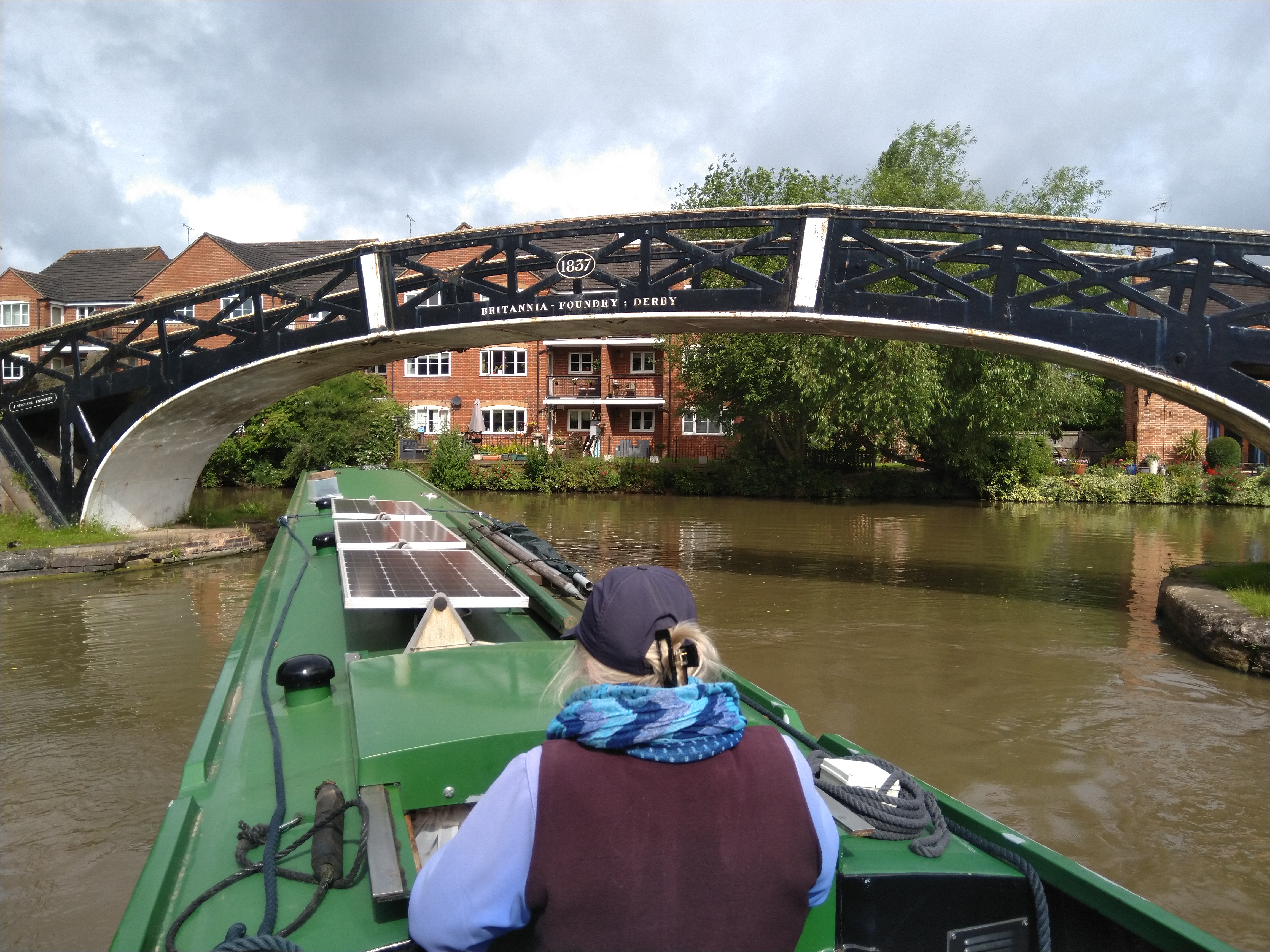
I'm not too sure what this bridge was, just an accommodation bridge it looks like, but the walls facing the canal seem to have become detached from the corners and looks like it may soon topple into the canal, on both sides.

We had a day of drizzle and dull weather, and then once clear of Hawkesbury there was heavy rain with thunder and lightening, all very impressive. Once that had cleared the sun came out and it was a nice day. I waited for a boat to come through Newbold Tunnel and then another started through so I went through too. It is two way so no problem. We got to the Brownsover moorings and went on a little before mooring as there are still rings to tie to. We went in to Dunhelm for some stuff and then to Tesco's for milk and a few extras. We decided to head to the Harvesters for tea too. All in all a varied and enjoyable day, all round.

Friday, 14 June 2024

Coming to Coventry.

 We headed off to the stop lock and met up with the voluntary lock keeper we had been told about the last time we had come through. He was from Hull, and we had a good chat as we waited for the levels, well for a boat coming from the Coventry basin direction, until he had swung into the basin and then left the lock for them.

Through the bridge and headed to the left, we were off to the basin.

Looking back at the stop lock we see the hire boat heading in that was full of Australian blokes. They had obviously done this before.

It is just off to the left where the original junction between the Oxford and Coventry Canals was made. Hence the wide area where there are now residential moorings by a pub but a sharp bend under this bridge.

The canal towpath, and the canal itself seems to be still much cleaner than when we first came this way. Three years ago we came this way as Coventry was (is, until the end of this year) the City of Culture taking over from Hull, and I think efforts were made to clean it all up, and it still is. The city had to contend with COVID etc, but I still think that they could have done better for their stint with the accolade. Mind you I think whoever has it will find it hard to beat Hull for the lasting changes they were able to make. Maybe this mural was one of the things added.

This is the over bridge at the entrance to Stoke Heath Wharf. It was the base for the Cooperative Dairy working 26 narrow boats carrying coal.

This building was the largest in the world when it was built in 1906. It was built by Cammell Lairds who took over the site of a works making tubes for the Admiralty. Here there were two huge lathes to bore out the tubes that went to make the 15" guns for the battleships of the era. ('Scuse the finger).

These are Cash's Hundred housing. In actual fact only 48 were built and now only 37 survive. Cash was a weaver, (who remembers Cash's name labels that were put in all our school uniform etc.). He was a firm believer in the fact that cottage industry could compete with factories. He built these houses form the workers and the top floor was for the weaving looms. There was a steam engine in the courtyard that powered all the machinery in the top floor by shafts and belts and worked with no trouble for 70 years until 1926.

Coventry was the centre of ribbon making until 1860 when a new a treaty with France meant that imported ribbon was cheaper and the town's industry crashed and very hard times were felt all around. These buildings were painted as some sort of remembrance to the trade, and colourful it is.

A little further on there was even more colour with this mural.

We got to the basin and found a berth before having a drink, getting changed and heading into town. Helen wanted to take advantage of there being a M&S and a few other shops we don't have, and came away with a few ticks off her list. We then walked over to the Herbert Museum to have a look.

We walked past the City Hall that had been commissioned in 1910 following a competition. The foundations stone was laid in 1913 and completed in 1917. It is constructed of Runcorn stone and roofed with Cotswold Stone. Above the door were added statues of Lefric, Lady Godiva and Justice in 1924. At the top of the door is an elephant with a castle and the motto 'Camera Principis' which means the Prince's Chamber as Coventry was regarded as the chamber of Edward, the lack Prince!

Dippy the Diplodicus is at the Herbert Museum. We went round the various galleries at a fair pace as we were getting close to closing,16:00.

One of the exhibits was an old microwave. We were struck as we still have one like this. My Mum and Dad bought all my brothers one of these and ours is the only one still working. This one was dated 1985
which was about the date we got ours too. It is still going strong.

The old cathedral got hit in November 1940 in the Coventry Blitz but has been a symbol of forgiveness  since the end of the war.

The new Cathedral is right next door to the old and is completely different. I con't really like the exterior but the interior is fantastic and featured a fair bit in the brilliant TV series 'This Town' recently.


Thursday, 13 June 2024

Dull..... But Only The Weather.

Once again we were off at 09:30, but didn't get very far as we stopped just under the first bridge, by the Barley Mow pub, to top up with water as it was free. Soon accomplished and then round the corner and into Newbold Tunnel. There were a couple of boats approaching the other end, but they stopped to wait, despite it being two way, so thanks for that.

t Bridge 43 we could see Falls Bridge boat yard straight ahead and to the left is the old over bridge that goes over the old canal bend that started at Newbold and comes out here. One of the many loops that were cut off when the canal was straightened.

Helen catching up with the ship's log. She later completed the ensemble with her waterproof too, but still has he legs out, just to show willing!

All Oaks Wood should be done under the trade Description Act as clearly there are many different types of trees there. It is very nice though, however much nicer when the sun is shining and we aren't trying to go astern in a straight line like the last time we were here.

It looks like C&RT have taken preventative action here at Easenhall cutting as there is a second area of scalped bank. I wonder if although the roots of trees help bind the topsoil and scree together, when they get too big the top heavy trees topple over and bring anything loose with them. Maybe if they kept the trees small, more like buddelia or other shrubs, they would have the root effect without the tendency to topple over?

This was the site of the main slip that blocked the canal. There was obviously a work meeting going on, maybe to sort out the next spate of work.

Stretton Stop bridge was closed so Helen had to hop off and do the honours. The water point here is not very obvious and the sign that used to indicate it has gone. It also doesn't look like it is a 'proper' C&RT water point as it is just a tap on a fence post. I thought they had spent loads of money with those tin plate things as many of the old ones didn't not prevent accidental syphoning (or something similar!).

The M6 goes over the canal, the West Coast Mainline runs alongside it and the Oxford Canal makes an almost straight line (for now) towards Ansty.

The canal widens here and there is a depression across the adjoining golf course, all clues to show where another loop rejoined this bit of the canal before the straightening in the 1830's.

The concrete beyond bridge 9 shows where yet another loop left the canal.

Here the concrete to the left of the over bridge shows where the old canal joined here, but it was just a bend to go back under the over bridge on it's windy route to Wyken Colliery.

On the left of this part of the canal was Longford Power Station that provided much work for narrow boats bringing coal from the Warwickshire mines. On the right is the electric sub station that distributed the power and still does. It does look other worldly, and on the power station side slightly dystopian and the old concrete lamp posts are still standing despite the trees and bushes growing around them.

We found a mooring round the bend toward the Sutton Stop Lock. We didn't bother going any further as we were hoping to get moored up before the rain caught up with us. After lunch we went for a walk to drop off the rubbish, and to stretch our legs. This Oxford Canal Company plate was on the towpath just over the cross over bridge opposite the Greyhound pub. It seems very close to the Coventry Canal, rather than the Oxford so maybe not in the original position?

The stop lock to prevent the Coventry stealing the Oxford's water and a couple of canal cottages. I wonder if this is where the Sutton family lived that gave their name to the junction in canal speak?

The Coventry Canal is to the left and the Oxford Canal to the right with the junction made below the bridge.

The Greyhound pub at the junction. We are meeting a friend here this evening. and strange to think that we met in Dehli and it was also unseasonably cold then, especially when you have packed for very warm weather. Mind you they had temperatures of 45 deg last week so maybe I won't wish that heat for here.

A lovely splash of colour in these very red poppies.


Wednesday, 12 June 2024

Rugby and Rugby day.

 We were off at our normal 09:30 and headed off. There were plenty of boats moving, one left at 06:30 from ahead of us. The managed to leave the mooring without colliding with me, unlike when they arrived.

The armada that protects the Clifton narrow boat base was not there today. We had seen a few around so was expecting there to be room to swing a windlass as we passed, and there was, but we didn't!

We didn't go very far to be honest as we stopped at the visitor moorings at Newbold. We had a bit of time to kill so we decided to catch the bus into Rugby for the afternoon.

The bus only takes a little over 15 minutes and dropped us at the Clock Tower. This was built to celebrate Queen Victoria's Diamond Jubilee in 1897. It was selected from eleven ideas of how to mark the celebration. A fund was raised and the building cost £500. It was designed by Goodacres of Leicester and built by Parnalls of Rugby. The base is made of grey granite and the tower of Derby Dale stone. It is partially filled with Northamptonshire iron stone. There is a clock face on each side. It has survived despite being lined up for demolition several times.

We walked to the south and came across the Rugby School buildings. These are almost the oldest parts of the school still existing. It is the Old Quad Buildings that date from between 1809 and 1813 and were designed by Henry Hakewill and there is a lot of detail in them. The school was started in 1567 as a part of a will of Lawrence Sheriff who left money for alms house and for a school for the local boys. Just before he died he reduced the money given to found the school, but added a bit of land he had. It turned out this was a good deal as it is now part of the Bloomsbury area in London. By the end of the 1600's children from all over the country attended the school. It was the Head Thomas Arnold (1828 to 1841)who really set the blue print for a Victorian Public School by his pushing of the moral and religious principals. 

Of course the Town of Rugby and the school gave the name to the sport of rugby. Famously William Webb Ellis ran with the ball in 1823. He was a day pupil after his father was killed in the Peninsula Wars and his mother moved to Rugby so that he could come to the school. Apparently he was a good pupil and good at cricket. He went to oxford and then joined the church. He never married and ended up in Southern France. His grave was rediscovered in 1958 by Ross McWitter. 

We had a turn round the Rugby Museum and Art gallery. Whilst interesting there is more to be found in our Hedon Museum.

The Temple Speech Room was opened on 3rd July 1909 and was named after Frederick Temple a former Headmaster. It was designed by Thomas Graham Jackson.

This building attracted me due to the 'chimney pots', if that is what they are as they may be ventilation flues, but they do stand out. This is Stanley House that currently is for 6th Form Boarders and was built in 1828 and became for girls in 1992.

This is the Geography Department down Horton Crescent. I liked the windows and the tower at the corner of the buildings, but especially that the windows at the bottom are at a slope.

We went round the little Webb Ellis Museum which is where Gilberts made the first rugby balls and they had some interesting stuff. We got a present for No.1 son too. The museum is free by the way.

I was struck by the fact that St. Andrew's, Rugby's parish church, has two towers. A church has been here since the time of Henry III (1216 - 1272). All that is left of that is the west tower (left in the above photo). The church was extensively rebuilt between 18798 and 1899 and the last bit to be added was the North East tower with a steeple top. I can't really remember a small church with both a tower and a steeple. They are doubly lucky as both towers have a full peel of bells and both are used for English change ringing.

Opposite where we caught the bus back to Newbold was this lovely brick carving. It was unveiled in 2000 and was by the artist John McKenna to celebrate Rugby's industrial heritage. You should be able to make out a cement works, a steam turbine generator that was made at the Willans works. There is also a Gloster Meteor jet fight which was the first British jet fighter. The jet was invented by Sir Frank Whittle in Rugby. Of course the canal features too.

Tuesday, 11 June 2024

Known but nice.

 We got underway at about 09:30 and within 15 mins. it was spotting with rain, and within another ten it was chucking it down. It soon stopped though. This stretch of canal is well known to us but usually quite nice, other than at the height of summer when it is stacked out with moored boats and others searching for somewhere to light the barbecue.

On the stretch between Napton and Braunston Junctions there are several blind corners as the canal passes under roads or disused railways. This is the one where the canal goes under the old Weedon to Leamington. This was the line built from what is now the West Coast Mainline at Weedon Bec through to Leamington Spa. This originally was to get Daventry connected to the railway system and the line opened from Weedon to Daventry in 1888 by he LNWR. The line was extended through to the LNWR line between Leamington and Long Itchington in 1895. This is the line with station at Braunston, Flecknoe, Napton and Stockton and Long Itchington.

Once the rain had passed there were flashes of the sun and with the black clouds behind the hills the flash of light on the waving fields called for a photo.

The sun is trying here as we approach another blind bend. Just round the corner there was a boat moored I wonder how often they had a boat land alongside as they have to go full astern as they meet another boat coming round the corner.

I think this is Bridge 99, but maybe wrong. It was from a distance so that I could get the reflection in. It is when I miss the camera.

We approached Braunston Turn after meeting around 8 or 9 boats, but although one boat came out of the Grand Union canal, and one passed from the Oxford up to the Braunston Locks we had a clear passage through. There was a small boat on the water point that did a great job of providing a chicane to negotiate.

They are busy putting in a short length of Armco here, but mainly I think to protect an over spill to a stream, or similar, 

We got to the top of Hillmorton Locks just as one was coming out so could more or less straight. After passing comments about the lock Helen said never mind there aren't any for a good while now, and they seems surprised, as if they didn't really know where they were. I hope they enjoyed the rest. He did say that they would take the rain with them too. There was a voluntary lock keeper at No.2 who was working like the conductor of an orchestra standing between the locks, opening and closing paddles and gates with gay abandon, speeding everything on there way.

We stopped at the bottom for a top up of water and then went to look for somewhere to stop. We didn't go far and moored up to the rings on the visitor moorings. Done for the day.


Monday, 10 June 2024

Back aboard for R and R.

 Well we are back aboard. We left home about mid day and hit the motorways. It took 2 hours 45 mins. There are long stretchers on the M1 that are reduced to 50 mph. This is for the construction of an increased number of  emergency zones on the four lane motorway sections. There never seems to be much going on at these sites, and I can never understand how it takes so long to do these jobs. Most motorways are three lane ones and even with these roadworks there are three lanes. Why is the speed limit 50 mph?

We got the car unloaded and noticed the the 12v fuse panel had a couple of lights out when I had turned everything on. The first problem was trying to remember how to get into the fuses them selves. It took a search on-line to work out that you needed a sharp 'thing to poke into the side of the fuse holder to make it click out. The sharp 'thing' had to be short enough to get in the gap between the fuse and the bulkhead. I settled on a cocktail stick and this worked fine. In the end the fuses were fine and everything was working fine.

After fettling that we got everything else ready for sailing and set off. It is then that I realised that I hadn't brought my camera! I will have to master how to move phone pictures from my phone to the blog.
We had high hopes of having a partner to share with as we popped out of the marina entrance but they moored up on the outside of Calcutt Marina and we were on our own. We crossed with a boat in the middle Calcutt Lock and we were on our way to the Junction.

In the middle lock just waiting for the levels to equal. The sun is shining but the wind is a little cool. There were heavy black clouds all round the horizon too. We didn't get wet though. We just turned east and didn't go too far before mooring up.

That is it for the day now.