Total Pageviews

Sunday, 2 October 2022

Retracing Our Steps.

 A plan was hatched that we would leave our over night mooring, proceed to the winding hole and head back to Atherstone. Unbelievably once again we were away at 0930!

The sun was shining and it was nice and warm as he set off. We were soon at Hartshill and this is the flying fish on the weather vane. As there was nobody on the water point we stopped and topped up before heading off towards Nuneaton, bridge 28 and the winding hole.

This was one of the four wharves that served the Hartshill Quarries by tramways, or may be even full scale track as it linked with the mainline too.

I am pretty sure that this is the same wharf as you can see the little rectangles in the concrete as there are today.

Just another of those autumn light pictures I'm afraid, but also has a hint of the turning of the leaves.

After winding we headed back to Hartshill and was struck by this little beauty.

The Hartshill yard is a lovely place with the clock above the dry dock and a suite of outbuildings around the yard. I especially like the rounded end of some of the buildings. It seems that they are rounded at the entrances into the yard, presumably so that wagon wheel hubs do not catch the brickwork. Of course wagon wheels are now not as big as they used to be! 

Helen was struck by the new paint job on this little Rothens tug, and I believe it is going to find its way into our sitting room when we get back home.

This fender hasn't been moved for a while. Mind you I don't think the boat has either!

This older paint job is s till quite nice. I would say that as it is the same colours as 'Holderness'.

There were keepers at the top two locks as we started down after a short wait for a boat coming up. As there are no bridges across the bottom of these locks it is easier if I do the locks heading down as I can stride across the gates saving a lot of steps round the lock to the otherside. Helen kept her usual eagle eye on the cill as we dropped down.

We were moored up in the pound between 5 and 6 by 1230 and were quite quickly changed and off. We decided to see if we could get fed at the Kin's Head and we found that there was a place for us and we had a full roast dinner with a couple of pints.

After being fed and watered we walked into Atherstone and found that it was busy as it was Atherstone Car show. Long Street was closed and cars were parked along the way, and came cruising past too. The Market Square was also full of them. Cars do nothing for me, I am happy so long as they work when you want them too, and I have never been into engines etc, although when younger I would strip them down, including gear boxes etc, to get the old bangers I had going. This one is for No.1 daughter who lusts after one of these.

Merevale House on Old Watling Street looks like it would be alms houses but it is actually a residential home for those that are living with dementia but don't need nursing care. It is a lovely building too.

Back to the boat and a bout of sitting and reading and watching the TV as I had to have it ready for Strictly tonight.


Saturday, 1 October 2022

Basins are the Pits.

 After the wind and rain of yesterday afternoon/evening the morning was still and bright with the smoke from the many boat fires rising straight up in the air. We must have missed moving yesterday as we both seemed to want to be up and away, without it being said out loud. Mind you it wasn't that early as it was just a little before 0930, and a boat had passed already an hour earlier.

The low sun shining through the trees on either side of the canal as we wiggled along the Coventry made me smile with the dappled light and the warm sun on more open parts.

When you see the trees along canals today it is in stark contrast to the photo's of old and even the film of the 1950's as it looked like the trees were deliberately removed to prevent leaves, branches etc falling in the water. Mind you on a windy it is really nice to have the protection of a hedge or wood as you wait for a lock or just trying to keep warm on the tiller.

Acorns were bouncing of the roof of the boat as we passed along, under the M42 and past the Pooley Heritage Centre and moorings and on to Polesworth.

By Bridge 54 is this set of lovely old buildings and in 1901 it was a blacksmiths shop and home. It certainly looks like it was too.

Just after bridge 54, on the off side, was a very busy wharf area. There was a basin with a tramway (from bottom left corner of extract) connected to the Birch Coppice mine that had two shafts from 1875, one near Birch Moor and one near Hall End. The bricks for the shafts were made on site at Hall End with fire clay from the mine. The pits were expanded during WWI and in 1957 the shafts were deepened and electric winding gear installed. In early 1960's Birch Coppice was home to an experimental smokeless fuel plant. When the method and recipe had been refined in 1963 the plant was closed and production started in Coventry. In 1982 improvements were made to ventilation of the pit and then in 1983 a new coal face was opened up. When this new seam came up to the expected fault in 1986 the pit became uneconomic and was closed.
The Wharf by the bridge was the Coventry Canal Co wharf and the Midland Sanitary Pipe Co. This seemed to start before 1870 and looks to have been a large affair with six or seven kilns.

This is what the site looks like today.

There is not much left of this swing bridge, but if rescued I reckon it could be reused at another location and with new timber. Of course we are lucky today as despite being close to the west coast main railway line all is quiet as the drivers are on strike. We did have one freight train pass, heading south, but that was all.

Yet another photo of light through trees.

We stopped for water at Bradley Green and dumped the rubbish. There was a boat just finishing so we didn't have a wait at all. So we were soon on our way. We were following a single hander up but we never really caught him up as we seemed to be waiting for boats to come down. On guy came down a lock and as the bottom gates wouldn't fully open he started taking his side fenders off. As he left he advised me to stop my engine as I entered as he had lost one of his fenders!! I told him that I never travel with fenders down as I have picked up far too many of other peoples. In fact I even picked up one as I was waiting for him to leave. Luckily it was a floating one.

At Lock 8 we met up with 'Percy' and fellow blogger Nev. I forgot to take a photo but in his blog today he apologised for being scruffy? After we had left I noticed I had a great smudge of chocolate on the front of my shirt as well as shorts I have had on for nearly two weeks!! Nev's blog is here Percy, Nev's blog

At Lock 7 is Baddersley Wharf. This wharf had been connected to some mines up near Baddesley Ensor. There had been at least three mines, Maypole, New Church and Home but by the time another shaft was dug, Speedwell, the other three had mainly closed or being retained for ventilation. 

It seems that a tramway was run through to the Coventry Canal about 1817. It was all formalised in 1871 after the new Baddesley Mine was opened in 1850. It the tramway was widened to standard gauge about this time to link up with the Midland Railway. In 1882 there was an explosion down the pit and 32 miners lost their lives.The basin seems to have closed for commercial use in 1965 but the pit didn't close until 1989. It is interesting to see that in this 1901 map extract the large part of the dock indicates it is full of weed!

It took us 2 hours to get to lock 7 and half an hour to get to the the top. It was that sort of a day. There were no moorings to be had at Atherstone, it was chocka so we steamed on to close to Hartshill.

Rothern's yard is always neat and tidy and it seems that they have spent some money on having a few of their craft painted too. Just down the way is their new marina that also looks neat and tidy.

All in all a nice day.


Friday, 30 September 2022

Mine's a Priory.

 We decided that as the rain was supposed to land in Alvecote about lunchtime we would just stay put and go for a walk in the morning and move tomorrow.

We took the path through Pooley Hall Country park known as the Miners Way. It looked to me as if it was a plate or tramway or maybe a railway track of old but looking on the old maps it seems that it has always just been a footpath to get the miners from Amington and Alvecote to the mine at Pooley Hall. Then path takes you past a few ponds that have been caused by subsidence following the extraction of the coal. It seems that the first seems to be worked were only 2 mts below the surface.

We crossed the canal and headed for the Heritage Centre. The head gear pulley is visible from the canal. I wonder if it was from Pooley Hall Colliery, or just a generic one. I also wonder whether it was made by Thompson and  Southwick whose engineering business started out near the basin as Glascote and expanded into the brick and tile yard next door.

This sign was never a truer word as we had being daring to believe that the Heritage cafe was open but instead of tease we had a tease!

There were couple of lumps of rock outside the centre that had been carved. One had a couple of animals and a blanket and this one seemed to be a cloth draped over a table with mice running over it. I could find no information about them though.

The Pooley Hall War memorial was erected in 1921 and records 32 men who gave their lives in WWI who had worked at the mine. It is another object often seen from the canal but never visited.

We had also glimpsed the Golden Tower of Leaves from the canal and the Miners Walk goes right past it. It seemed very steep and looked quite slippy with the rain so we gave it a miss. That was our excuse anyway, and I took the photo from the war memorial.

This was Pooley Hall Colliery at its largest extent in 1939. It had started with a pit being dug in 1847 and was producing coal by 1850. By 1897 it had become a limited company and included a brickworks. Many mines in the area had brick and tile works as the coal seams included clay among them. In 1924 the Duke of York (George VI) visited and trusted miners were ordered to form a guard of honour in their Sunday best and a flat cap. If they didn't have a cap they had to buy one, at their own cost! They painted the mine at the bottom of the shaft with white wash and installed a bucket toilet! Also in 1917 it was the first mine to generate its own electricity from excess steam for the winding gear. It was also the first pit to have pit head baths that were installed in 1928. Tamworth Mine became Alvecote Mine in the 1940's and became the access pit for Pooley Hall with man riding and coal hoisting. In 1951 these two pits were merged with Amington Pit to become the North Warwickshire Mine. It all closed in 1965.

Pooley Hall had a wharf for loading canal boats with the coal being brought from the pit head by a single track mineral way. Original this was the entrance to a basin, but by 1921 the basin had been pushed through to the other side of the bend in the canal and this formed an island, as it is today. It appears that there never was a bridge to access the island either.

We walked past Pooley Hall but there are no views of it due to trees. It looks lovely in the  few photos and parts for the building date from 1509 but it has seen a lot of changes. We walked back up the canal  and enjoyed the peace and quiet and the colours turning. I was hit on the head more than once by acorns dropping from the trees as the wind rose.

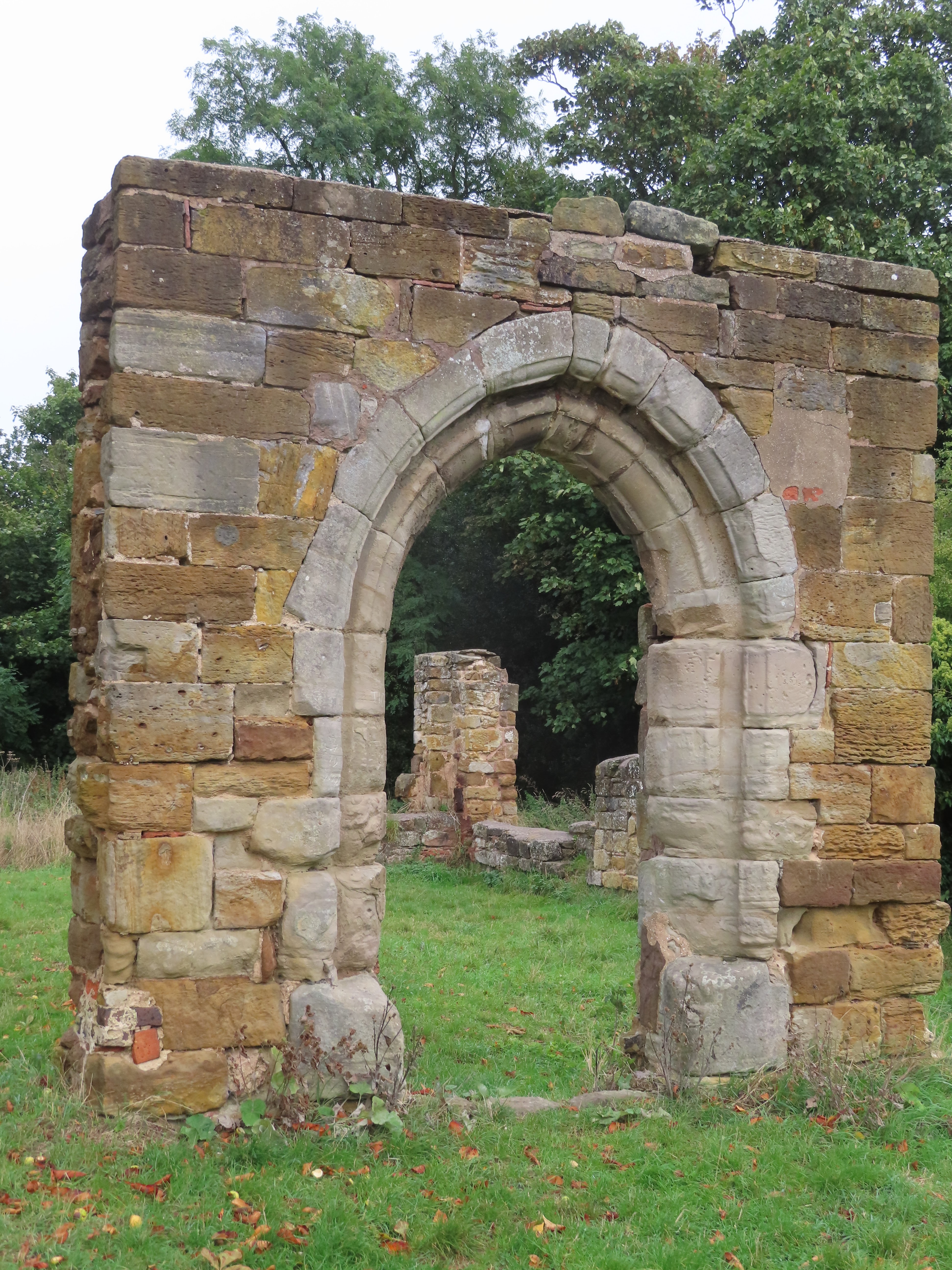
When we got back to Alvecote we popped over the bridge to Alvecote Priory ruins. The Priory was set up in 1159 allegedly as a certain William Burdett, on return from the Crusades accused his wife of being unfaithful with his steward and ended up murdering her. When he learned the steward had taken advantage of her he tried to atone by paying for the priory. It was a sub priory of Benedictine Great Malvern Priory. It seemed to only have had around four monks on site for much of the time and was dissolved in 1543. At some stage a house was built on the site using the stone of the priory.

Apparently this was the main entrance to the original priory.

The ruins of today seem to be the rectangular shape with the 'blob' on the upper left corner. Right by the canal is the rectangular dovecote, that is the oldest in Warwickshire. The 1938 shows that the Priory House built after the closure of the priory in 1540 was quite a massive one. It was demolished in the 1960's.
PS. I have just discovered that Alvecote Priory became the Tamworth Agricultural College and Training Farm in 1886. It had closed by 1914.

We had remembered that there had been a horse chestnut tree so we went to find some to keep in the boat to keep the spiders away in winter. (Yes we believe that it works, so long as you use fresh conkers each year!). The map above also shows that there were orchards laid out in the grounds which would explain the presence of the old pear tree by the ruins. So, as well as two pockets of conkers we came home with enough pears for a crumble in the next day or two. 

The rain arrived on queue at 13:00 and we settled down to reading and drinking tea. It is all supposed to be gone by the morning.

Thursday, 29 September 2022

A Bit of a Blast from the Past

 Lazy day today with a wander around Tamworth with a tourist mobile phone guided walk, lunch and a trawl of the charity shops.

The sun was shining on the trees by our moorings as we went ashore to the pictures last night.

The walk from the moorings to the town centre take you through the park next to the River Anker and bring you out at the base of the castle. The gardens are always well tended on these terraces and were installed in 1940. However the bandstand was there from 1900 and is still used today. The castle was first there from the original Motte and Bailey from 1070AD. It is now earned by Tamworth Borough Council after they bought it in 1897 for £3,000.

St. Editha's Church is on a high point in the town. The original 963 church with Norman additions burned down with much of the rest of the town in 1345. It's rebuilding was used to revitalise the town after the fire, the Black Death and a famine. The church has some lovely stained glass. The lady told us that some of it Pre-Raphelite. She also told us that Andrew Lloyd Weber had been to see it as he is a lover of all things Pre-Raphelite. He saw that the glass was not protected from external damage so raised the money for the grills to be erected.

In the church yard I saw this monument to Edward Farmer the writer of the poem 'Little Jim'. see here. I think I am going to learn it by heart as it is great to say out loud, and is a real tear jerker. It Turns out the Edward, or Ned as he was known was a batchelor and died age 70 as the head of the Detective department of the Midland Railway Co. police department. He had gone to work via the train from Tamworth to Derby and had a stroke at his office. He was taken to the Midland Hotel where he died later.

When I first saw this building I thought it would turnout to be an old cinema. In fact it was the old Tamworth and District Electrical Supply Co. new showrooms that were opened on 28th December 1936. They moved from further down Church Street where they had been since 1924. What a lovely Art Deco building.

We wandered up Colehill and saw a pub and gin bar called Hogarth's. As we stood outside I saw the painted window over the door and above, the plaque on the wall. Edwin Gooderidge Ashwood bought the the old building in 1882 when it was just a small rundown beerhouse. He had followed his father as a carpenter/joiner, training under his father. After his fathers death he carried on the trade but also started to run the beerhouse. Over the years he removed the old building and rebuilt it in 1894 to the fine building you see today. It was where all the Societies and groups met and had their meetings. It even had an air shooting club that had competitions there. His mother lived nextdoor as a shopkeeper and men's barbers. By 1901 Edwin had retired, aged 46 and moved to Wigginton/Hopwas. He had been elected to Tamworth District Council and then Wigginton. When he moved to the country he became a farmer and when he died in 1934 he left over £9,000.

To the left is the basin that was home to the Samuel Barlow canal long distance haulage business. You can see that the triangle concrete structure must be the buffers for the line that can be seen running along the side of the basin from this 1938 OS map.

We have seen this sign before but I had a look to see what the story was. Charlotte was born in Maidenhead and started work as a nurse maid age 13 to a Doctor's family in London. By the time she was 23 she joined the household of Duke and Duchess of York. She took over as head nurse when the previous person had been dismissed. When the Duke became King Charlotte Jane Bill stayed at Sandringham with Prince John who had been born in 1905 and had several medical problems, epilepsy and austim/learning difficulties. He died in his sleep in 1919 and Charlotte, or Lala as the children called her, was devastated. For her devotion to the children, and especially Prince John, she was given a grace and favour house on the Sandringham estate. It seems that she never married but she continued to assist at many royal births, including Princess Elizabeth in 1926. Queen Elizabeth.

On the way to Alvecote I spied this brick wall in the trees. I thought it may be a railway line but I think it was this basin. I can't see that it served any particular factory of works, but it is close to the Tamworth Colliery so it may be just a transhipment point for coal not sold direct.


The basin that now houses Narrowcraft was built for the Tamworth Colliery. This OS Map is from 1938/39. The pit became the entrance for the Polley Hall Colliery and all in the area were closed in 1965.

We moored up for the night almost opposite the Samuel Barlow pub at Alvecote Marina, that by the way was built on an old brick works. It is supposed to be wet tomorrow afternoon so we will have to see what we are going to do, after having slept on it.