We were off by about 0930 this morning. A few boats had been clinking chains and sticking in tillers before then. It had been warm enough over night but there seemed little prospect of the sun coming out today, despite it being brilliant sun at home!

We were soon passed the Wedgewood factory and a boat that slipped past us heading our way just before we set off moored up just through the bridge so we were in pole position.

Despite it being early'ish, 10am, the tow path was quite busy and not everybody had a dog either. The canal footpath certainly makes a green corridor through Hem Heath and Trentham.

Down by bridge 108 I had never noticed that there were rings and, other on match day, this would make a great place to moor over night to get a run at the Stoke locks the next day. Just past was the winding gear wheel of a long gone pit that I think must have been Great Fenton Coliery and Iron works on the off side. It was dug in 1873 and closed in 1969. Part of Stoke City's ground is built on the land.

Just after Bridge 110 is the collection of plastic cruisers, the shooting gallery and the line dancing place that was Dolphin Marina. You can just make out the entrance to an old basin that was Stoke Wharf that may well have serviced the North Staffordshire Steel Foundry and the engine works close by.

We were soon crossing Stoke Aqueduct that is over the tiny River Trent. I always thing about the other end when we cross here, and some of the exciting trips I have had on sea going vessels in and out of the wharves on the Lower Trent.
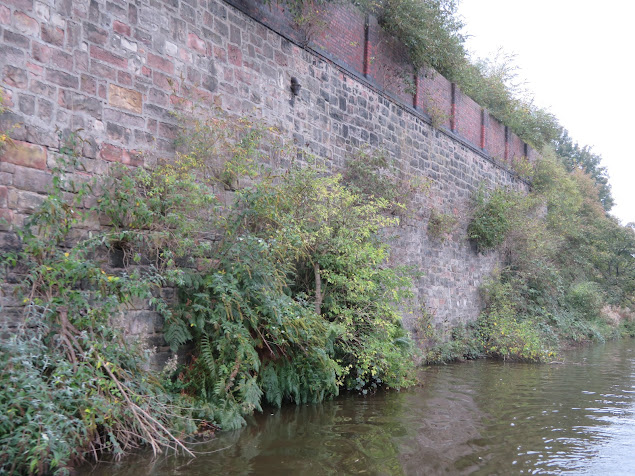
I think if there is a contender as a rival to the Great Wall of Todmorden it is here as we pass the old entrance of the Newcastle Canal alongside the A500. This part is the original stone part but there are modern bits with different bricks. In parts it is up to 15m high. It is a shame that it isn't made more off. Maybe it should have the shrubs etc cleared of anyway.

On the hill to the left was this distinctive building. It turns out that it oas a distinctive name too. It is the Our Lady of the Angels and St. Peter in Chains church, convent and school! It was started to be built in the hill in 1856 and finished the following year. It was also a Dominican nunnery and was built on the site of an old catholic church that had been built there in 1838. It is Grade II listed.

This used to be known as Cockshott Lock and as we approached the Stoke Locks we seemed to meet several boats coming down. They must have all come through the tunnel at the same time. It seems that this flight of locks is locked between 0800 and 1800 due to vandalism it seems.

As a mason's mark this seems to take the biscuit as it must have taken loads of time to cut to ensure that you got paid. I suppose that a simple triangle could be easier but is not so distinctive and this one could not be confused.
We soon popped out of the top lock at Etruria as two boats were approaching. We had to hold them up a little as we were turning into the Caldon Canal. We were soon out of the way and tied up for water. We dumped the rubbish that we had picked up as we came up the flight and then went to wind and moor up. We had a bite to eat and then we went for a walk to Wolstanton Retail Park as Helen thought it was time I got some trousers and as it is soon my birthday she can give me them. She also wanted to have a look at a jumper or two as well.

On the way we passed this quite hypnotic sculpture. It is called 'Privilege' and is supposed to identify Etruria's social and industrial identity, creative innovations and of renewal and growth. It was by Denis O'Conner.

I was impressed that the bollards even have the impressions of old hand tools on them.

The walk is alongside the Etruria dula carriageway and then crosses the roundabout with the A500 before ascending through woods to the housing and then down to the retail park. The area of the shops was once the Wolstanton Colliery. The first shaft was built in 1927, and in 1963 it was the first pit in the West Midlands to produce 1 million tons in the year. It suffered after the Coal Miners strike and actually closed in 1986. It was one of the mines in the area that piped the methane from the pits to the Etruria gas works. I think that methane is still being recovered from some of the old mines in the area.

I had been a good boy and even tried some trousers on. I ended up with three pairs. (Anything for a quiet life!). Helen got her jumper too, and a couple of Christmas presents too. On the way back we stopped at this place that we had spotted on the way there. It is the brewery tap of the Inadequate Brewery. I had a pint of stout from the Three Tuns Brewery that was absolutely gorgeous. I followed that with a pint from the brewery here, Peculiar Liquid Batch No.2. I'm not sure what was wrong with Batch No.1 but this was chock full of flavour and is styled a New England IPA and is supposed to be hazy. It is a place that is only about 15 mins walk from the locks so we will be visiting again. We could have stopped much longer, but moved along as it is Stickly night!
We got back and did a few jobs whilst tea was on and then settled own with our score cards for the evening.