Total Pageviews

Wednesday, 18 May 2016

Ekk we are at Evesham!

It started to rain in the early morning and it was still raining when we got up but by the time we were ready to get under way it had sorted it's self out into an occasional slight drizzle. Result. As we were about to pull away a day boat pulled away from the boat yard opposite so we knew we would have lots of help at the next lock at least.

The river after Bidford on Avon was quite pretty and despite the clouds we didn't get wet.

The sun was making the trees glisten with gold despite the dark clouds in the background.

The hire boat was going quite slowly as they got the hang of the boat etc so we were going slowly so as to share the lock. The bird song from the trees was fantastic. We actually only saw two boat moving (other than the day boat) so it was like having our own river.

The second lock we arrived at was the Robert Aickman Lock. As you can see it was built in 1982 as the original one built was not in a good spot. As you can also see it is the biggest on the river and can take three narrow boats easily. The folk on the day boat were the Birmingham and New York sections of a family and were having a great time and were pleased to have us to make sure they were 'doing it right'.

George Billington Lock was built following a donation from George Billington. The work was carried out in six weeks as he was terminally ill. The construction was completed about a week before he died so he lived to see his dream complete. The tower, lighthouse, was built by Eric Pritchard who was a navigator and craftsman who worked on the locks and weirs etc during the restoration.

This is Norton Corner, a sharp bend in the river. Cox's Bottom is on the left. A little further down the river you come to Dead Man's Ait. This is near the scene of the first Battle of Evesham. In 1265 the army of Simon de Montfort was cornered in the loop of the river. De Montfort led the Rebellion of the Barons against  Henry III and became the 'de facto' ruler. During this time he did call two parliaments and at the first did a way with the unlimited rule of the King and the second included ordinary citizens in it and for this he is regarded as the creator of our parliamentary democracy. How ever at the Battle of Evesham Henry III got his revenge by butchering De Montfort, his son and 5000 of his followers. In the 18th Century on the Ait a mass of bones were found as those trying to cross the river were caught and killed.

We soon arrived at Evesham lock despite a rather heavy shower. After the biggest lock this must be the smallest, at least so far.

Soon after the lock we were passing under Workman Bridge and we decided to stop alongside Workman Gardens on the left.

The bridge and gardens are named afdter hnery Workman who was Mayor of Evesham five times. The gardens were the site of warehouses and river wharves. The wooden carving and steel arch are to commemorate an arch formed of a bow heade whales jaw boane that was sent back from a whaling trip on the 'Andrew Marvel' from Hull to the Davis Strait where they caught 6 whales. The actual jaw bones became unsafe so were replaced by the metal arch. There is an outline in the grass of the actual size of the bow headed whale. 

Our mooring from Workman Bridge.

The Nat West Bank was a nice building. The sculptur by Helen is  a tribute to Eof the pig hearder who had so pigs disappear into a thicket and when he went in to recover them he had a vision of the Virgin Mary. he went and told the Bishop of Worcester who came to Evesham and investigated where upon he had the same vision. He then went to Ethelred the King of Mercia and an Abbey was started her in 701. The name Evesham derives from Eof and Hamm which meant the land in the bend of a river.


The Abbey grew to be very large but was lost, almost at the time of the Reformation of Henry VIII. This was the Almonary and is now the Tourist Information and a small museum. It was closed today but we will go back tomorrow.

In the grounds of the old Abbey is St Laurence's Church in the middle, All Saints on the left and the Bell Tower of the old Abbey behind. The Bell Tower has 14 bells and a carillon that plays a tune after every hour. There are two churches and they were built within 100 years of each other. Why you may ask?! The reason is that St Laurenc's was built first as the parish church for the original Evesham that was to the south. With nthe construction of the Abbey etc the town developed to the north and the parish was split into two and a second parish church was needed. Where better than on the high ground near the Abbey, hence why all the churches are all together.

The avenue of trees took us back to the boat through Workman Gardens after a pint at the Weatherspoon's in town, the Swane Inn.

Tuesday, 17 May 2016

Bridge dodging.

The sun was shining as we got under way ans straight into the lock, Weir Brake, Gordon Gray or Anonymous Lock, take your pick. A wide beam had gone down the lock about an hour earlier so we had to turn it round.

The Upper Avon is quite intimate and the banks aren't all as high as above. There are places that you would have to be careful if passing another boat, especially a wide beam. We stopped for water and dump the rubbish etc at Luddington Lock as two boat shared the lock travelling up stream.

Here we are at Binton Bridges. The river splits into several channels but only one is deep enough for navigation and it was best to follow the arrows!

There was plenty of room on this bridge in the end. It doesn't look so good from a distance though. It is actually 12'9" wide.

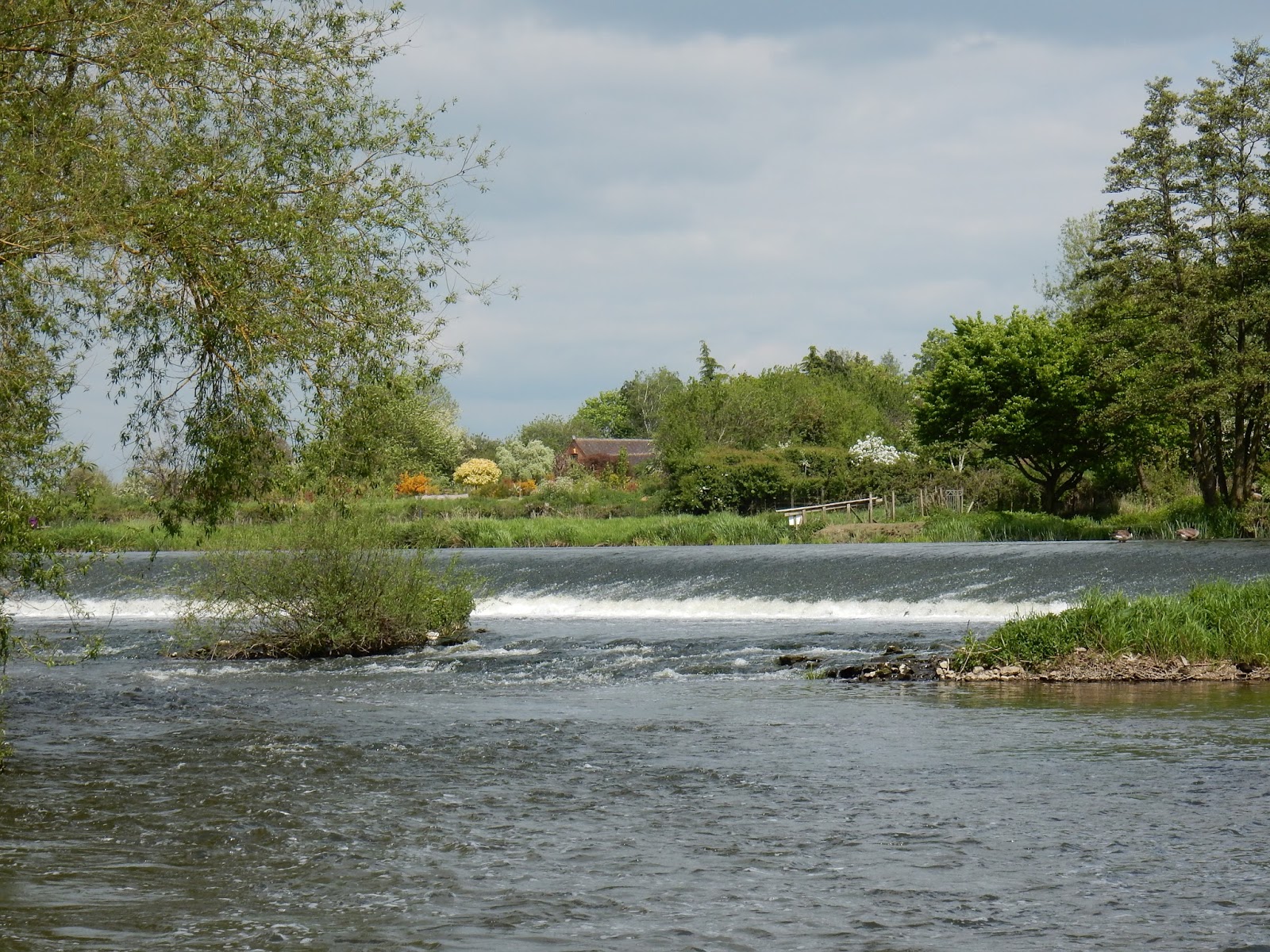
This is the weir at Welford, or W.A. Cadbury Lock.

Helen enjoying the sunshine at Bidford Grange or Pilgrim Lock

St Lawrence's Church at Bidford on Avon from the river.

The Bidford on Avon Bridge is Grade 1 listed and dates from the early 15th Century but has been rebuilt several times. In the 16th Century stone from Alcester Priory was used. In 1644 the bridge was demolished by Charles 1st troops to cover his retreat from Worcester to Oxford. On the approach you can see how it looks much narrower than it actually is. The river is very shallow to the right of the arch and also by the bank so you have to line up carefully.

Apparently this arch is 12'9" like the previous bridge but it still doesn't look like it.

Here you can see why you can only use the one arch. In actual fact later a narrow boat had tried to get on the moorings that you can see through the arch in the photo above. On the diagonal from there to the arch is very shallow. Less than 1' and they went aground. It took them the best part of an hour to get them off and included getting a rope ashore and pulling their bow round.

There was just enough room for us, the last spot, on the Trust moorings at Bidford on Avon. After a bite of lunch we did a few jobs including potting up the for'd tub with some petunias and fitting the new solar fan motor. After that we went for a walk over the bridge in to the town. The bridge is wider than a pack horse bridge but is only one car wide and with cut ins for pedestrians to get out of the way. Obviously the bridge is regulated by traffic lights. We went for a beer at the Frog which was okay but we didn't stop for a second as chicken pie was calling.

Monday, 16 May 2016

Back home.

I had a few errands to run in town so was out the house by 0830 and into Hull for the train in good time.
The statue of Philip Larkin is linked to his poem where he was 'running late last Whitsun'. I wish they had found a poem when he was arriving in Hull and not leaving the city!

The route back was the reverse of the other journey. I think Cross Country Trains must make a good profit as they always seem to be full with seats at a premium. I don't understand anybody not booking a seat if they can as otherwise it can be like musical chairs. I arrived at Birmingham New Street and managed a picture of the mirrored front of the station and the 'magic eye' screen to the left.

A 10 min walk took me to Moor Street Station and I had a little time to look at some of the research that I did yesterday. Here we can see the site of the goods depot part of which is now below the iconic Selfridge's building.

As I was waiting for a through train from Stourbidge to Stratford upon Avon I was on Platform 1, that along with 2, are the tracks coming through the Snow Hill Tunnel. In the distance is another iconic building, the Rotunda.

Everything went as planned and I was soon been greeted by Helen waiting at the station. We walked back to the boat through town and stopped at the chemist and also for milk. We then had a cup of tea and toyed with the idea of leaving.

Our minds were made up as the trip boat was just coming up the lock. There mooring would make it very difficult for us to get out and head to the lock. We therefore left straightaway and lingered out of his way when they came out before and we took their place. There were plenty of watchers so it was just as well all went well.

The rule is on the Avon that you drop the paddles of the exit gates but leave the gates open so Helen was able to get back aboard in the lock. The swans are greedy for bread that the many visitors are ready to give them. I wouldn't like to be eating sandwiches near to where they are as they may well be like the worst seagulls.

The show is over and the watchers start to disperse.

We didn't go far, just past the RSC and stopped to take on water.

It isn't very far to the first lock on the river but we had a bit of a wait as all the trip boats seemed to arrive at the same time. None of them went through the lock, just turned round by the weir. The one one the left went into the lock and then reversed out to turn, and then we could go in.

We finally managed to get into the lock. It is made a little difficult to use different guides as each lock seems to have two names, sometimes in the same guide as in the one published by the Avon Navigation Trust. This is jointly known as the Colin P. Witter after a generous benefactor,or Stratford Trinity Lock after the near by church where Shakespeare is buried.

We didn't go very far as we settled for the night just above the next lock Weir Brake Lock (or Gordon Gray Lock also Anonymous lock!). Our moorings are the first ones you can see as we should get some evening sun and in the morning. The current is very lethargic at the moment. There is heavy rain forecast on Wednesday so lets hope nothing untoward occurs.


I like local. (Not the pub this time).

The day turned out to be nice and sunny here in Hedon, East Riding of Yorkshire, but still definitely cooling off. One reason I cam home was to run my history walks around the town. Hedon was the 11th largest port in England in 1205, and believe it or not quite a lot has happened since then too. However, in common with most places in the country, outside of the obvious tourists spots, visitors and locals alike are largely unaware of the large part of the history that has made the place what it is today, and in no small way helped shaped the landscape and character of the town too. It is one reason that I enjoy the canals as they have history that can be actually seen and studied as a lot is still to be found on your voyages. However this Sunday not too many wanted to join me. On the two walks nobody came to the first and one person to the second. That was fun though as we had a leisurely stroll round in the sun, taking 45 mins longer than normal, and with me learning almost as much as he did......I hope.

Hedon is in the centre of the map, naturally. 

There were some good omens on the sporting front for the area today as North Ferriby a small village to the west of Hull and the place where several Bronze age boats were found on the foreshore of the Humber, gained promotion to the 5th tier of football, just outside the Football League. 

A 2003 reproduction of what the Ferriby Boats looked like.

At Wembley today Grimsby Town, not a town that we would normally use as a bellweather for anything north of the Humber, were also promoted back to the Football League by beating Forest Green 3-1. This added to the fact that in the Football Championship Semi-Final Derby played Hull at Pride Park and Hull won 3-0. All this adds up to the planets being aligned for Hull to win the second leg on Tuesday. We will find out whether it is to be Sheffield Wednesday or Brighton to play us in the final and make the leap back to the Premier League and take the £173 million prize. It just has to be us as it is our year next year. Hull UK City of Culture 2017. Book early as places are going quickly!

Saturday, 14 May 2016

It's gone.

I had to leave Helen today to dash back home to carry out some business. Once again I had a seamless journey by train and in fact managed to get home 30 mins earlier than planned.
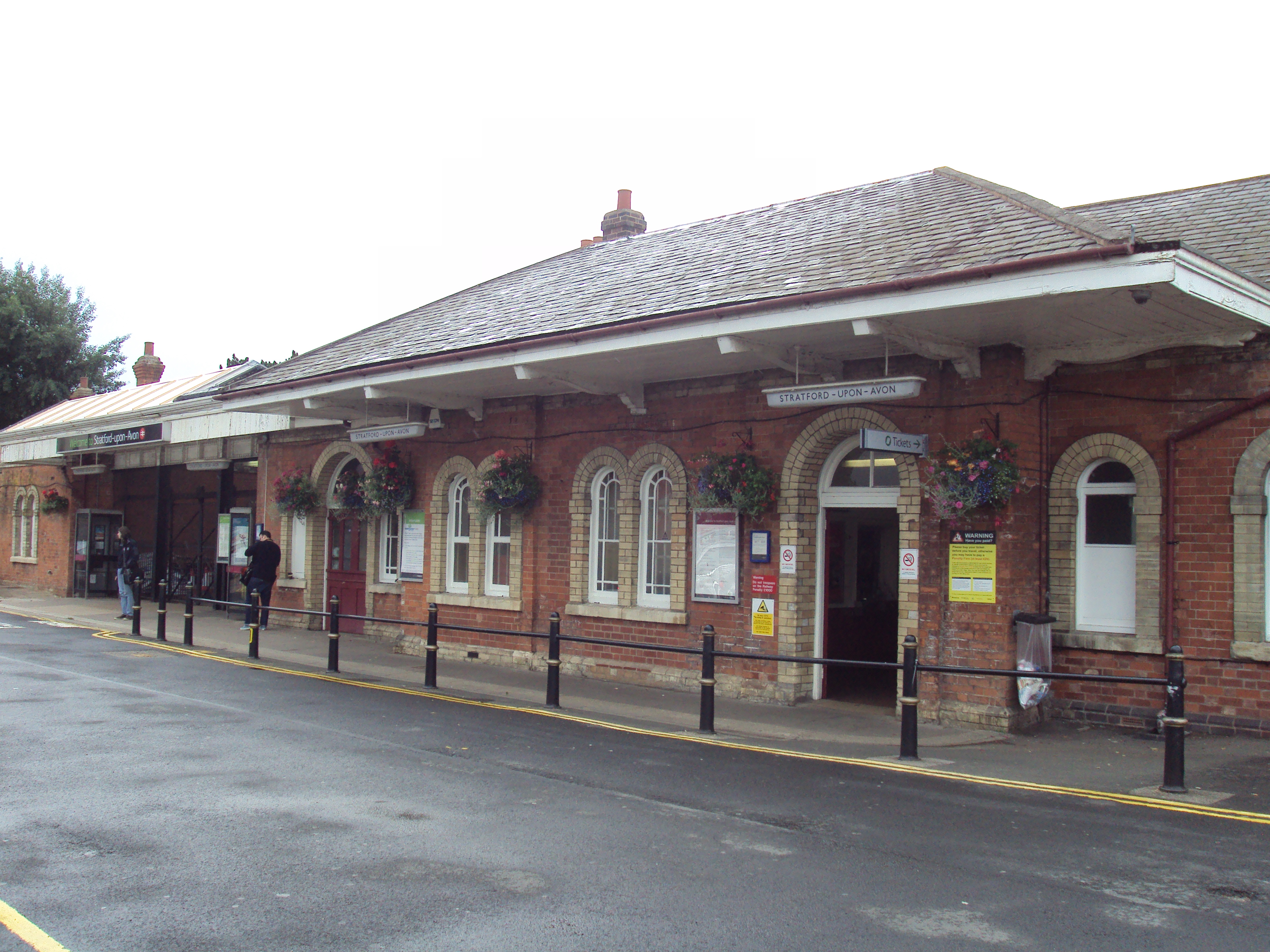
Helen already had a list of shops she was going to 'visit' but on the walk to the station we passed the market so that will occupy here for a while. I'm sure that she wont even miss me. Stratford upon Avon station was built in 1861. The first line to pass through went from Cheltenham to Birmingham but the line towards Cheltenham was closed to passengers from 1969 and for freight from 1976. You can also get to London via Leamington and Warwick. There was a Stratford Old Town Station but this closed in 1952. In 2013 a new station was opened just outside the town called Stratford Parkway. It was built to reduce congestion as folk from out of town no longer needed to get into town. Traffic has increased on the railway. Some of the trains have several request stops on the route into Birmingham.

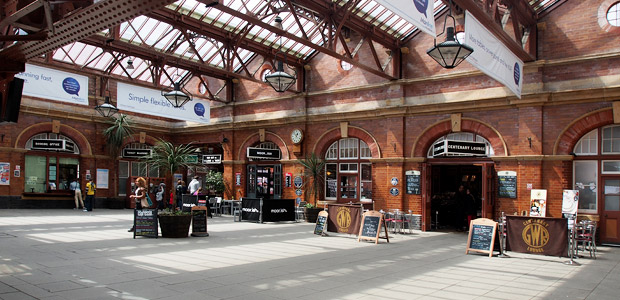
I had never used Birmingham Moor Street station when I lived in the area as it was closed. It's history is quite interesting, (well I find it so anyway). The Great Western Railways terminus in Birmingham was Snow Hill. This made use of the double track Snow Hill tunnel which passes under the city centre. Snow Hill became too busy for the traffic through the ntunnel and it was felt the expense of widening the tunnel too much. They therefore built Moor Street at the other end of the tunnel. There were no trains stopping before going through to Snow Hill so it was a terminus. As it was the last station to be built in the City it was hemmed in on all sides so they installed a transverser that shunted the engines side ways on to the next track rather than running up a length of track to some points.  The station opened in 1909 and the permanent buildings opened in 1914. There was also a goodsstation built on the site. It also had transversers and wagon lifts to lower wagons down to the lower level to go direct to the markets at the Bull Ring. The Goods Station closed in 1972 and is now under part of the Bull Ring Centre. The passenger side closed in 1967 with the trains running to New Street. Snow Hill was also closed as was the tunnel.  1978 saw Moor Street platforms open for local trains. Traffic increased in the 80's and the tunnel and Snow Hill station were reopened with new platforms being opened on the through line at Moor Street. This left the old Edwardian terminus redundant. Local activists saved it though which was just as well as by the 1990's traffic had increased once again and the terminus was opened again and services to London mean't that for the first time in it's history it was a main line station. It certainly has a very different feel about it and was well worth saving.

Birmingham New Street is called New Street but it doesn't actually have an entrance from New Street. It is the eighth busiest in the UK, the largest outside London with 35.3 million. It is also the busiest interchange station outside London with 5.4 million changes every year. The upstairs has now been opened and it certainly is more like an airport terminal than a station now, but is definitely much more light and airy than previously. The same can't be said for the underground platforms as they are dark and claustrophobic. There does seem to be some work going on bu they will have to work miracles to make it much better.

We got to Doncaster a little early which enable me to jump on a train half and hour earlier than planned This then allowed me to get an earlier bus once back in Hull so I was nice and early to start the task of working through the post and weeding out the ones that mattered. Not long to do all that is required and then back to the boat. Oh I did get time to find my razor charger and the get sufficient power into it to shave my beard off. It's gone, so very sorry ladies. A photo maybe tomorrow.

Friday, 13 May 2016

Back to civilisation.

We decided to set of about an hour earlier than normal. I wish we hadn't as we ended up behind a hire boat and a single handed bloke. After the first lock the list was added to by a small boat that had spent the night in the pound and pulled out between us. It was a good job that the weather was good for locking.

Starting down the locks after Wilmcote.

There is a couple of flights with the locks close enough together to be able to set the locks ahead so I was able to assist by closing gates and filling locks so everything did keep going okay.

I quite enjoyed watching this moorhen who seemed to be enjoying the paddle in the by-wash.

Helen dressed for the cold, but she had taken her gloves off. Shortly after this the sun did come out but I'm not sure any layers came off.

It was a bit of a culture shock as we got to lock 51 and the suburbs of Stratford upon Avon. There was even more of a shock when coming out from under bridge 69 and into Bancroft Basin.

Luckily the trip boat had just winded so there was nothing moving.Helen had spied a couple of berths on the pontoons but it woluld be interesting slotting in to the position as we need to be stern to.

I managed to get the bow round so that the angle allowed me to get the stern clear of the FMC long boat and still have the bow clear of the trip boat. Then astern nicely into the slot and safely moored. The wind helped nicely.

 After a bite to eat we had to find and find some food as the cupboards were bare. We walked up to Aldi's as Helen wanted the backing stuff from there, plus loads of other bargains. After dragging all that back to the boat we had to find a bank and so left for a look around the town. We found the very impressive HSBC Bank and filled the coffers again.

We then wandered round to get our bearings and passed this hotel, some of which is original and old.

This is the Grammar school and Guild Hall.


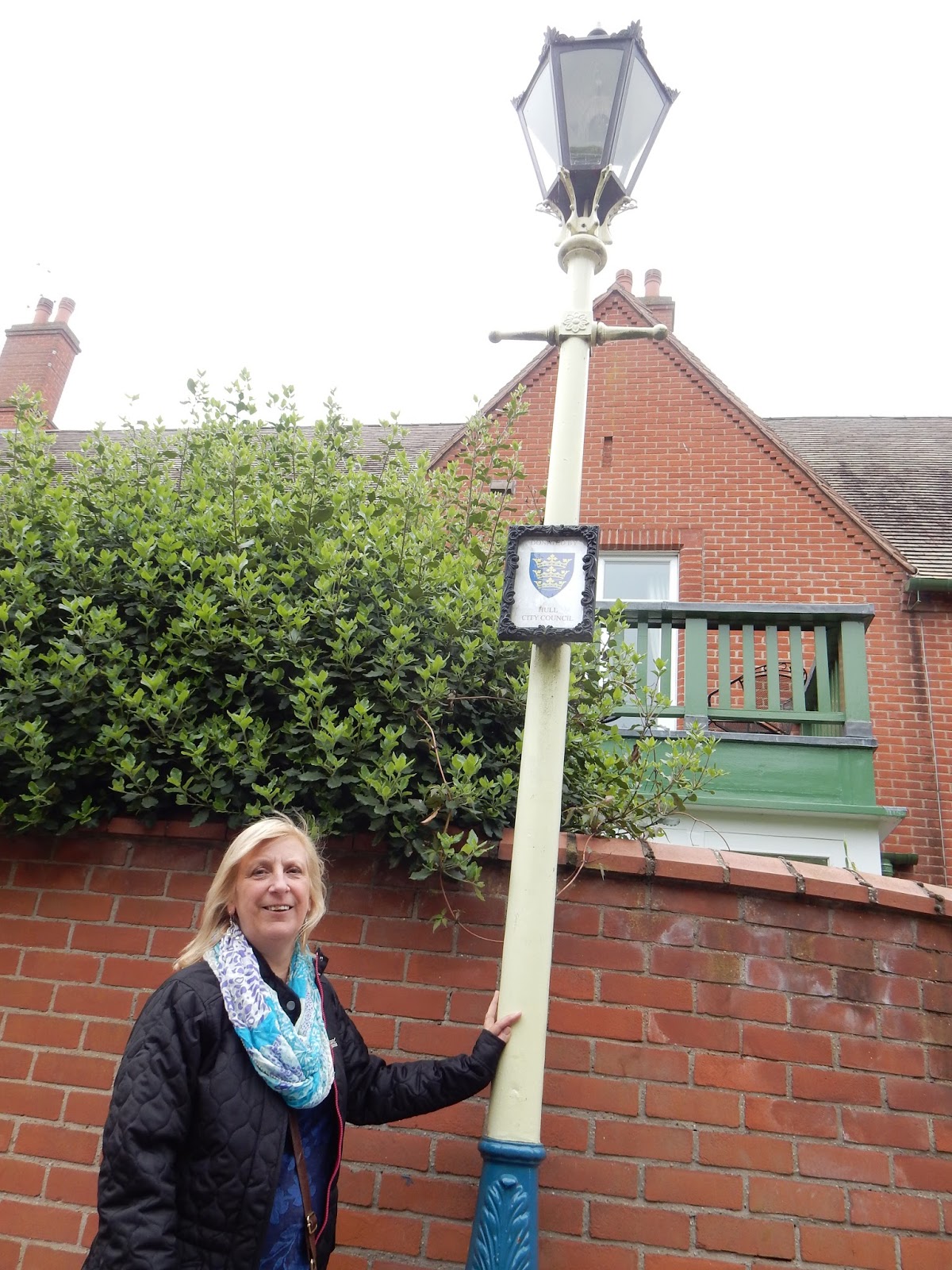
Down Southern Lane by the river and past the theatre every lamp post has been presented by a city in England. After pointing this out to Helen she looked ahead and said the next one was from Hull. And lo and behold it was!! She said that she recognised it but I think the colours had a lot to do with it.

Here is the RSC Theatre that looks a bit of a hotch potch of a building. I looks like a cross between a church, hospital and a government building!

After this Helen took pity and led me to the Golden Bee, a Weatherspoon's pub, for a pint before going off and spending £20 to save £4 at the Sainsbury's. I think I may talk her into going out for a look round a couple of other pubs in town later.


Thursday, 12 May 2016

Jobs done.

The sun was due to shine today so we decided to have a day off and stay where we were. Well I say a day off but I took the opportunity to do a few jobs, but slowly!

First off I have tempted fate by cleaning the stove and chimney. In doing so I found yet another use for WD40! It cleaned the glass beautifully and much easier than Methalyted spirits does, and with no rubbing. I then went to the hedgerow and found a hawthorn branch that had a good number of branches etc and cut it to the right length. As it is spring it is nice and springy and the thorns on the twigs are nice and sharp. I squeezed this down the chimney and pulled it up and down. I made sure that the stove door and vents were shut too by the way. There was not much soot, but plenty of rust! The glass is nice and clean. The fire rope still looks in good condition and there are no smoke leaks so It will do for now.

The outlet on the roof is 7" which is a little rare and I have hand made a cement bung to fit it. It now needs another coat of paint.

The stove had a few rust spots so I sanded these down and then gave the whole stove a good coat of Zebrite and a buff up. The lamp came out of a skip and just takes tea lights.

I found where the all the soot had gone as it was baked on to the chimney itself. In fact at the bottom of the chimney was very thick tar. Fortunately this came off quite easily with an old screwdriver and the rest also was quickly shifted. I have put the chimney away and inserted the bung knowing that it is due to cool off at the weekend but I have my fingers crossed that it wont be bad enough to need to lit the fire again. We have one scuttle of coal and a box of logs left though just in case.

Next winter we will be having a new stove pipe fitted and a new section on the roof too. This time it will be a double skinned pipe and the connection will be done correctly so that any dripping tar drips back down to the stove rather than leaking out on to the roof. As we are having a re-paint that would be a disaster. We are also going down to the more normal 6" chimney which may make the stove more controllable and hopefully more economic too.

My other job was to re stick the magnetic strip that secure my double glazing to the window frames to the neoprene strip that fills the gap at the top. I had bought some special glue for this but as I had used some glue to stick some acrylic sheet in the bathroom I decided to try that on the double glazing too. I left it to dry as long as I could and cleaned the windows of the boat and later in the afternoon the double glazing panels too. I had earlier trimmed the sides of the acrylic sheet as when the boat got warm and expanded the sheets jammed between the frames and bowed out so pulling the glue apart. We will have to see what happens with this latest modification. Helen does say that of all the things I have done to the boat these are the best as there is no need to mop up condensation every morning. They can be left in place as the top hopper is still available for use and it certainly does keep the boat warmer.

Helen set too first thing going through the boat cleaning the lot. It the end of that she was done in and took the rest of the day off. As the sun was shining she picked the bow as it was out of the wind and settled down with a book. At least I knew where she was all the time.

I haven't mafe up my mind weather it was Helen on the st'bd side causing the list or that we are aground a little. There has been a steady number of boats passing today in I here many of them slow as the thread through the narrow bridge hole astern and then speed up. They may then drop their revs again, but not usually until their bow is level with our stern. I think you should slow down to tick over about two or three boat lengths away so that the speed drops by the time you approach the moored boat. This means there is more time for water to flow into the displacement of the boat so reducing the suction and surge interaction. Really you could go back to cruising revs as you get to the moored vessel as by the time you are clear the speed still hasn't increased to that set by the revs. When you are in the boat though the passing boats always look to be going faster than they do if you are outside in my experience.