Total Pageviews

Wednesday, 11 May 2016

Moving onwards.

We set off when there was no rain and actually we didn't really get wet all the way to our mooring. We passed over the aqueduct again as a sort of warm up act for later.

We only had one lock to do today and it is known as 'Odd Lock' as it is one on it's own. I think it's proper name is Bearley Lock.


We soon arrived at the Edstone or Bearley Aqueduct. It isn't quite the Pontcysyllte Aqueduct but to come across it here was quite a sight. It looks much higher than the stated 28 feet high. Like the Welsh canal in the sky there is nothing, almost nothing, between us and the drop on one side.
The aqueduct takes the canal over the old Birmingham and North Warwickshire Railway, that is the double track in the above photo. The tarmacked track is the old Alcester Railway. There is a road and a stream too.

The aqueduct, at 145m, is the longest in England and like the other two much smaller ones on the canal already crossed the tow path is on the same level as the bottom of the canal.

The trough is supported on thirteen brick piers and as the canal and railway was at one time was owned by the Great Western Railway. They fitted a valve to the bottom of the canal so that they could fill their engines with water on the track below.

After we moored up and had lunch we set off to walk into Wilmcote. Here we came across a dastardly plot to put young Kiwis out of work and reduce the immigration of Antipodeans into the country. Self shearing sheep!! It seems that the value of the fleeces of sheep is now less than the cost of shearing in many cases. By crossing UK breeds with tropical sheep that naturally shed their fleeces they have produced a new breed called Exlana (Latin for used to have wool). Not only does it save shearing costs but the lack of a big fleeces also means they are more resistant to parasites so minimise costs of medical and chemical interventions. 

After a little bit of shopping we called at the small church of St. Andrews in the village. We got quite a surprise when we got there. It was built in 1841. It was needed as the village had no church but the population was growing due to the opening of nearby quarries. It was built by members of the Oxford Movement that was a Catholic revival movement within the Church of England. It was designed by William Butterfield and was paid for by  Rev. Francis Fortescue-Kottesford and his son became the first Curate.

A later priest painted wall paintings on to zinc panels and they give the interior a dark and spiritual feeling.

The church is very high church and must be as close to a Catholic Church as you can get whilst still being a C of E. There are many incense burners above the alter so it would be a very unusual church to visit if you were expect a 'normal' C of E service.


On the way back to the canal to walk up the tow path back to the boat we passed Mary Arden's Farmhouse. This is where Shakespeare's mother was born and lived before marrying his father and moving to Startford. There seemed to be a lot going on with lots of school kids and visitors being shown around a period working farm by folk min period costume.

Helen has baked bread and so we are going to scoff that for tea and she has also replanted our daffodils in a likely place on the tow apth so we are now looking for something to plant in their place.

Tuesday, 10 May 2016

A wet wander.

It has rained just about continuously from about 2000 last night. Today though it has mainly just been light drizzly rain and with little wind. This morning we shared the ironing (sorry Heather) and then after lunch went for a walk round the local countryside.

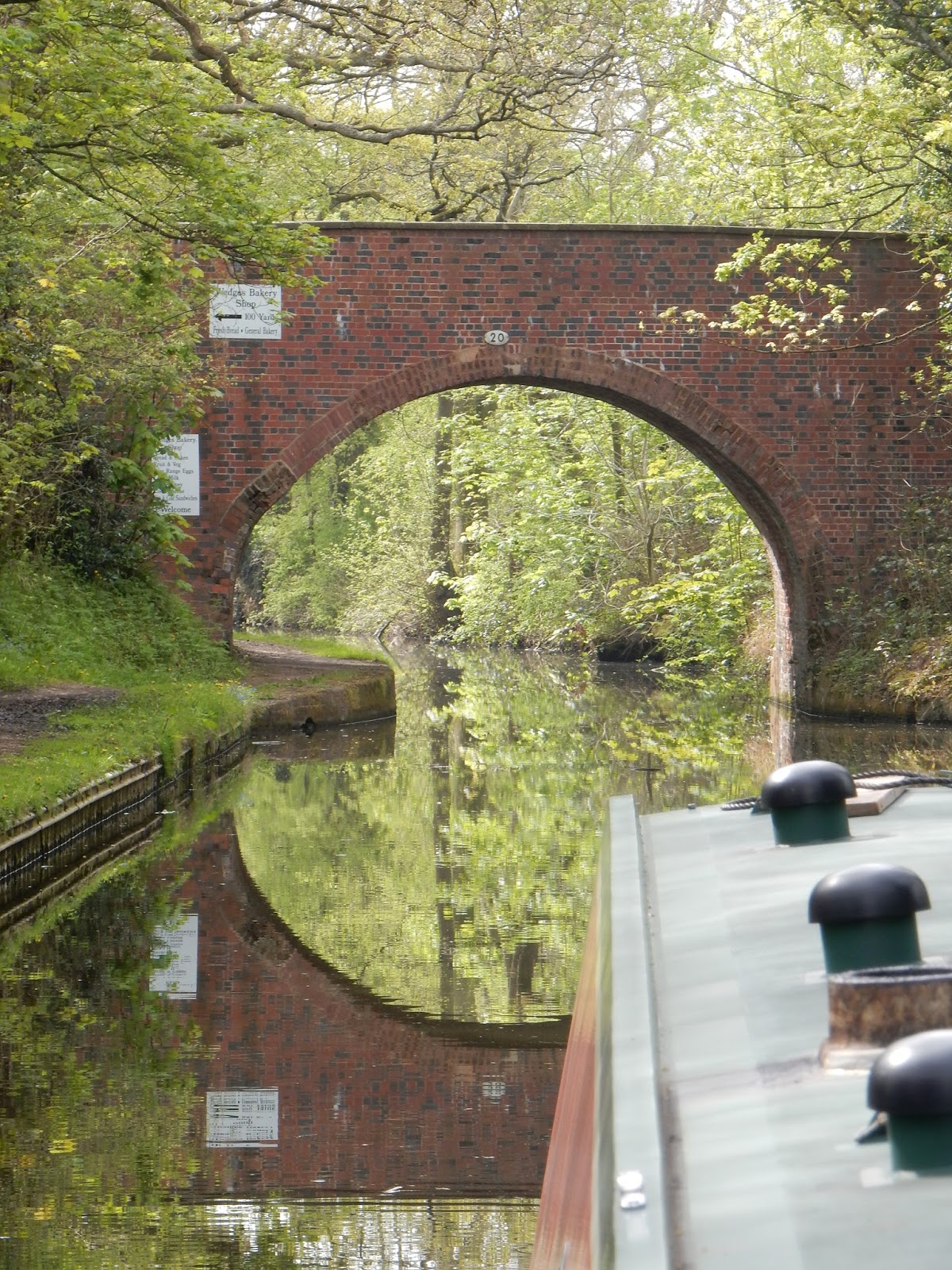
It was only when we walking back up the tow path it dawned on my why the Stratford had the synonymous split bridges. Obviously from the photo above they didn't provide a tow path through bridge holes, so rather than unhitch  the animal at each bridge they could give slack and pass it through the gap. I think the boat crews would have preferred to just walk the animal through so it must have been cheaper to build like this.

After leaving the tow path we set off past a hill that actually had an Iron Age fort among the woods. It has a double bank and ditch fortification and was called Ashborough and was maybe a home for a chief of the Dobunni Tribe.

A nice green lane to walk on. Not all the footpaths today were quite as well made as this.

This very nice barn conversion is in the hamlet of Kington which, means farm or estate of the King so maybe this was the lands of a King in pre-Saxon times.

One for the family album. No not ours, silly.

Despite the low cloud and drizzle the rolling countryside of South Warwickshire was looking at it's best with the leaves bursting forth and the bluebells hanging on. It wont be long until the hedgerows are full of May blosoom.

We walked through Austy Wood whose old name was Horstow which means 'hallowed place' so was probably a site that was used to Druids. When the area was converted to Christianity the priest erected a cross near her where they worshiped before setting to and building the first church at Wootton Wawen.

As we approached the canal near the aqueduct this stand of trees made a stark outline on the grey sky. I couldn't tell what trees they had been but they reminds me of paintings by David Hockney.

The Wootton Wawen aqueduct and the Anglo Welsh base.

We made a detour to Yew Tree Farm Craft centre here to take advantage of the tea rooms there and for Helen to have a gander around the shops there. On Bank Holiday weekend there had been an organised route through the bluebells in Austy Woods. They had raised over £35000 so there must have been plenty there. It rained on the Monday and they had to call seven ambulances for broken legs and ankles etc as folk came in flip flops and pumps to walk around the woodland moody paths. It was all for a good cause. We were at the Black Country Museum and there were families there with just T shirts and sandals on. They either don't ever hear a weather forecast, have only lived here for a short time and haven't learned that it always rains on Bank Holidays, or shouldn't be allowed out with out supervision. There is 'naught so strange as folk'!

Monday, 9 May 2016

An easy day.

We woke up to the lovely smell of wild garlic on the air. The wood next to our mooring was full of the stuff,along with some bluebells.

There were carpets of ramsoms spreading the aroma. The little star like flowers are pretty too.

Just as we were getting ready to let go a boat was seen coming down the lock behind so we waited for them to pass and get a little further along before setting off. As we did there was another boat starting down the lock so we would be in a queue. The countryside was beautiful so it wasn't a chore to pootle along. The boat ahead had four aboard so once they realised that we were behind them they cracked on and we didn't really meet up with them again. The boat behind were a couple of Australians on a Kate Boat hiring for a week. After the first lock we were just leaving when they arrived.

Yaringale Aqueduct was built between 1812 and 1816 and was originally made of wood. In 1834 it washed away when a burst on the nearby Grand Union Canal flooded the stream below the aqueduct. The canal was only closed for a month and the wooden one was replaced with a cast iron trough. It looks like it was from stock as it doesn't actually fit the space. The tow path is below the level of the canal. We carried on for six locks and found a mooring close to Wootton Wawen.

After lunch we set off to explore the village. Our first stop was the church of St. Peters. It is the oldest church in Warwickshire and was founded as a Minster named St. Mary's about 900.  In about 1150 the church was re-dedicated to St. Peter in Chains. It is a hotch potch of different periods with some Anglo Saxon and some Norman and other bits. The lady chapel is a barn like thing and currently houses an exhibition of the history of the church and village. The canopied altar tomb above belongs to Francis Smith 1522 to 1605. He had been the Lord of the Manor but was a Catholic even after the Reformation. However he asked to be buried in the church on the site of his family pew.

This chest alabaster tomb has the effigy of a knight John Harwell who died in 1428. His head rests on his helmet and his feet on a spaniel.

The tiled part is the lady chapel of St. Peter's.

We decided to have a walk round the fields down by the River Alne. There are loads of horses there and I can't believe that there are that many young girls to ride them regularly. As it was the flood plain it would have been very muddy but it has been dry for a good while now. That is set to change overnight as rain is forecast. As we passed through the village it would have been rude not to stop for a pint.
At the church we were talking to a lady who sounded just like Susan Carter who runs the Ambridge village Post Office in the Archers. When we got to the pub it was called the Bull. The Archers are based on the land in this area I think so we may be warm!

On the road side of the Wootton Wawen aqueduct has this plaque on it. Actually this is a replica. The original is supposed to be on the tow path nearby.

As you can see this aqueduct is very similar to the on at Yarningale with a cast iron trough and a sunken tow path

This is the view from the road below looking for up towards the Navigation pub and the entrance to Anglo Welsh's base on the left.

We may stay put here tomorrow and see the rest of the sites of the place. And I am going to find out how to pronounce Wawen in Wootton Wawen. Named after a bloke called Wagen who was the last Thane of Wootton before the Norman Conquest.

Sunday, 8 May 2016

Locking in the sun.

We were at the top lock at 1000. One boat had come up so the locks were mainly our way but the bottom gates were leaking so we had to fill most of them up.

Our second lock was very photogenic with a nice cottage and a split bridge. There is even a roller on the top of the bridge for the tow rope of old.

This is the easy bit. All the locks nice and close so we could zip down these 7 locks at Lapworth

We stopped at Lock 19 and filled up with water and whilst we were filling up I went to find a post box and a Sunday paper and did both before we had finished the water. We had put the washer on as the weather was so good for drying. Here we are just below Lock 19 and at the junction with the Grand Union. There is one lock between the two.

Here is the second link to the Grand Union and this one doesn't need a lock to link up. We also have the barrel roofed lock keepers cottage that are found on the Stratford Canal. I had gone on to the next lock to get it ready. Kindly a couple of C&RT blokes opened the gates for Helen and shut the paddle saving me the walk back to the lock.

Helen passing the barrel roofed lock cottage at the junction. I had missed the rubbish disposal at the offices so had to walk back to dump the garbage. Most of the rubbish points now have a bin for dry recyclables. It is good to be able to separate the rubbish but I see that many are not doing it and chucking all in the non recyclable bin. They are not that well marked so you have to be careful. 

A lovely rural scene with the split bridge and barrel roof of the cottage but the M40 is just round the corner.

Looking the other way.

I'd love to know what the weight limits would have been for the split bridge.

By now I was feeling a bit tired but not too far to go now.

We had been hoping to moor after Lock 31 where we had taken water again as we had done two loads of washing. The water points on the Stratford seem to be badly spaced as like buses two come along at once and then there aren't any for ages. We found that it was permit mooring all the way to the next lock so we had to keep going. Here we have the Antony Gormaly statue at lock 31. It was placed here as part of the celebrations of the Landmark Trusts 50th Anniversary in May 2015. It is to be removed soon and nthe celebrations prior to this take place next Sunday, so if you want to see it in position go now.

We moored not far down from the lock and after lunch and a read of the paper we set off back up the towpath to the Fleur De Lys pub that was doing roaring trade. The first didn't touch the sides but it was a nice stretch of the legs. All in all a great day and loads of people up and down the tow path. I can take it easy for a few days now before there are loads of locks in a day.

Saturday, 7 May 2016

A (an) history hit.

We were going to walk to Packwood Hall today so there was even less rush this morning than normal. It is about a 15 min walk from our mooring and on a lovely morning like today it was a pleasure despite the traffic on the road.

The first view of the House.

The house didn't open until 1100 but we spent the time in the kitchen garden. The house was built for a yeoman farmer called Fetherston between 1556 and 1560. He had pretensions and wanted to upwardly mobile. Eventually his sons became a lawyer and a doctor and they became more like gentlemen farmers playing at the farming bit. The acquired upwards of 700 acres of land around the house too. The property stayed in the family for over three hundred years.

On of the big features of the garden is the Yew Garden. This was started by taking over some of an orchard in the mid 17th Century. It now consists of 100 trees and some say it represents the Sermon on the mount. This is because there are small trees on the slopes of a mound with 12 great trees higher representing the apostles and 4 representing the evangelists. It the summit of the mound is one large tree. This is looking back at the house from the 'multitude' on the slopes.

Here you can see the mix of large yew trees and box hedges.

The grounds have lovely gardens and woodland walks and the bluebell walk was still looking great.

One of several 'art installations' in the woods.

Looking back at the house from the far side of the lake.

The Fetherston family fell on hard times and after renting and then selling the house lay empty for a few years before an industrialist from Birmingham, Alfred Ash, who had made is money out of galvanising bought it in 1904. He died in 1925 and the house etc was left to his son Graham Baron Ash and a daughter Beryl. Graham lost no time in selling the business interests and investing in the stock market. He then set about transforming the house back to a 16th/17th Century manor house. He was able to do this as at the time many of the landed families of the country were in difficulties and house were being closed and demolished so he was able to buy original items for his conversion. Graham (Baron was just a middle name) never married and was a precise and fastidious man who liked everything to be tidy and just so, and that is how he wanted the house to be. He did have visitors but only so long as they didn't overstay! Above you can see the converted cow barn that was finished just in time for the visit of Queen Mary in 1927. It wasn't connected to the house at the hat time. He later had the long gallery added to join the two up. The oriel window is named after Queen Mary. He sold his stocks at just the right time before WWII. By 1941 he had finished his project and persuaded the nascent National Trust to take over the house and grounds and a lump sum of £35000. He added 42 conditions to the gift, things like there must be fresh flowers in the rooms, the furniture couldn't be moved, the land couldn't be built on etc etc. He wanted it not to be as it was but how he wanted it to be seen. He lived there still until 1947 when he moved into Wingfield Castle in Norfolk where he started the process of restoration again. He had leased the castle for two years to get it habitable and taken a bathroom and the kitchen from Packwood. He died in 1980 at the castle and he still had over £800000 so not only was he a restorer and conservationist but seemed to have a good eye for investment.

The beard will have to go when I get home to get the charger cable. We had a walk round some more of the grounds and then headed back to the boat. The air seemed to be cooling off and there were black clouds looming. Thunder and lightening had been forecast along with torrential showers so we were hoping to escape them. As it happens, to press, there hasn't been a drop of rain falling. It has been a nice relaxing day and worth the stop. There is another National Trust property within easy reach of Kingswood Junction, Baddesley Clinton, but I think we have had our fix and besides it doesn't open at the beginning of the week so we would miss it.

Friday, 6 May 2016

Warming weather.

Well this is more like it! How long do you think it will be that you were the first person saying it is too hot, or close or something. We are never happy with our weather really. I love the variety myself and would be pretty fed up if there was set season and it was too hot/cold, wet or dry etc for a long period and then just swapped with another excess. Give me British weather any time.

We heard our first definite cuckoo this morning. I may have heard one at the Kingsbury Water Park the other side of Birmingham but it was a long way off and could have been a wood pigeon.

Another heron picture. This one is under a bridge and it didn't want to move. When it did move it did fly astern of us rather than the usual of flying ahead, settling and then having to fly off again when we arrived again.

We didn't see many boats moving today. The canal seems to be quite shallow and mainly in shallow cuttings with trees that cut of much of the views. However in the daplled sunshine it was a very pleasant trip to Hockley Heath. We moored up to make a visit to find a post box and to do a little shopping to see us out the next few days.

Once loaded up we set off again to the top of the Lapworth Locks. The little arm with the Wharf Tavern was built as a a coal wharf.

Helen had to put in a little more effort than her first bridge as she had to wind a handle! It was soon up and down with no traffic held up as no walkers were passing.

This mum only had one duckling. I wondered whether that was the reason she had it sitting on a plank and didn't budge even as we passed. Maybe the pike are active on this stretch of canal.

We arrived at lock No.2 and the start of the flight down towards Kingswood Junction. It is numbered No.2 as the stop lock at Kings Norton is numbered No.1. The paddle gear seems to be a little stiff, but it maybe that I have to toughen up a bit.

The gorse is still, out and Helen seems to be enjoying the summery weather and sliding the boat into the locks.

We met a boat coming up at No.5 so making it easy to leave the gates open and Helen do the mid pound shuffle to get in to our last lock of the day. The pound between Lock 5 and 6 is a long one so we thought we would stop here for the night as there is less chance of it draining over night and tipping us out of bed. Mind you there is plenty of water going over the bye washes. After a few maintenance jobs we went for a walk down the locks to find the Briar Cottage Canal Shop to find an ice cream as the weather was so nice.