Total Pageviews

Saturday, 9 October 2021

Old Ground but new sights.

 We were off by about 0930 this morning. A few boats had been clinking chains and sticking in tillers before then. It had been warm enough over night but there seemed little prospect of the sun coming out today, despite it being brilliant sun at home!

We were soon passed the Wedgewood factory and a boat that slipped past us heading our way just before we set off moored up just through the bridge so we were in pole position.

Despite it being early'ish, 10am, the tow path was quite busy and not everybody had a dog either. The canal footpath certainly makes a green corridor through Hem Heath and Trentham.

Down by bridge 108 I had never noticed that there were rings and, other on match day, this would make a great place to moor over night to get a run at the Stoke locks the next day. Just past was the winding gear wheel of a long gone pit that I think must have been Great Fenton Coliery and Iron works on the off side. It was dug in 1873 and closed in 1969. Part of Stoke City's ground is built on the land.

Just after Bridge 110 is the collection of plastic cruisers, the shooting gallery and the line dancing place that was Dolphin Marina. You can just make out the entrance to an old basin that was Stoke Wharf that may well have serviced the North Staffordshire Steel Foundry and the engine works close by.

We were soon crossing Stoke Aqueduct that is over the tiny River Trent. I always thing about the other end when we cross here, and some of the exciting trips I have had on sea going vessels in and out of the wharves on the Lower Trent.
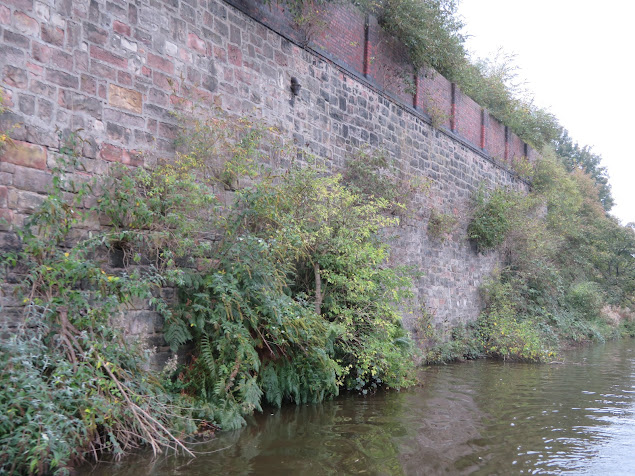
I think if there is a contender as a rival to the Great Wall of Todmorden it is here as we pass the old entrance of the Newcastle Canal alongside the A500. This part is the original stone part but there are modern bits with different bricks. In parts it is up to 15m high. It is a shame that it isn't made more off. Maybe it should have the shrubs etc cleared of anyway.

On the hill to the left was this distinctive building. It turns out that it oas a distinctive name too. It is the Our Lady of the Angels and St. Peter in Chains church, convent and school! It was started to be built in the hill in 1856 and finished the following year. It was also a Dominican nunnery and was built on the site of an old catholic church that had been built there in 1838. It is Grade II listed.

This used to be known as Cockshott Lock and as we approached the Stoke Locks we seemed to meet several boats coming down. They must have all come through the tunnel at the same time. It seems that this flight of locks is locked between 0800 and 1800 due to vandalism it seems.

As a mason's mark this seems to take the biscuit as it must have taken loads of time to cut to ensure that you got paid. I suppose that a simple triangle could be easier but is not so distinctive and this one could not be confused.

We soon popped out of the top lock at Etruria as two boats were approaching. We had to hold them up a little as we were turning into the Caldon Canal. We were soon out of the way and tied up for water. We dumped the rubbish that we had picked up as we came up the flight and then went to wind and moor up. We had a bite to eat and then we went for a walk to Wolstanton Retail Park as Helen thought it was time I got some trousers and as it is soon my birthday she can give me them. She also wanted to have a look at a jumper or two as well.

On the way we passed this quite hypnotic sculpture. It is called 'Privilege' and is supposed to identify Etruria's social and industrial identity, creative innovations and of renewal and growth. It was by Denis O'Conner.

I was impressed that the bollards even have the impressions of old hand tools on them.

The walk is alongside the Etruria dula carriageway and then crosses the roundabout with the A500 before ascending through woods to the housing and then down to the retail park. The area of the shops was once the Wolstanton Colliery. The first shaft was built in 1927, and in 1963 it was the first pit in the West Midlands to produce 1 million tons in the year. It suffered after the Coal Miners strike and actually closed in 1986. It was one of the mines in the area that piped the methane from the pits to the Etruria gas works. I think that methane is still being recovered from some of the old mines in the area.

I had been a good boy and even tried some trousers on. I ended up with three pairs. (Anything for a quiet life!). Helen got her jumper too, and a couple of Christmas presents too. On the way back we stopped at this place that we had spotted on the way there. It is the brewery tap of the Inadequate Brewery. I had a pint of stout from the Three Tuns Brewery that was absolutely gorgeous. I followed that with a pint from the brewery here, Peculiar Liquid Batch No.2. I'm not sure what was wrong with Batch No.1 but this was chock full of flavour and is styled a New England IPA and is supposed to be hazy. It is a place that is only about 15 mins walk from the locks so we will be visiting again. We could have stopped much longer, but moved along as it is Stickly night!

We got back and did a few jobs whilst tea was on and then settled own with our score cards for the evening.


Friday, 8 October 2021

Canal Cruising Customers Continuing.

 As planned we walked up to Canal Cruisers to see if they could slot us in for replacing the isolation switch. They said they could so we legged it back and set off, just before two or three others from the moorings.

We didn't stop for water and were straight into Star Lock. I haven't been into the pub, but it has been there for around 200 years before the canal was dug. It had stables for 15 horses. There were plenty of botanicals on the lock gates and walls. I'm not sure whether that is a sign of pure water, or that the locks need maintaining.

Just by the lock on the towpath side is this white pole that I don't think I have noticed before, maybe I have been trying to avoid hitting something or other before. It has been there since 2016 so it is not new. It is one of approximately 250,000 in 180 countries. They are peace poles and they all have the same message 'May peace prevail on Earth'. It is in several languages and in Stone it is in Polish, Urdu, Russian, Chinese, Spanish, Hebrew, Arabic and Braille. The idea was pushed forward by the Stone Quakers and was erected just over five years ago.

Plenty of growth on Yard Lock too, as well as loads of water coming down too.

Plenty of water coming in the top gate too. We just moored up alongside four of their hire boats that were just being turned round ready for the next hirers. They only have three more weeks of hiring it seems and they have been very busy this year.

Helen got dressed in her glad rags and was off into town for some wool and paperbacks, basically a Charity Shop run! I was soon asked to move once a hire boat had left from the dry dock, I slotted in there so they could spread their other boats about a little better. The 'leccy was just finishing off a starter motor problem of one of their boats and then came to me. I was a little worried as they had told me he was away in the afternoon. He soon had the bolt off and had a new switch lined up. It was not the same so had to drill mounting holes, but it was soon done and all before 12pm. We settled up and were soon away. Thank you Canal Cruisers for slotting us in.

There was somebody on the water point below Newcastle Road Lock so we went straight up. After Limekiln Lock we did something that we don't usually, stop for lunch. We were both in our 'go ashore' so we stopped and had lunch too.

One we got underway again and just by Bridge 96 is this garden with the signal box, signals etc. It says it is 'Stoneycombe Sidings Signal Box'. I would be mightily impressed if this was the actual signal box from the quarries near Newton Abbot. 

The quarries are still working but it doesn't look like the sidings are active as the signal box is all sealed up now. This was the original GWR box from around 1894. It has a concrete rough to repel an stone debris thrown up by blasting at the quarry behind. The stone strip, where the white name board is now, looks long enough to fit the stone name board on though!

We were soon up Meaford Locks. It was the first time I can remember that the road bridge wall at the top lock has been in one piece. I wonder how long it lasts? You wouldn't know that there was a large power station just here would you. Nature soon reclaims the land.

Bridge 100 is Turnover Bridge and it does what it says on the tin, although not with quite the panache of those on the Macclesfield Canal. 

A little further on there is a stone block in the parapet of the bridge that obviously had the cast iron bridge number, or some other sign that was fixed into the stone. I haven't noticed this in the other bridges so far, so may this just marks a different sub contractor building the bridges.

This looks very much like the stone I saw by Hoo Mill Lock, but less eroded. I saw it but by the time I had grabbed the camera and found a gap in the vegetation we were well past. There seemed to be a lot of writing on it below the G/B. I will have to remember to step of and read it on the way back.

This swan family seemed to be waiting to be fed by the householder here. It is no wonder the cygnets are so large, and still hanging about too!

As we passed through Barlaston and the Plume of Feathers pub you get to some open land on the off side. I love the roots and twisted and knobbly tree trunks. We passed the winding hole and moored up with open views to port and st'bd. It has been warm enough today but we haven't had a glimpse of the sun, and it is all about damp, so Helen insists the fire is lit one again.


Thursday, 7 October 2021

Relaxtion curtailed, temporarily hopefully.

 Last night before eating we decided to go for a stroll in the evening light. It has become a bit of a tradition when we are moored near Great Haywood.

We walked up the tow path to cross the Essex Bridge and to the back gate of Shugborough Hall. It is closed for visitors now though. There were a couple of fishermen at the sand banks by the bridge who seemed to be losing more fish than they were catching.

Looking back as we ascended the track we have a good view of the house. By now it was getting quite dark. None the less we thought that the house had been cleaned or painted since we were last here.

A bit further on we passed the Tower of the Winds. It was erected in 1765 and originally it was surrounded by water with two bridges for access. This was lost in 1795 after massive flooding in the area. The ground floor was converted to a dairy around 1803 and the upper two levels were said to be gambling dens for the 'gaffer'. We are pretty sure that this was covered in scaffolding last time we passed and looks all new now. It was pretty dark when we got back to the boat

We got away before 1000 and were first at the Haywood lock. there was one at the top to come down and another had arrived before us. The oat cake boat was swinging about at the junction, and we thought he was going for water but he was mooring by the corner. That left a free tap so we nipped in to top up, and were soon on our way. By the time we got to Hoo Mill Lock there were two ahead of us, but nobody coming down. I switched off as the wait would be a few minutes.

That was my first mistake as the engine wouldn't restart!! When I started it this morning there was a bit of a hiatus once the switch had been turned but it was fine. I switched on and off at the water point, but no joy this time. I did all the checks I had learned when it was the wiring loom that had come adrift. That was still secure and there didn't look like any wires out of place. I checked the engine harness fuse and that looked fine too. I checked everything electrical I could think of, including the batteries, before admitting defeat and calling RCR. They were there in good time and were very methodical with fault finding. I was worried when they got a kick out of the starter after cleaning up the 40 amp spade fuse, but that wasn't it either. It turned out to be the engine starter battery isolation switch. One of the bolts holding it in place was seized so Kerry bypassed it  and left it in place so that we could get under way. The isolation switch is the top left most red switch.

Helen had not wasted the time as she had set too making the 'Bake Off' technical challenge of ciabatta bread sticks. I did a few jobs around the engine hole too. Once we got up the lock I noticed this stone at the foot of the wall of the lock cottage. It looks like a milestone with a definite P on the up stream side and possibly a G on the down stream. However this does not match up with the 'normal' mile posts. It does not coincide with a parish boundary on the old maps either. Any ideas?

There is all sorts of kit down the arm that used to lead to the Weston Salt and Manure Works.

The sturdily ornate Salt Bridge frames another boat. The trip seems to be in quite deep water but there is a lot of time lost for slowing down for moored boats who have taken advantage of the lovely countryside. It isn't as bad as the leg from Kings Bromley as Pearson's reckons that it should be three hours, but it seems to always take five hours!

Helen gets Sandon Lock ready with the lovely cobbles and worn stone steps.

It is traditional to take the half way post at Aston Lock. 46 miles to either end of the Trent and Mersey, and was one of the original mile posts that was made in Stone in 1819.

Almost to Stone as I was attracted to the greenery around Bridge 92, Andre Mills Bridge. I wonder what the colours will be like when we come back this way.

We then had to wonder whether there would be a mooring for us before Star Lock or we would have another lock or two to do. Luckily there was a few places and we settled in. We quickly changed and headed into town as we thought we deserved a drink. We headed for the new Joule's Crown Wharf pub and on the way settled on eating out too. Although new they have kitted it our in the style of wood and brick and it looks good. It is massive too. The only food they have at the moment are burgers but they were really nice, if a tad expensive. I did enjoy the beer though. We are heading to Canal Cruisers to discuss the isolation switch tomorrow.


Wednesday, 6 October 2021

And relax.... aaaah.

 Well we are finally here! We were last out of the marina when we arrived back in the middle of July. We also had a couple of nights aboard towards the end of August but didn't leave the marina, but went for walks in the region which was very relaxing. We have been very busy with just 'stuff'. I have no idea why I am seemingly so busy with the various things I am involved with and with the delight of grand parenting too, but I have been looking forward to getting away, and out, on 'Holderness' for a couple of weeks now. Being on the boat has its worries too, will everything continue working, will there be a mooring where we hope to stop, will there be a queue at the water point etc, but they seem to be less onerous than those at home.

We loaded up and we were away by around 11 am. Macy the Cat knew something was up, but once she realised she wasn't going to put in her case she knew we were off to the boat she relaxed. It was a good drive down and we were at the boat and not before time as it just started to rain as we opened up the boat and Macy settled in. Everything looked good, and everything started up as it should and the engine hole was dry. We brought the load in bit by bit as the showers relented. Helen had a Zoom call in the afternoon so we deiced to sit on the pontoon until the morning.

When we arrived yesterday there was a funny noise going on. I quickly realised that it was the transmission wires near the marina. They seem to be dropping some longer insulators in and probably adding more cables so everybody can charge their cars in the future. The noise was the wires slapping against each other in the wind. This morning I watched as they pulled another guide wire across with a little cable car 'thingy' (the little yellow bogey behind the men. I assume they then pull the transmission cable through using this down to the ground. I loved the aluminium ladder suspended from the arm. Rather then than me. I never seemed to worry about heights in my youth, but now I would certainly think twice about heading up there.

We filled with water and did all the other jobs you have to do before heading out. The engine fired up first time with 6 secs on the glow plugs. No smoke either. We left the marina and headed off towards Rugeley. This time of year, before the autumnal colours start to dominate the greens look well washed out, but I love the light at this time of year. It was sunny all day, but there was a slight bite to the wind but we are both in shorts.

I love the swoop of the curve to the Armitage Shanks factory. I'd love to have a tour round. I wonder if they do factory tours. There were lots of sinks and toilets in the yard so I wonder if they are getting out of the 'just in time' delivery idea these days or they can't get any containers to export them or any drivers to deliver the containers or to our home depots!

We had to wait for two boats to come through Armitage Tunnel Narrows, I can't remember the last time we had to wait for one! The sandstone of the old tunnel is impressive. As we came out of the road bridge above, but still in the narrows a swan family took me on in a game of chicken as they swam along towards me, but with nowhere to go for me they inevitably had to turn round and head back from whence they had come.

We stopped in Rugeley for about 30 mins and Helen went off to get some food items, milk, but mainly the ingredients for the ciabatta bread sticks that featured on 'Bake Off' last night. They will be good with our soup I'm thinking. It is quite strange to see no cooling towers at the site of the old power station. It is something when the vast coal mine and power station could now hardly be imagined here now. Once over the Trent aqueduct at Brindley Bank there are good views of Cannock Chase. 

we are running alongside the Trent for the rest of the day and it is a little higher and faster running than the last time we came this way.

Bishton Hall looks nice in the sun and with the virginia creeper or ivy turning red. It didn't look very open from a distance but since it was bought by Charles Hanson, the auctioneer participant in the Antiques Road Trip etc, it has a cafe and a courtyard craft shop area. In the end it is said to be going to be opened up to the public. You can attend auctions there now I think. At least it wasn't pulled down like so many between the wars.

There always seems to be a queue at Colwich Lock. It is just as well it is so pretty and photogenic. It is a shame the railway line is so close, but I'm sure you get used to anything.

As we passed Little Haywood bridge there is a hint of what is to come when the leaves turn.

We moored up before the carriage bridge to Shugborough with a view over to the house. Whist I got into filling the greaser in the engine hole and generally checking stuff over Helen got to planting some cyclamen that she had brought with her. Our tub was looking a bit bare but some acorns that we had poked in had taken weel and we will have to dig them out as the roots have gone right down to the bottom. We will take them home and find somewhere for them. We will head off for a little walk later when the sun is setting I think. All in all a lovely first day out and one that allowed us to relax into our trip.


Friday, 3 September 2021

Merchant Navy Day


We now come round to another Merchant Navy Day. The 3rd of September was chosen as the day as the first merchant vessel to be sunk in WWII. War was finally declared at 11:00 and just a few hours later, at a little after 19:40 north west of Ireland the Anchor/Donaldson Line ships 'Athenia' was struck by a torpedo on her port side on passage to Montreal from Liverpool. The passenger liner had aboard 1418, including crew and 117 were lost, 98 passengers and 19 crew. In all the UK Merchant Navy lost 1554 ships, with many more damaged beyond repair. Over 29,000 seamen were lost.

The SS Athenia took 14 hours to sink.

However this year we had the stranding of the 'Ever Given' in the Suez Canal. Whilst nobody was killed, and no vessel lost the impact of this one incident had exceedingly far reaching effects. Around 12% of Global trade passes through the Suez Canal every day, as well as one million barrels of oil and 8% of the worlds LNG. There was a major disruption with $9.6 billion of world trade being held up. That is $400 Million a day and $6.7 million an hour, every day of the year. It is said that the effects of this halt in trade will be felt at Christmas too.

Ever Given is one of the largest container ships in the world. Her keel was l;aid on 25th December 2018

Times have changed; 
SS Athenia was steam turbine driven, was built in Glasgow in 1923 with a GRT of 13,465t and 160.4 mts long with a speed of 15kts., and registered in Glasgow. She carried emigrants and passengers across the Atlantic and had 315 crew aboard. There was no such thing as modern containers.
The 'Ever Given' was built in 2018 in Japan with a GT of 220,940t and a length of 400mts and a speed of 22.8 kts. She is registered in Panama and runs between China and Europe carrying up to 20,124 TEU (equivalent of 20' containers). She has a crew of 25.
We have to remember the sacrifice of our Merchant Seamen in times of war but the loss of ships goes on and is hardly known. In 2020 49 ships were lost of all flags, and such is the way of the world I can not find out how many seamen lost their lives. In 2019 no UK registered vessel over 100GT was lost but three seamen lost their lives. It is often only when there is an oil spill, or an incident results in the loss of passengers that it is felt newsworthy enough.

This goes to show the importance of marine trade to the way the world works, and the importance of seamen of all nations to keep it going. They suffered badly during the first year of COVID 19 pandemic as they weren't able to get on or off their ships and so were stranded a long way from home, with few people to champion their cause.

Now that the regime has changed in Afghanistan will we return to the years after the 9/11 outrage when every ship was seen to be a terrorist threat and no crew allowed ashore? The semen of the world always seem to be the common denominator with all world events, and it never seems to in their favour.

When you are watching your TV, eating your take away or getting dressed to go out just think about how all the 'stuff' gets here and that you are doing things that the average seamen oin a ship can not do for much of his time aboard.

Wednesday, 25 August 2021

Nearly one of far too many, and a hero.

 
On the 23rd July 1888, in Aston, Birmingham, an elderly married woman walked down Catherine Street with her arms full of peas and red currants, looking like she was about some household chores. Catherine Street ran down from Aston Cross Road/Lichfield Road towards the canal. 
These are the moorings at Aston Cross Business Park where we moored one night. Catherine Street used to come down towards the canal from behind the camera. The fake lock is just for show.

Photo from https://www.flickr.com/photos/geoffsimages/8678186565
Catherine Street in 1969 before much was demolished. The business park starts about half way down now.

It was nine forty in the evening and as she reached the bottom of the road she bore rights and crossed the Gunnery Field towards Rocky Lane Bridge which crossed over the Birmingham and Fazeley Canal. The Gunnery Field was named after the gun Factory that fronted Lichfield Road just by Catherine Street. It was opened by William Tranter and was named the ‘Tranter Gun and Pistol Factory’. The Factory was very up to date being one of the first privately owned gun manufacturers to install steam driven machinery. Tranter had many patents for mainly pistols but the company made many different small arms under licence too. The site covered 4 acres and by 1887 there was a still a field, or wasteland between the factory and the canal.

This was the warehouse cum showroom that fronted on to Lichfield Road (at the top of Catherine Street), built in 1887.

The inside of the fsactory showing the steam driven machinery. In the foreground are pieces of timber to be used as rifle butts.

A little way astern of her were a group of lads larking about, also heading down Catherine Street towards the canal. As they watched the elderly lady threw down the fruit and vegetables and drew off her apron, and as she ran towards the canal shouted ‘I will, I will’. She flung her apron into the water and jumped after it. The astonished ladies ran to the spot. One of their number Samuel Tuckey jumped straight in after her. The water was deep, well over his head, and the woman had already sunk below the surface twice so it was difficult to locate her. Samuel saw her hair floating and managed to grab hold of it and pull it to the side, and with help they had her on the bank. There she lay unconscious for 10 mins. before coming round. She then begged Samuel to let her drown herself, but by then a crowd had assembled including a policeman.

These details were published in the report of the court proceedings for the attempt to commit suicide. Unbelievably suicide was illegal until 1961, so attempted suicides were taken court. The Magistrates were E.H. Stringer and Dr. Griffiths. The lady in question was Ellen Brittain who lived at 3 Court, 10 House on Catherine Street. Ellen’s husband gave evidence at the trial to the fact that his wife was a confirmed alcoholic. He further stated that he gave her 35s a week but the children did not have clothes on their back, and she pawned everything in the house! He said that she had given her 35s the last Saturday and by the time she got home she only had 4s 6d left. Superintendent Walker told the Court the defendant was barely clothed in the cells and her husband said she had no clothes at home other than those she stood up in. The prisoner was then asked to speak and she told the Court she was not a drunk and that she had been driven to attempt suicide by the actions of her husband and went on to bring many charges against him regarding domestic troubles. She was remanded to Winson Green whilst reports were assembled.

Winson Green Prison


Samuel Tuckey gave evidence about the rescue and when asked why none of the other lads helped by jumping in the canal he stated that they were reluctant to spoil their Sunday Best clothes. As it was his best trousers were spoiled as he couldn’t rid them of the smell! Samuel Tuckey had been born in Aston, in 1872, and was the son of an iron plate worker. His mother was Agnes, nee Mailing. They lived with Agnes’ family at 95, Upper Trinity Street near Bordesley Junction. The father of the house was a pearl button cutter, as was the eldest lad. The second eldest boy was a bedstead fitter, and Samuel’s mother Agnes was a bedstead painter. At the time of the rescue Samuel was sixteen.

Victoria Road Police Station, Aston Manor, which I believe had been the court building previously.


At the second hearing a week later, the original evidence was gone over, but nothing new came out other than Ellen Brittain thanked Samuel for saving her, and she admitted to been a drunk. The Magistrates discharged Ellen on the promise that she would not attempt to take her life again, and would behave better in the future. Different times indeed. The Magistrates were Yates and A. Hill and Samuel must have impressed them as A. Hill said to the court that there was no fund available to enable them to reward Samuel for his actions but that the Magistrates themselves rewarded him with half a sovereign for his efforts that was passed to him via the clerk to the course Mr. E Rowlands. In the newspaper report Samuel was said to express his thanks in a brief but suitable way. It seems that the Magistrates went further to reward Samuel Tuckey as they applied to the Royal Humane Society for him to be rewarded.
The Royal Humane Society was started by two doctors who were worried about the number of people who were drowning and could have been revived. Dr. William Hayes promoted artificial respiration techniques and the use of tobacco smoke enemas to revive people. He paid the public to bring him bodies to him that had not been in the water over long. He was joined by Dr. Thomas Cogan had grown interested in the same subject whilst in Amsterdam where as society had been set up in 1763. In 1774 they invited fifteen of their friends to a coffee house in St. Paul’s church yard and the ‘Humane Society for the Recovery of the Recovery of Persons Apparently Drowned’. In 1783 King George III became the patron of the Society and in 1787 it’s name was changed to The Royal Humane Society. The top award is the Stanhope medal that is awarded annually for the most gallant rescue, first awarded in 1873. The Silver Medal was the first awarded when the society was first started. It is awarded to those that put their own life at risk to same others, by putting themselves in personal danger, a long and arduous, or returning to the scene repeatedly. The Bronze Medal was first awarded in 1837 for the rescue of others at their own personal risk. Also awarded are Testimonials on Vellum for a rescue performed by putting themselves in considerable danger. There is also a Testimonial on Parchment presented for an act whereby the receiver rescues by putting themselves in danger. These two awards are now issued on card.

The current form of the Testimonial on Parchment.


In October 1888, before a sitting of the Aston Police Court A. Hill, the presiding Magistrate presented Samuel Tuckey with a Testimonial on Parchment from the Royal Humane Society for his rescue of Ellen Brittain from the Birmingham and Fazeley Canal. In his speech Mr. Hill said he hoped that this award would act as an incentive to others to follow this noble example under similar circumstances. He went on to say he had no doubt that he would cherish this testimonial to his bravery and would be able to hand it down to his children, and children’s children. The report goes on to say that Samuel went on to thank them in his self effacing way and withdrew!
The next time census in 1891 we find Samuel has enlisted in the Royal Warwickshire Regiment and on census day he was with his regiment at the Tower of London as the guard. He had joined up in 1890. In 1899 his regiment were shipped out to South Africa to fight in the Boer War. We know he was there as he was awarded the South Africa 1901 service medal. He could have served in Johannesburg, Diamond Hill, Belfast, Cape Colony and the Orange Free State. I am unable to follow him after this with any certainty.

British Troops during the Second Boer War. (not necessarily the Royal Warwickshire Regiment).


This is the story of just one potential drowning but the newspapers were full of many cases of drownings and rescues and suicides that travelling up and down the canals must have inevitably turned up many bodies. I'm so glad it isn't like that today!