Total Pageviews

Monday, 15 March 2021

Bridging the gap.

 The next day was neither dull, nor bright, and it couldn't make up its mind whether to rain or not either. We had to go as we had a schedule, so off we went.

Three locks down and we come to Longford Bridge. In the distance through the arch you can just make out the M6 Bridge. 

This section of canal almost looks as if it is running through park lands of a big house. That is because it was! Teddesley Hall was built by the Littleton Family in 1754. In 1835 the family were knighted and he became Lord Hatherton and he must of become rich, or richer, from all the coal etc found below his various properties in the area. (Including Littleton Colliery from the last blog). The house was no longer needed after 1930 and became a POW camp for 200 Germans in WWII. It was then to become the HQ for the regional Health Board, but that never happened and the property was demolished in 1953.

Park Gate Bridge is photogenically all you would expect from a canal bridge and lock. Neat towpath and offside. White painted arch and a stone set horse path up to the lock with a dribble of water from the gates. Lovely, shame it isn't sunny too.

As you approach Acton Trussell you glimpse St James' church on its own, outside the village. The original church was built in the 13th Century but like many it was enlarged and rebuilt in 1869, the work designed by G.E. Street, who also designed the Royal Courts of Justice in London. Before this rebuild the church had been closed for more than 40 years. In 1985 the remains of a Roman villa were found and subsequent work has taken habitation from the neolithic to the 4th Century.

The canal was driven through part of the moat of the old moated manor house. Acton Trussell was in the Domeday Book, but although it is an apparent affluent commuter village there are little of no shops to be found. There is Acton Moat Bridge just ahead of the boat when this picture was taken and the moat is now in the grounds of the Moat House Hotel, with a pub in the oldest part of the building. Maybe worth a walk next time we are passing.

Stafford Boat Club is built on a disused arm that once went a short distance to a brick works from around the mid 1800's but was gone by the end of WWII.

After the roar of the traffic over the Radford A34 bridge it becomes all quiet again as Baswich Bridge. The 'wich' in Baswich should tell you that there was a salt works here as well as a spa in Stafford. A thick bed of salt was discovered laying below Stafford Common and the baths were built by the river. It was opened in 1892 and demolished in 1977. Stafford Common is to the north of Stafford so the brine was piped right through the centre of town to supply the spa baths and the salt works. A Salt works opened near the common in 1893 and in Baswich 1894, just to the north of the railway line. In 1948 a factory started using the vacuum method of production rather than the open pan method. The old factory became to expensive and was closed in 1957. As Stafford had expanded and brine extraction was causing serious subsidence its extraction was banned in 1970!

Another very photogenic bridge that looks like a turn-over one. The railway line is right next to the canal at this spot, and just beyond is the busy A513, but until a train comes past you could be miles away from the rush of modern life.

Since Baswich, where the Rivers Penk and Sow joined the Sow has been supreme. The aqueduct that crosses over it has good views up and down the river and the autumn colours will be lovely. We are just a week early but still it is a special place, and worth a return to.

Tixall Lock and Old Hall Bridge along with the lock keepers house and wharf on the off side, complete with crane make this spot another delight of the Staffordshire and Worcestershire Canal.

When passing through Tixall Wide, or as it used to be called Broad Water the old Gatehouse of Tixall Hall is always photographed. However there are several other buildings that can just about be seen from the water. This one is Tixall Farm and was built at the end of the 1700's/early 1800's and is a classci model farm of the time Through the coach arch is the entrance to the quadrangle enclosed by the barns etc on the outside. There were some buildings in the quadrangle but they were demolished when the whole thing was sold for residential development. They would be neat flats. There are 17 bays along the road. The last 5 to the right are a wonderful brick Dutch Barn.


Just by the farm can be seen the roof of the Bottle Lodge at the end of the carriageway that connects Tixall and Great Haywood. Once known as the, less glamorous, Upper Lodge, it was home for tor the shepherd and his wife in the 1800's. Even better their children had to sleep over the road in the other farm buildings! It just has one room on each level. Tixall looks to be another place I will have to have a walk around.

In December 1847 the Trent Valley Railway opened fully for goods and passenger traffic. This was a line that was designed to reduce the distance and time between London and the NW of England and hence to Ireland, north and south. It had been started in November 1845 by a new company the Trent Valley Railway. A year later that company had been taken over by the London and Birmingham Railway Co, and just a month later they amalgamated with several other companies to form the London and North Western Railway Co. In a report of May 1847 there was a report on the progress of the line. It stated that other than the tunnel at Shugborough the main engineering was crossing the Staffs. and Worcs. Canal and the River Penk and its flood plain. They had done this using a wooden viaduct that raised the line above the water by 25 'to 30' for a distance of about 150 yards. The whole structure was said to remarkable in its strength and solidity, and from a distance has a light and elegant appearance. The whole thing had taken 40,000 cu ft. of timber and there was some difficulty in finding a solid footing for the piles. The whole thing had cost £7,000.

The first Baswich Railway Viaduct, opened in 1847. Note the pile drivers

All went as it should until Wednesday 25th September 1858 and the down goods train driver saw that there was a small fire on the viaduct and stopped at the Queensville level crossing as he cleared it and informed a policeman, who in turn roused the plate layer lengthsman. He made haste to the bridge an quickly realised that there was little he could do on his own. On the way back towards Stafford he met a pilot engine with an inspector and a gang of men who had been alerted by the first driver when he had arrived at Stafford. When they arrived at the scene the hand rails on the bridge were alight in three places, but no flames were seen on the track bed. The gang of men did all they could but there was a strong SW'ly wind blowing and the fire was below them. The structure was wooden and soaked in creosote. The fire rapidly spread across the structure. By now the fire engines had arrived, one from the Norwich Union Co and the other the Stafford Municipal fire engine. They concentrated at the southern end where there was access. They played their hoses at the underneath of the spans across the River Penk and the canal. In they end they managed to save the canal crossing only. The showers of sparks and flames rose high into the sky and could be seen ten miles away. By 06:30 the beams had plunged to the ground and into the water leaving a few charred stumps and the metal rails suspended above the gaps. 

The newspapers managed to make a great story out of the goods train driver who reported the fire. His names was Thompson and it claimed that he had seen the flames when he cleared Shugbrough tunnel and ploughed on, crossing the bridge through rising flames and beams collapsing as he crossed them. He was christened 'Hell Fire Jack'. The first man on the scene, the lengthsman was George Dodds.

The Railway Co. did not hang about and set to quickly to clear the site. Passengers and mail were transferred between Stafford and Colwich station via omnibus until the next Sunday by when a foor bridge had been installed and trains stopped at either end of the viaduct and walked across to continue their trip. A floating platform across the river was put in place and sheds were built for the 140 to 200 workmen on the site. The original wooden piles had survived close to water level and this fact was used to speed things up. A metal sleeve was fashioned for each of the stubs. This closely fitted the old pile and extended sufficiently to allow a new timber beam to be driven into it securely. These 'sleeves' used inch thick steel and weighed about 9cwt. After one week the piles were completed for nearly a third of the length. On Wednesday 13th October the new single track viaduct was tested by driving to heavy engines over it and was declared safe, and the line reopened, just three weeks after the fire! Unfortunately there was a death of a workman, Gibbs, died at the Stafford Infirmary having fallen head first down the saw pit. An enquiry had found that the fire was started by errant cinders from the 10:50pm train from Stafford. The next train up from Tamworth, the 11:12pm reported that there was a smell of burning, but no sight of flames or smoke.

Viaduct over the River Penk being repainted in 1934. You can see that the number of lines 

Whilst this temporary bridge was under construction the Board of the company also agreed to a permanent replacement and tests were made to find safe foundations for the new bridge. Gravel conglomerate was found at 12 to 40' and this would form the base. Despite the expense they agreed to build an wrought iron girder bridge, supported on Staffordshire blue brick piers, the bricks coming from West Bromwich. Work actually started on site in December 1858. There was to be six arches or openings of 42 ' each with two to span the River Penk and to be sited to the north of the wooden viaduct. One of the tracks was opened for traffic on Monday 14th March 1859, and the second line on Wednesday 22nd June 1859.

The two track bridge was added to by a completely new bridge next to it between 1880 and 1900 to provide two up and two down lines. The two bridges can be seen side by side in the photo above.


In August 1952 the older bridge was closed for modernisation. Staffordshire Advertiser photos.

The work consisted of replacing the brick pillars, trestles and steel girders. A precast concrete track bed was added and this was not tied to the rest of the structure. This meant that there was less vibration and noise caused by passing trains. It was said that the original elm piles used were still in excellent condition and were largely left in place. The work took just three months and was two weeks ahead of schedule. The workers were a multinational team, Poles, Ukranians, Scots, Welsh and Irish as well as some Displaced Persons. 30% of the work force were local too.

The bridges today.

Who would have thought that a bridge could be so interesting !!


Friday, 12 March 2021

Downs, Ups and Downs of Industry.

 It was a gloomy day with a bit of drizzle in the air when we left out mooring at the Fox ans Anchor near Coven. In 1974 the Staffordshire and Worcestershire Canal Society had a rally along this stretch that was 20p for two adults to enter. Children free. How much is Crick these days? Only saying.

Between the road and railway bridge at Slade Heath is this collection of buildings that must have been a wharf. I had previously looked on the 1888 map and there was no note of a wharf. I have dug further and there was a wharf at Slade Heath and it was to let in 1812 and 1818, and there was a sale of railway building equipment there in 1838. It originally consisted of a warehouse, stables, yard and small house.

As the canal meets the railway again what looks like another wharf can be seen. There is a small pumping station the other side of the railway and I thought it may have been used to bring equipment for that, but I now suspect that it was used for the electrification of the railway as a convenient point to bring equipment in by canal.

The enclosure of Coven and Slade Heaths occurred around 1851 and 1852. I assume that before then there would have been less field boundaries, but it is a very quiet rural place today too.

Hatherton Junction is now a quiet spot on the Staffs. and Worcs. but was a busy spot in its day. This end of the Hatherton Branch was constructed by the S&W canal themselves and went 3.5 miles to Churchbridge. The canal company made such good profits they didn't obtain an Act of Parliament so that they could compulsorily purchase land and raise money, they just negotiated individually with the land owners and paid for it out of profits. It was built to provide a route for the Cannock Chase mines produce. In 1860's the S&W made an agreement with the BCN to create a link via 13 locks between Churchbridge and the Cannock Extension Canal. It seems the two companies jointly purchased the land but the S&W paid for the locks over the 1/2 mile length. The link was made in around 1859/9 but the Cannock Extension Canal wasn't opened until 1863.

This would have been a busy toll station at the height of the coal period, and maybe will be again when the restoration is completed. It is perhaps the next sizable length of canal to be re-opened in the near future and see boat pass down it since its closure due subsidence in the 1950's.

Calf Heath Chemical works has grown over the years, starting in the 1920's and is owned by the Amewrican SI company now. There is also the waste incinerator with a sedum roof next to it. There was no smell or noise when we passed so not a bad run on this dead straight section, with a sharpish bend at the end.

You are then quickly at the Gailey Lock and the much photographed round house. It was the toll clerk's office and built at the same time as the lock and wharf nearby. The wharf was very busy with the turn round of their hire fleet as we passed. We had a small wait at the lock, just long enough to top up the water tank.

After Brick's, Bogg's and Rodbaston Locks the shine on the canal is lost a little as it butts up against the M^ with the noise and bustle but we were soon coming into Penkridge where we found a mooring and settled in. I had got a bit cold, but after a while we went off to explore a little.

At the end of the length of canal that runs alongside the M6 is the Littleton Colliery Railway Bridge, No. 81A. This peaked my curiosity and had had a poke about.

In the early 1870's there was a boom in the demand for coal and several pits opened. In May 1873 seven men got together and registered the Cannock and Huntington Colliery Co. They were men who had prospered in the Victoria Age, solicitor, iron founder, iron master's clerk, iron merchant and men with a property portfolio, plus others with aspirations to equal them. They planned to raise £100,000 by selling 5000 shares at £20 each. They planned that the cost to start production would be £70 to 80,0000 and then produce 1000 tons a day with annual profits of £52,000. The big plan was to construct a plateway from the mine site to the Staff and Worcs. Canal so as to avoid the massive congestion at Hednesford, where 200 boats could be waiting to load. The other plan was to sink the shafts using a continental system, the Kind Chaudron method that was popular on the Continent, but ti would be the first time it had been used in England. This method was selected due to the of a gravel layer in the bedding before reaching the coal seam. This was flooded with water and made the sinking of the shafts very difficult. It also is where a lot of the areas water is taken from by the numerous pumping stations in the area. In 1875 an exploratory shaft was drilled and coal was found at 650ft

In 1877 a plateway was laid and horses were used to bring up material from a basin dug at the canal, a distance of a bout 21/2 miles. The Kind Chaudron method was to drill the shafts by dropping a drill bit and then lifting, turning the bit a little and dropping it again, around 25 times a minute. When enough debris had been created a spoon or grab would be exchanged for the drill bit to bring the cuttings to the surface. The shafts was lined with a double skin of and the gap filled with concrete. The pioneer shaft of 6'7" was completed to 419' by October 1871. The full size shaft was completed to 405' in April 1879. The shaft had a lining tube in it at this stage and water was allowed to fill the shaft as drilling when on as it was all done via a derrick at the surface. The tricky bit of fitting the iron ring tubing down the shaft was next. These were all constructed at the site. The lining rings were bolted together and made water tight. At this stage a false bottom was created using a 'moss box'. This was a false floor that was lowered to the bottom of the shaft such that the tube linings were lowered into it and a watertight seal was created by the weight of linings compressing moss that had been packed into the threads and seams making it water tight.  A false bottom was fixed to the bottom of the tube lings that were bolted together. This allowed them to be floated on the water in the shaft. A pipe was fitted from the centre of the false floor and extended upwards as the linings were added. By opening valves on this central pipe water could be introduced to relieve pressure and to allow the whole string of linings to sink in a controlled fashion down the shaft. Concrete was then poured into the linings and once set the water could be pumped out and as the waterlogged section had been passed through men could descend to the bottom of the shaft in the normal way.

This is Otherton Basin in 1882. The sharp bend at the head of the basin shows that it was very small gauge and it appears that there was just a shed at the wharf.

At he Cannock and Hartington No.1 shaft this is where things went wrong. In May 1879 9 or 10 sections of tubing were bolted together and allowed to sink to the bottom. As the central pipe was tried to be used to control the sinking it failed and it sank quickly and obviously damaged the moss box! The only thing to do was to recover the linings etc. through 135 yards of water. By October all the complete rings were removed then it took until October 1880 to smash the pieces up and bring them to the surface. The shaft was drilled a little further to make a new seating for the moss box and eventually, in April 1881 82 lining rings were lowered into place successfully. The linings were then filled with concrete and allowed to set for two months. They started pumping out the water but after 5 days and at 330' it became obvious that the lining was seriously leaking!

Meanwhile No.2 shaft was started a little after No.1. By October 1880 they were ready to lower the lining rings down the shaft to the moss box and 87 rings were successfully positioned. The concrete was poured and left to set and then the water removed. The reached the false floor and digging below the moss box continued by hand. A ledge of rock was left to support the weight of the tube lining but unfortunately there was a small fault in the strata at this point and as soon as the shaft was extended below it, it collapsed and the men had to evacuate.

The Cannock and Huntington Colliery Co, now tried to raise a further £20,000 and renegotiate terms with the Lord Hatherton the land owner. He was onboard so long as they could raise the extra money and he would chip in with money of his own. However by the end of 1883 they had managed to source any new capital so Lord Hatherton amicably foreclosed on the company. In August 1884 a massive auction of everything was held. 400,000 red bricks were sold from the brickworks on site as well as three miles worth of wood sleepers and iron rails from the rail line down to the basin. The Company was officially wound up in 1885.

From this map of 1882 you can see the plateway was been taken up, and the brick works in the bottom right hand corner.

Lord Hatherton, who took the surname Littleton, decided to resurrect the colliery and gave it that name. He raised £150,000 and decided to complete the shafts using 'traditional' means of pumping the water out as they went. He had appointed new mining engineers in 1897 and they decided that it would be best to start with No.2 shaft and in September 1897 the two pumps were started and three weeks later the bottom was reached. The water was coming in at 150 to 200 gals/minute. Strangely the level in No.1 shaft did not go down. The method of limiting the water was a mixture of iron tubing, brickwork and concrete linings and by February 1899 the shaft had been sunk to 1644' feet, passing through all the important coal seams of the district with around 90' of workable seams of coal.

In June 1899 work was resumed on No.1 shaft. In the end they had four new pumps working on the shaft and managed to lower the water level to 347'. It was then decided that they would have to cope with water ingress of around 2000 to 3000 gals./min and therefore they withdrew the pumps and took the decision to sink a new shaft. Work started on No.3 shaft in May 1900. By November they had reached 877' where a connection with No.2 shaft was made via a drift giving a second access and ventilation. It took another year to reach 1662', partly due to a bed of very hard sandstone that even defied blasting. The shaft had been sealed like no." with a mixture of linings. After a few months the water table rose back to normal levels and further lining had to take place. 

This map from 1900 shows that the basin and railway to the canal were not in use at this time, Equipment etc was brought to the mine via the railways.

Compare the 1900 map with this one of 1921 and you can see that production has ramped up and the use of the canal for transport of the coal is busy. The branch line that cross the canal on the bridge is the branch from the colliery that goes to the Penkridge sidings that link in with all routes. At its height it employed 2000 people.

With the mine having such a length of a branch plus the basin and sidings it had its own steam engines too. The first at the new pit was Littleton No.1 that arrived in 1901 and was still there in 

This is Littleton No,5 that was new in 1922 and was still at the pit in 1967, and has since been preserved. It looks like it is crossing that canal on the bridge as the line does not cross another watercourse, and it is a single track line.

After WWII the pit was nationalised and in 1963 it was thoroughly modernised and production rose to a million tons a year. In 1992 it was ensured that it was had been reprieved from any closures, but the following year it was closed, the last deep mine on the Cannock and south Staffordshire field with the loss of 600 jobs. The mine has been demolished and hardly anything exists to show it was ever there. The building of the M^ seems to have removed the basin too as there is nothing to see now.

Wednesday, 10 March 2021

Dark Deeds Done.

The next day we were off in the cool but sunny morning with a few miles to make.

Just before the Dimmingsdale Bridge is a little set of moorings that have been created behind an old wharf that had a warehouse at one time. I very nice spot too.

This is Compton Lock and is said to be the first narrow lock that James Bridley actually constructed. You could say it has stood the test of time well, but it has been rebuilt since then.

Despite getting closer and closer to Wolverhampton the canal still retains its rural charms, especially with the leaves changing and the smell of wood smoke in the air.

This big girder bridge carried the Great Western Railway across the canal. It is also known as the Meccano Bridge. It was known as the Wombourn Branch or the Wolverhampton and Kingswinford Railway. It was built to link up with the many collieries and brickworks of the area using a single track way and the southern section was built in the 1800's. The northern section had an Act of Parliament passed in 1905 and construction started in 1913 as can be seen from the maps of the time. WWI intervened and construction was delayed until 1918 and the line was opened in 1925. It was now running passenger trains, but numbers were poor and this service terminated in 1932. Next time this was we must have a look at Tettenhall station just near the bridge that is all but intact and even has a small transport museum. 

A little further along the still wooded banks we come to a little basin that didn't get dug until around 1900. The maps do not reveal it being attached to any industrial site. You can see the bridge over the entrance at the left. It seems it is now owned by the West Mercia Guides and houses their narrow boats.

The next bridge along is also from the 1920's when Courtalds built a rayon yarn factory on the site of old Dunstall Hall. Construction started in 1924 and production started in 1926 so this bridge was added between those dates as a branch into the Courtauld factory. The factory was the other side of the Wolverhampton Race Course whose other side runs along the canal up to the Aldersley Junction.

In this photo we are just passing the bottom pf the Wolverhampton 21 at Aldersley Junction The bridge here is No.64 and has the little horse hole on the tow path.

On the other side was the boatman's lodgings. This was four stories high with the bottom one on the towpath and was the stables, as you can see from the large doors. The rest of the buildings stories have gone now. In the corner between the bridge and the stables where ovens for something or other too.

After the junction are more bridges. The first is the loop from the main line to the Wombourn branch. The next is the GWR main Line. After that is the old Oxley Moor bridge and then the new road bridge. After that there are several pipe bridges that carry 'liquids' over the canal to the sewage farm on the left bank.

Autherley Junction. The Staffs. and Worcester Canal opened in 1772 and enjoyed a good trade as a few months after the canal opened a link with the Birmingham Canal Navigation was made at Aldersley by way of the Wolverhampton Locks. Trade then flowed to the north via Great Hayward on the Trent and Mersey Canal. That was until 1835 when the Birmingham and Liverpool Canal opened in 1835 and the junction with the Staffs and Worcs. was made here at Autherley, via a stop lock to protect each others waters. The Staffs and Worcs. lost a lot of income as boats now passed up the Birmingham and Liverpool rather than travel to Great Hayward and to the north via the Trent and Mersey. To make up for this they increased the toll to pass from Aldersley to Autherley junction, half a mile to exorbitant levels! The Birmingham and Liverpool and the BCN got together and decided to obtain permission to build the Tettenhall to Autherly Canal. This would have left the Wolverhampton flight at about Lock 19 and cross the Staffs. and Worcs. in an iron aqueduct and then drop down three locks to meet the north going canal. It was never built as the Staffs. and Worcs. realised that some tolls are better than no tolls and dropped their charges. The bridge has obviously been painted white at some time, but I doubt it was originally so. I wonder when it got its first coat. It would certainly beautify it now, but would be a blank canvas for tag artists unfortunately.

After the junction you come to the 'Pendeford Rockin'', which is almost like a tunnel as the trees and ivy seem to enclose the channel. That channel narrows right down as it is cut through a band of sandstone. With the slight bend you can see in the photo it seems as though you have taken a wrong turn and are heading up a back channel, and starting to wonder if there will be a winding hole! There are several passing places along the roughly half mile length so there should be no fear of having to travel astern for long distances.

We passed under the M54 and moored for the night just past the Fox and Anchor and walked into Coven for a fish and chip supper that evening. Not a bad days cruising at all.

History corner today unfortunately is another death, even worse than the last blog. At Aldersley Junction there was often a large fleet of boats waiting for the locks and on Saturday 30th October 1875 it was no exception. At about 04:20 on Sunday morning a boatman named Frederick Musson knocked on the door of the toll house at the south side of the bottom lock of the Wolverhampton flight and asked the BCN toll collector to come to his boat as the little girl fainted or had a fit. Musson was 23 and lived aboard with a small son, Frederick,  and wife Ann Maria, 21. Musson was a boat steerer with the Shropshire Union Canal Co., and seems to have been on the Chester to Wolverhampton/Birmingham. In 1871 he had been a mate of the boat 'Form and Thought at the Grand Junction Co Wharf at Leicester. Fred Beasley went along and found a small girl, about 7 years old, laying on the narrow bed covered in a couple of coats. He felt her, and her face was cold, but her body warm, but she was dead. He noticed she had black eyes, but was told she had stumbled and hit the coal box earlier. He told Musson to go and fetch a policeman and a doctor, meanwhile the body was taken to a stable near the toll house. Later that day he again looked at the body and found that it was covered in cuts and bruises 'from head to toe'. There were large cuts with skin missing and a massive bruise in the small of her back, and her stomach and ribs were black and blue. PC Clayton had arrived and he corroborated these findings. Charles Millington had been asked by Musson to report the crime and when he returned he noticed the boat had been moved about 40 yds and that the body had been moved and the face washed. Later Police Inspector Hackney and PC Billett searched the craft and found a blood stained apron and absolutely no medical remedies. Musson and his wife were remanded in custody. There is no mention of what happened to the baby.
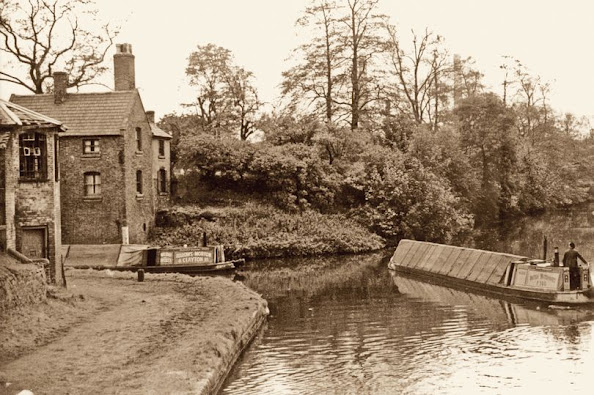
Aldersley Junction Toll House.

At the inquest it turns out that Musson and Ann Maria were not married, her name was Hillman. The dead child was named as Elizabeth Lowke. It seems that she was the daughter of a boatman Joseph Lowke and had been placed with th Musson and Hillman by another boatman Joseph Lowke. The circumstance were that he had three children and his wife, Caroline, had died in 1873. Elizabeth was the eldest child then came William and Hannah. At the inquest it was stated he was living in rented accommodation and could not cope with the children and work. He placed his eldest with another boat couple, but they mistreated her. Joseph was from a boating family with his father Thomas and grandfather Joseph being boaters, as well as his brother William. Our Joseph's son William also went on to be a boatman until at least WWII. He had known Musson 8 years and Hillman 2 years, but did not know they weren't married. The plan was that Elizabeth would look after the baby, Frederick jnr.,  in return for food and clothing and the hope that they would adopt her later. She had been with the couple for around four months. It did not come out at the inquest or subsequent trial but I think Joseph had remarried a widow, Elizabeth Harrison, nee Blick, in June 1874! Joseph had seen his daughter every two or three weeks and had found her clean and tidy. he thought that if she had been ill treated she would have said so. But, when questioned, she was always in the presence of Musson. When the 'defendants' were questioned they said that the girl had been kicked or trodden on by the horse and as they were travelling they did not call a Doctor.

 A Doctor Cooke performed an autopsy on the body and found that the girl had died from blood and fluid on the brain caused by injuries to her head. He listed the other extensive injuries too.. The inquest was reconvened several times for the collection of more evidence but in the end the inquest said that Elizabeth had been willfully Murdered and Musson and Hillman were committed to trial at the next Staffordshire Assizes at Stafford.

At the trial the prosecution brought forward many witnesses to mistreatment of Elizabeth. At the inquest many of these had been heard but it was felt that none of them related to acts close to the time of death so a jury may not be convinced of guilt. One, Sarah Swift a boatman's wife, said that In Chester Musson had told her that he was going to give the girl back as he couldn't cope with her and he was too 'heavy handed with her'. Others spoke of Musson and Hillman both beating the girl and leaving her standing outside with few clothes on. They defendants said that the girl frequently soiled her bed, not surprisingly perhaps, if she was being ill treated. Labourers at Chillington Wharf, (This was built in 1830 to serve the Chillington Iron Works.), witnessed the girl being beaten with the butt of a whip on 7th October. They also witnessed her being left naked in the hold.

Chillington Wharf.

Thomas Cowern was a check clerk for The Staffs. & Worcs. at Aldersley Junction and gave evidence that he noticed Elizabeth had swollen lips and scratches when she came to his office for the ticket for the boat to travel to Ellesmere Port. She wouldn't tell him how it happened. On the boats return he saw her again. She was very weak and had difficulty walking being lame in her right leg. This was the day before her death. On the day before the death Tom Mander and his mother Mary were on a boat moored a little away from Musson's boat. Tom saw Hillman lift Elizabeth on to the tow path that evening,  with hardly any clothes on. It seemed she had soiled the bed. He saw Hillman strike her. He also gave evidence that at about 22:30 that night he heard a loud cry from the boat. He went up to the boat and called out, but got no reply and as there was no further noise returned to his boat. He stated that as Musson was ashore when the earlier event had happened ho assumed that he had returned and on being told of events had given out punishment. It is obvious that it was well known that they did not treat the child correctly, but maybe the collective of boat families did not interfere. Although some did tell Musson and Hillman to stop treating her badly, or take her to the hospital, or return her to her father if they did not want her!

The jury were out of the court for around 30 mins before returning. The foreman gave their verdict as manslaughter and made a point of being very critical of Joseph Lowke for the neglect of his own child. The judge stated that they were as close to it being full murder, and the death penalty, as it was possible to be, before he sentenced them both to 20 years penal servitude. Musson was sent to Parkhurst prison on the Isle of Wight and Hillman to the Female Prison in Fulham, in London. Musson was transferred to Portsmouth Prison in 1876. It looks like they were both well behaved prisoners as they were out by 1891. That year we find Fred. Musson marrying an Ann Maria Hawkes. This is very likely Hillman as other details fit. Musson returned to his old trade and in 1891 he is on a boat named 'Florence' in Wolverhampton, with his son aged 18. in 1911 he is still with Ann Maria and now has another two children Charles, 18, a boatman and Annie, 14, at school. Frederick Musson died in 1920 and Ann Maria in 1938.

It can't be said that events such as these do not happen during our own era, but arrangements for caring for children  are now not quite as ad hoc as in 1875. The boat people had a bad reputation for theft, drunkeness etc and this case will have done nothing to disabuse the public of those ideas. The fact that it could be seen that the boat families tried to keep it all in house would maybe also solidify these thoughts. It should also perhaps be noted that in 1839 the murder of Cristina Collins by the crew of a Pickford's fly boat between Stone and Rugeley also involved a member of the Musson family. William Musson was the boy aboard, and was the only member of the crew exonerated. 


Tuesday, 2 March 2021

The Dark Side of Dimmingsdale.

 After mooring up below Swindon Lock we were soon on our and up through that one and Marsh lock close by.


On the left is the OS map from 1900 you can see that the tow path runs on the west side of the canal, right through the iron works and under the three canopies over it for sheltered cargo working. On the right is the OS map from 1921 with the works extended to the north and a tramway running along the old towpath that has been transferred to the east bank. The is a greater length for covered working too.

As soon as you are free of Marsh Lock I feel it is a little like the Leeds Liverpool Canal, but round the corner is the Botterham staircase Locks.

The Botterham Lock cottage has no real road access as the Smestow Brook is right behind it.

Helen is in the bottom of the two locks with the top lock looming above. They still have the original cast iron bridge at the foot of the lock. Not sure about the hand rail though!

Looking a little more like October in 2020 is the run up to Bumble Hole Lock with the sloping bridge just before it.

The next locks are the Bratch flight of three locks. Just at the foot of which is a lovely Victoria pumping house for the water works there, with towers gorbelling and coloured brick work effects. There was the inevitable short delay but we were soon been helped up the locks, that most people will know look like a staircase but there is a very short pound with side ponds between them.

The octagonal lock keepers house seems to be the star of the show, but there is another just down the cut at Stewpony and on the Smethwick pound in Birmingham. (Vandals burned it down as soon as it was rebuilt, so has gone to ruin last time I passed that way).

It was a lovely afternoon as we passed through Awbridge and Ebstree Locks and found a spot to moor up for the night just above Dimmingsdale Lock where there are a couple of berths on the off side.

It is a lovely spot with few comings and goings and we soon had the fire lit. and caught up with a few inside jobs.

Very close to where we were moored a boatman called Charles Stokes had just passed through the lock at on his way to Compton when at around 16:30 on Saturday 30th November he spied something odd at the mouth of the weir that led round the lock. Charles was the son of Henry and Annie who had been boat people themselves. In 1891 The three of them were in Chester aboard the ARENIG, Charles was one and Annie the only other crew. In the end Charles was the oldest of 5 all born in Wolverhampton except one born in Kinver (on a boat?).  He married Hannah Green and they had two lads. By the time of WWII they were ashore with Charles working as a carter for LMS and his sons working in the motor vehicle department for the same company. On the day in question we don't know what boat he was on but using his boat hook he soon realised that it was the body of a young girl floating face down. He left her there and hurried onward to Wightwick Lock where he alerted the Police.

The police hurried to the spot and recovered the body It turned out to be a young girl of between two and three with blond hair. She was wearing a saxe blue coat trimmed with grey fur with vest petticoat and liberty bodice and a strawberry coloured machine knitted dress with champagne or yellow coloured slippers with a pearl like button. So far very tragic but by no means uncommon as deaths in the canals by accident, suicide, or other, were not uncommon. What was not common that the body had been weighted down with a fire brick weighing around 6lbs that had been tied around her waist with a rope like a soldiers lanyard. The was she was dressed suggested that it was not the daughter of a boatman. The Police continued to drag the canal in case it was a double tragedy. Nothing else was found. No girls were reported missing.

The inquest was delayed several days to allow the Police enquiries to continue but eventually it was carried out. The pathologist stated the girl was well nourished and healthy and had been in the water for a week to a month. There were no signs of violence on the body and there were no distinguishing marks. He stated that it would not have been possible for her to tie the knots in the lanyard herself. Despite there been no water in the lungs or stomach he came the cause of death as probably drowning due to the cold water causing the lack of inhalation. The verdict was given as willful murder of a person unknown. On Friday 6th December the small body was buried at Tattenhall Church. Due to the kindness of a woman parishioner who took sympathy she was not buried in a paupers grave and a proper service took place. The casket was collected by by a hears drawn by two horses and escorted by members of the investigating police force. Superintendent Jeffery was also in attendance. There were several wreaths on the coffin and the plaque on the coffin stated 'Unknown child found drowned'.

The Police enquiries continued with them asking along the canal and taking the dead girls clothes in to schools along the canal to see if the children recognised them. Even more macabre was that they dressed a small girl in the same clothes and photographed her to post the pictures in several newspapers! However this tactic worked and the result was that the name of Elsie May Maiden, age 22, was put forward as the murderer. She was the youngest of three of John Maiden who was a shepherd on a farm near Shifnal. Her address was given as Manor Lodge Shifnal in Shropshire. The dead girl was said to be Beryl Gloria Maiden who was 2 and 7 months when she died. At her initial  arraignment at Wolverhampton on Monday 3rd February 1930 she was charged with the willful murder of Beryl between 26th October and 30th November. At the hearing there were large crowds outside the court and all available seats were taken as the case had received great publicity. Edith May was dressed in a blue coat edged with fur and a close fitting hat. She was accompanied by a prison Matron. She had been arrested by Superintendent Jeffery. She made no comment when charged. He father, brother and brother in law were present. Following information received Super. Jeffery and his wife went to an address, West Acre at Compton, to interview Elsie May. When questioned she stated that her daughter had been given to a couple in Walsall. When asked for the address she couldn't remember but told him that they had moved to London. She had put and advert out and had met them in a confectioners, but she had burned the letter. She also said that she had heard from them at Christmas and that the girl was fine. When shown a photograph of the girl she stated that it wasn't her daughter as she had dark hair, like herself. The policeman admitted at first he was inclined to believe her but when she admitted that she had taken her he told her that he was going to take her in for questioning she said; 'Oh I put her in myself, Oh, help me, what will they do to me, don't let them'. She was remanded to appear at the next Staffordshire assizes. The whole thing took eight minutes.

You can imagine if this had happened today, the mainstream and social media would have gone wild and the trial would be talked about everywhere, with many people having already made up their minds about the affair not knowing any facts.

The trial in Stafford took place on Tuesday 4th March and the story was revealed. The evidence of the police and pathologist was given and then new witnesses were called. It seems that Beryl was born 17th April 1927 and rejected straightaway by her mother, Elsie. The child's photograph was recognised by Rose Hope Symons who was a porter at Dudley Union Workhouse. She had been bought to the Workhouse by a Mrs. Beatrice Muriel Falkener of 2, Foundry Street, Princes End, Tipton. When questioned Mrs. Falkener stated she took her there as she was suffering from pneumonia and they could look after her better there. It seems that not long after Beryl's birth she had been given to the Falkener's as they has recently lost a baby son. She has stayed with them happily for about two years. Elsie May had occasionally sent along 10s to assist with the upkeep, but nothing regular. When she had been compelled to take Beryl to the Workhouse she had written to Elsie May but had received no reply. She wrote a second letter and indicated that she did not want the child, and never would. Eventually on 13th November 1929 Elsie May had gone to the Workhouse with her mother Edith Elizabeth Maiden to pick up the child. They then went to the home other other daughter, Mary Elizabeth Broxton at Shifnal where she lived for two to three weeks. The mother visited every day. One weekend Elsie May came along and said that she got upset every time she saw her daughter, and had found her another good home. The family went along with them to the station to see them off, but Beryl was never seen alive again. The proceedings were halted when Elsie May collapsed and had to be revived. She later gave evidence that she remembered getting off the the train at Wolverhampton and vaguely recalls taking a bus, but nothing else until she woke up in a hedge bottom near Dimmingsdale Bridge. The defense called a Doctor who stated that there was such a condition brought about by stress called masked or massed epilepsy that is manifested by mental rather than physical blackouts that could last from 3 to 4 hours to a day. Elsie May pleaded not guilty and following the Judge's summing up the jury retired. 80 minutes later the Foreman was asked by the Judge their findings and they admitted that they could not reach a verdict. The judge talked with them and after a further short deliberation the foreman stated that there was no chance that they would reach agreement. The Judge agreed and the jury was dismissed and a retrial at the Birmingham Assizes ordered. The press seemed to suggest that as there were two women on the jury there would never be agreement, and in those days a majority decision was not permissible.

Well what a roller coaster ride of emotions for the reader. First abhorrence at the abandoning of the child by her mother, then disgust at he being dumped at the workhouse. The hope that things would work out once Elsie May's mother and sister had got involved, and ultimate dread at the end result.

The retrial was heard at the Birmingham Court on Wednesday 19th March 1930. Elsie May was in the dock between two prison wardresses and looked extremely pale. The main body of evidence was rehashed and we learned that Elsie May had 'been company' with Laurence Tooth a couple of times a week and he had visited her in prison too. He was the same age and was the son of a baker in Tettenhall, Wolverhampton. Once again the jury withdrew and after a short time they reappeared. The Prison Doctor stood by Elsie May and supported her in the dock when the result was given.

There were great cheers when they found her not guilty. Her lawyer asked the judge for the formal dismissal of the case and once given she descended the steps of the dock into the courtroom and fainted into the arms of her mother. This was not the ending I had been anticipating when I started following this very sad case. I wanted to know the circumstances of the conception to know if that was the reason for the rejection. I wanted to know more about the ad hoc way that arrangements were made for children and I felt that Elsie May's fate would be sealed as a woman who was felt to have abandoned a child, never mind it resulting in that child's death. Throughout the trial Beryl was referred to as 'it', which sort of makes you realise where society was at the time.

I have looked to find Elsie May and it seems that she married a John Edward Elkes in 1933 at Shifnal. In 1939 he was a plumber and waterworks attendant living at the water works cottages at Stanton, Shifnal. He died in 1979 in Shifnal. Elsie May seems to have survived him and died at Shrewsbury in 1984. I can find no record of them having children.