Total Pageviews

Saturday, 11 June 2022

An Old Route but a new look.

 As the sun set there was quite a nice sunset for us, and the rays of light illuminated the sheep in the field opposite.


Several boats had passed us in both directions before we set off about 0930 and were soon at Sandon Lock.

I was surprised that there was a bit of a queue. I went to the lock to help down the next boat that was a single hander. He was a bit fed up with the boat that had just cleared the lock going our way. It seems he pulled out in front of him just before the lock and promptly let the wind get him across the cut and took time to get sorted and then managed to go as slowly as possible again. Helen dropped the boat into the lock and there were two waiting to come up.

At Weston Lock we caught up with him again but he moored up below the lock. I was struck by the structure built to protect the stop planks, and even named them. I sort of realised that for many years now BW and C&RT have not really built structures that are for 'industrial' use and specific. I don't suppose it will become a Listed building in the future, but it is good to see them doing it.

'Tamburo' is a beautiful wooden craft that we passed. You could be forgiven in thinking it is one of the classic craft that was built by Taylor's of Chester as it is apparently built by Charles Martin of Rock Ferry to one of Taylor's plans. Who ever built it, it is in great nick and must take some dedication to keep it in this condition.

It seems that paddle boarders have moved on to the canals in a big way, and I can't remember seeing one yet though. On rivers I have, but not the canals. Today as we approached Hoo Mill Lock these two canoeists/kayaks came passed us. Still no paddle boarders though.

As we approached Hoo Mill Lock, passing the permanent moorings I spotted a great pile of old lock gates. I'm not sure if there was a BW/C&RT wharf here in the past and they have just stayed in place. You would think that the timber would go for good quality logs, at the least. Can't they reuse the ironmongery on them? At Great Haywood Marina we met 'Lurcher', the Willow Cruises boat. It was full of folk tucking into their fish and chip lunch. It seems that they head up through Hoo Mill Lock and wind at Shirleywich. If they are pointing the opposite was they turn into the Staffs. and Worcs. and Tixall Wide, up through Tixall Lock and then wind and back again. The cost is £23-25 and they do cream tea cruises too. Helen was looking on enviously. The fish and chips come from a shop in Stafford.

We have noticed that there are more and more campers in the field opposite Haywood Junction. There is a port a loo and I think there is now a shower. Not exactly all mod cons., but what a great place to watch the chaos that must occur at the junction sometimes!

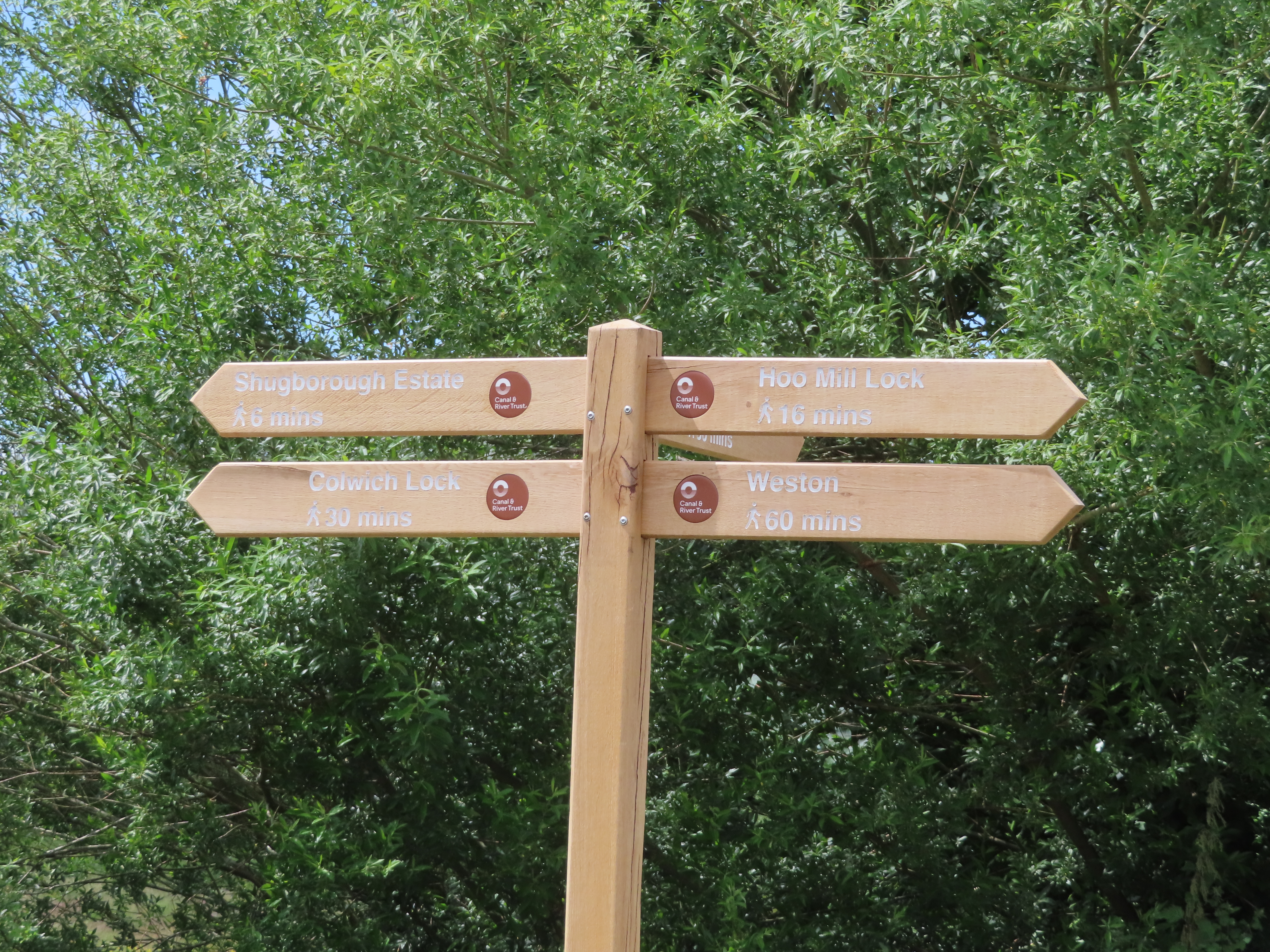
C&RT have erected a new signpost at the junction. Not quite as striking as the big white junction sign. This one is for the gongoozlers though.

There was a batch of about 6 or 8 mallard ducklings. Somebody out there must know what the odds are that one will be the yellow colour seen here.

This row of cottages is just before Colwich Lock. The white painted one is called Stonemason's Cottage and it has all sorts of signs and equipment outside it. I'm not sure if any of it is related to the trade named. I can find no references to stonemason at Colwich and Little Hayward in a rapid search, but the cottages were there in 1880 and opposite was a short arm, that had more or less disappeared by 1900.

This building has always made me think that it had a bit of history. It is the fact that it is next to the canal, there is a wooden structure near it and what could have been a wharf area by it too. I have now got round to looking it up and have found that it was known as the Wolseley Corn Warehouse. I can see it on the map in 1881 but it seems that it had been there before 1838 as a John Yates was advertising rape cake for sale as fertilizer. I think a quick check has found that John Yates was born in 1780, In 1842 he also had guano for sale. I think that in 1848 John died as the warehouse was put up for auction. There were several heavy and light carts, along with horses and a boat! There was all sorts of equipment for producing feed and fertilizer cake. By 1870 the place was up for auction once again under the ownership of Walter Yates and John Hulme.

Looking at the maps the warehouse seems to have butted up to the canal and there was some set back from the water a bit. Looking at the current building it doesn't seem as if this was the original buildings that have been adapted. I expect that they have demolished after 1961, the last time I can see the old configuration. It was a shame they couldn't be saved.

We stopped in Rugeley for a bit of shopping at Tesco and were soon on our way again. We stopped for water at the Spode moorings, just after the bridge by the Ash Tree pub and boat club. There was no waiting at the 'tunnel' and we were soon mooring up just after the winding hole at Handsacre. This stile is just by the mooring and I love the path leading off through the field, tempting us to follow it. 

#
However we followed a more beaten path to the Olde Peculiar pub just up the road. They did have Olde Peculiar on tap, but I had a pint from Exmoor brewery. The chips hope was open as we passed on the way back so we stopped for a bag to have with our salad tea. I was shocked when Helen said it was £4, but then I saw the size of it! It will does us two meals easily, so not too bad.


Friday, 10 June 2022

Back to Black.

 Well here we are back on the boat. We did have a dash back to the boat a couple of weeks ago to move the boat up to Stone from the marina so that we could dash back at the weekend to move it into the dry dock for blacking on the Monday and then off home and back to the boat to mover her out last night. This boating lark can be a logistics nightmare when we are busy. I don't know how folks move their car around all the time!

The iris' and marsh marigolds provide a splash of buttery yellow on the banks as we passed on the way to stone.

It is interesting that the old Armitage tunnel has been once more branded as a tunnel rather than a bridge. There are much longer bridges than this that you pass under, like every motorway. I can't see everybody putting their stoves out in winter though.

Love or hate them the Canada geese goslings are really cute and this bunch seemed to be in a creche as there were different sizes, and plenty of them.

We put a long shift in and stopped for the night about 2030 at the lovely moorings between Sandon and Burston. It is a really quiet mooring and was a lovely evening. We then finished the trip to Stone and moored up before Star Lock and close to the Scout hut. I then caught the train to Lichfield Trent Valley and picked up the car before heading back and picking Helen up.

After a busy week of Jubilee events including a carnival and a concert (with me singing too), we dashed back on the Sunday evening, ready to put the boat in the dock early Monday. We were straight back home having checked the hull once it had been blasted. There was more singing, and a talk to a WI and Helen was pretending to be ill for some training Doctors at the Medical School for a couple of days. Then we headed back, getting to the boat about 21:30 on Thursday.

We were in the northern dry dock and the job looked all done when I had a good look round.

The two bow, and two stern anodes were just down to the straps so new needed to be welded on.

In 2016/17 we had some mid section anodes added as there was pitting around the area. When we saw the hull after blasting this time we could see that they were about half gone. They were slim line ones so as not to catch! It was very clear to see that the anodes worked, and the area they covered, as between them the pitting developed, but still within normal levels.

This is the ash pit that is used to try to block the gaps between the stop planks that are dropped in at the mouth of the dock before the plug is lifted and the canal drains.

There are four docks at Canal Cruising in Stone. We weren't in the oldest that are those nearest the Yard Lock and were built in 1772, when the Trent and Mersey was being dug. Our dock only dates from mid 1850's. The water drains out to below the lock so is not lost to the canal. There is a hatch, about the size and shape of a weed hatch that is lifted with a chain block.

We were out by 09:15 and headed down the lock and lo and behold there was a space on the tow path side before Star Lock.  I headed off to the car and drove back to the marina and Helen went shopping. The trip from Lichfield Trent Valley went according to plan with a change in Stafford and I was back in two hours. We were just getting ready to head off when there was an almighty crash and a boats stern appeared in the window. It seems that they had decided to moor astern of us, and the wind had caught them as they were reversing for the space behind us. There was more room ahead of us. They proceeded to drag down the length of our boat. They had a bow thruster too! Maybe if he hadn't he would have been reading the signs better. We headed out and the water point was free so we topped up before getting off again.

I was struck as we approached Lock 88 as to how much it looked like the bridges on parts of the BCN. I wonder if as there the builders were worried about subsidence from nearby salt workings. As we passed under a few cows and a young calf decided the grass was greener on the other side.

We tied up back on the spot we had the last night out on the cut. Despite the wind it was really nice as we were sheltered by the hedge. The first day we have had the chairs out, and a fortunately a bottle of fizz had been cooling so that came out to celebrate.

We even had a new flag for the swan's neck, the Est Riding of Yorkshire ensign.

The blacking has already been scratched by a wandering boat so it is a good job that I'm not too precious about these things. The trouble with nice new blacking is that it makes it much more obvious all the other rust etc. I really will have to get busy this summer. I impressed Helen as I was able to predict when a boat was coming from Sandon, long before it could be heard. I had to let on that it was when the old piling on the off side poked up above the water it was obvious the lock was being filled!

I am not able to quantify it but the speed of the boat was substantially faster than before now the weed, or more likely algae had been blasted off. The smooth hull will save us money on diesel for sure. Not enough to recoup the cost of the blacking though I'm sure.


Thursday, 12 May 2022

Aftermath and Reminisces

 All the adulation of the homecomings had subsided by the time I returned home. But I was wrong as I was asked to attend a presentation at the Town Hall in Hedon in October. The Mayor at the time H.V. Suggit MM, JP had decided to give a tankard to all those from the town he had served in the Falkland conflict.

This is me receiving my tankard from Henry Vie Suggit who had a wet fish shop in Hedon. However years later I have discovered that he was a war hero himself. Having signed up and being at the retreat to Dunkirk when he was wounded and captured. One fit again he managed to escape 5 or 6 times, a couple of times on the run for a couple of weeks at a time!

Initially when I was home I was told that United Towing and Salvage Co. Ltd. had received my CV and application but at that moment they had no vacancies, but they would keep me on file. After about a month I was invited to King William House in Lowgate, Hull,  for an interview. I was offered the job and told that to be at King Billy at 23:00 on a Friday at the end of October to catch the coach down to Brize Norton. Now my previous company was one of the premier shipping companies in the country ans you were expected to travel to and from ships in smart gear. I turned up at 22:45 in jacket and tie, and there was nobody else there!. I thought I had the wrong day or something other than the fact that there was a coach there. I should have known as at 23:10, when the pubs chucked out the crew started arriving in drips and drabs, and we boarded the coach. A headcount was done and one was short. It was the Captain. A few minuets later this bloke that looked like Captain Pugwash with a Scouse accent climbed aboard and off we set.

King William House, the company headquarters at the time, as it was in 1982.

Everybody slept it off on the way down to the plane. Once at Brize we filled out all the forms that the RAF require and had breakfast before being boarded on a VC10 and off we flew to Dakar in Senegal. We weren't supposed to be there diplomatically or something as we were parked as far away from the terminal as possible and allowed to stretch our legs whilst they refueled the plane. Once re-boarded we took of for Ascension Island, landing just as it got dark.

RAF VC10 at the start of the Falklands conflict

We were shown to some tents with beds in and I remember the 'bathing facilities' as they were the odd sink and a long bench with holes in with no divisions between them. After not much sleep, and pretty early we were roused and ushered into a canteen for a full English breakfast before being trucked to the airfield where we were ushered up the after ramp of an Hercules transport plane. It was full of cargo, there were engines, post bags and loads of other unidentified things. Along either was along bench of what looked like camping chairs with seat straps. There was practically no leg room! The load master talked us through the flight. Once we got up in the air we would be allowed to move and find a spot where we wanted among the stuff aboard. Eventually we got the signal that we were free to move about. The veterans of this flight had bought sleeping bags and adjourned to the stern ramp which had loads of space but was very cold. If you were lucky you could lie on the mail bags and hope it would be soft. It never was! The one place you didn't want to be close to was the one toilet that just had like a shower curtain round it. The flight would be 12 hours, thirteen if unlucky. Even longer if everything was against you! The in flight catering was a cardboard box with a couple of sandwiches, a chocolate bar, and apple and that was about it. There was a boiler for hot drinks too. Sleep was next to impossible, and the time dragged. The highlight was when the plane was engaged in mid air refueling.


Not my picture, but we were allowed to watch the procedure. The plane had to arrive over Stanley airfield with enough fuel to be able to fly to Chile in case the weather made it not possible to land. This was the old airfield that had been bombed by the Vulcan bombers in the conflict. Some of our crews were unfortunate to have reached half way to Stanley then had to return to Ascension because of problems. The next day the left again only to be diverted to Chile due to weather, and then the following day fly on back to Stanley.

We landed in the late afternoon and there was a general melee, and as I hadn't got as clue what was going on I felt a little helpless. That is until I saw my suitcase being loaded into a Land Rover and being driven off! Quick enquiries garnered that it wasn't the right Land Rover, so I managed to grab another driver and off we sped to overhaul it before it disappeared completely. Fortunately it stopped at a rapier battery site not too far away and I recovered my case. By the time I had got back to the airfield the rest of the crew had gone so I cadged a lift down to the harbour and then waited for a boat to come alongside to take me out to the anchored Salvageman off the pier.

The Salvage tug 'Salvageman' off Stanley.

I dropped my case on the deck and skipped over the bulwark and made my way to the bridge. There I reported to the 'Old Man' and was just telling him the story of the case, when the bloke I was relieving came up and said he was off, taking the boat I had come off in. Not a very long handover. After saying goodbye I was back on the bridge when all the alarms started sounding. It was my first time on the ship and didn't know where anything was, or how to cancel the alarm. I was told it was a fire alarm from the engine room workshop, and as the Mate it was my job to sort it out! I grabbed a radio and tried to find my way to the right place. This was helped by the smoke and several people heading in the same direction. Once there I could see a man looking pretty blackened round the edges, but walking and talking. After establishing there was no fire we went up to the bridge and did our best with the burns to his hands and face, and then sorted out a boat to take him over to a nearby warship with a doctor aboard. Later we heard the full story. The injured man was one of the RN radio people aboard. He was in the workshop busy sawing the 4.5" shells up to make souvenirs. The shell itself is full of blue cordite granules and these he tipped into a bucket to dispose of over the side later. All would have been well other than the fact that he was smoking as he was doing this! He was lucky as he flicked his ash off and it dropped into the bucket of cordite!! Luckily it was an open bucket and as it wasn't contained it didn't explode but just flash off searing and burning his clothes and exposed skin. We were all very lucky it seems.
It turns out our job at that time was provide a platform for the RN divers to go down to the wrecks of the HMS Antelope and Ardent and recover all the secret and dangerous stuff they could. They were bringing up the 4.5" shells from the main gun. These were then taken ashore and blown up. Some obviously were taken for other purposes. I seem to remember they were taking about 12 and blowing them all up together. They were stopped from doing this many as the explosion was causing damage to wrecked freezer plant on the west shore of San Carlos that was being used as an hospital. You can see in the above photo how the projectile part has been cut off. The brass shell bodies are crushed due to the pressure at the sea bed.. The buoy is one that we found drifting and had come from an oil rig off the Argentine coast.

This is me and one of the RN radio team ashore burning secret documents using the ships boat, and doing a bit of site seeing too.

I did several trip to the Falklands on the Salvageman and United Towing's other tugs Yorkshireman and Iraishman, and later Euroman too. I think I must be the only man that has served in the Falklands on four ships that are inscribed on the war memorial in Stanley, the three tugs and Lycaon. The duties were varied, Here we are towing a floating hotel 'Safe Dominia' that had been brought down by a semi submersible vessel and was to be used as floating barracks.

In 1985 I joined the Salvageman in Soth Georgia where the ship had been contarcted to assist with the raising of the Argentine submarine in Grytviken Harbour after being attacked in the conflict. It was a great job, and a fantastic chance to visit a part of the world I would otherwise have little chance or in the normal course of work. Here the the British Antarctic Survey vessel Barnsfield is passing us in Grytviken Harbour.

A look back towards the whaling station with Salvageman alongside from close to Sir Ernest Shakleton's grave.

The graveyard can be seen in the distance in this photo. The submarine has been made watertight and has been injected with water and it has come to the surface at last. We were eventually to tow her out to see and sink her in 2000 mtrs of water.

Salvageman alongside near the slip way way whales were dragged up and sliced and diced to go into the boilers to make oil. Everything was pretty intact at the time.

I grew to love that ship and I was so sad when it was sold and I had to leave the company that I'm not ashamed to say, I cried. The only other ship that happened was when I had to leave the Patroclus, one of the most beautiful ships ever built, a class of eight. They were the peak of perfection just before the boxes of tankers and container ships took over. I sailed on the Priam and Patroclus and had some fantastic trips on them.

The object of my other bout of tears. I had some lovely runs to the Far East and back on this vessel and a six month round the world trip on the Priam. It might as well of being a cruise as we had so much fun and with a great crew too. Definitely the good old days.


Tuesday, 3 May 2022

They think it's all over! It is now.

 The official War Zone started just south of Ascension Island and for us in the Merchant Navy we started earning a war bonus. Vessels were staged for leaving Ascension in some sort of order that they may be required. The Royal Navy ships went down first along with their replenishment vessels, followed by the 'invasion fleet' with the assault ships and passenger liners with the troops, along with their support vessels. The RN ships were fully stored with ammunition etc. Their support ships had their first resupply and we were carrying the next lot.

When we left the anchorage at Ascension we went on to 'war' watches. This meant that no longer did I have the bridge and wheelhouse to myself during the day, and just a lookout and myself at night. Now there was a gaggle of people to keep me company! There were four lookouts, one on each side looking ahead, and another two looking astern, one on each side. There was a signal/radio man, a couple of messengers and odds and bods that I'm not sure what they did, other than stop me walking from bridge wing to bridge wing easily! The bridge kettle also seemed to permanently on.

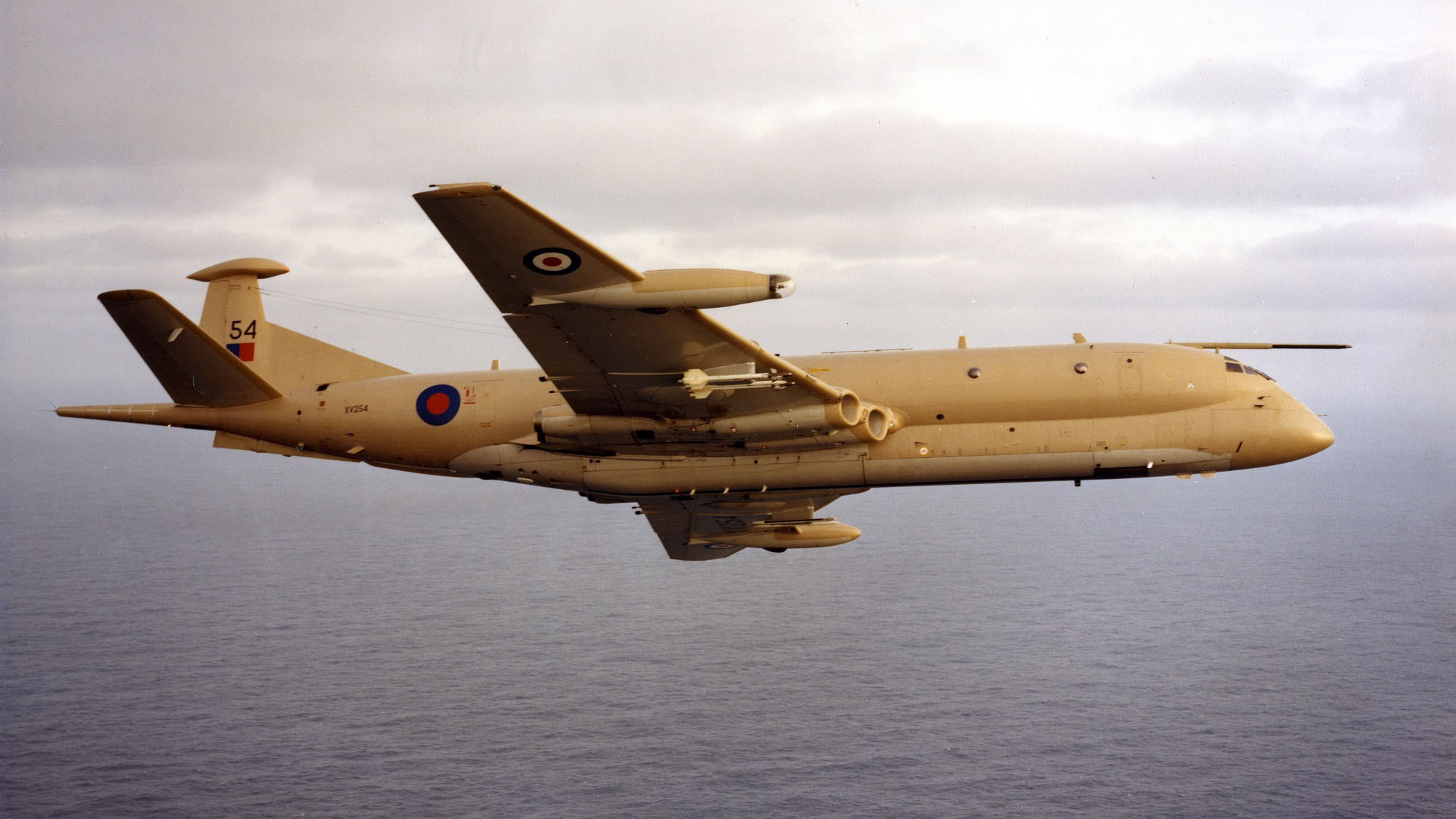
It was the day after we left for the South that I had my biggest shock. It was a beautiful day, flat calm and one of those days where you would normally hang about on the bridge wing soaking up the sun. I was on the 12 to 4 watch just doing the normal things when suddenly one of the forward look outs screams out the bearing of a low flying aircraft to st'bd!! I very nearly had to go and change my trousers as it was such a shock and so unexpected. However we had had reports of ships being bombed by transport planes from Argentina rolling bombs out of the rear ramp. However I was reassured when the bit of training we had kicked in and I dashed over to the wheel, (I can't remember now whether we were in autopilot as we normally would be, but as we were in a war zone I suspect that the wheel would have been manned), banging the general alarm button on the way. I gave orders to alter course to aim the ship directly at the threat and waited for developments. The Lt. Cmd and the Captain were still on the way up when this massive plane passed right over head, seemingly at just above mast height. It was an RAF Nimrod reconnaissance plane!! It gained height went round us again and waggled its wings before heading off to Ascension. It took my heart a little longer to calm down, but it was reassuring to know that we were being watched over.

Nimrod plane from just after the conflict as it is rigged for in flight refueling and has sidewinder missiles under the wing for self defense.

As we headed further south the weather got colder and rougher. Ships were arriving but obviously no landings had taken place as the political and diplomatic battle was still ongoing. As there was nowhere for us to wait in a port or an anchorage we were directed to an area of ocean to the north of the Falklands and just outside of the TEZ (Total Exclusion Zone). It was originally designated the TARA (Tug and Rescue Area). That is one thing I found we had to get used to very quickly; everything was referred to by their initials and never using full words. It took ages to understand what the hell they were talking about half the time!). It was later re-designated the TRALA (Tug, Rescue and Logistics Area). In this big circle of sea we were given a 5 mile radius bit to remain in at all times. This is where the boredom started, just going up and down trying to find the most comfortable direction that reduced the rolling and pitching in the sometimes heavy seas. This wasn't always possible and I remember being called out of my bunk in the evening to go and try to capture some 1000lbs on wooden skids that had broken loose and were careering around the tween deck, threatening to punch a hole in the ship's side. A gang of us managed to lasso them one by one as they slid past, and get them lashed up securely.

Luckily the first skirmish of the Falklands Campaign was the retaking of South Georgia on 26th April. We were ordered to head further south and ended up anchoring of Stromness whaling station, in Stromness Bay on the north coast of South Georgia.

The whaling stations on the island are marked in red. Leith, just north of Stromness in the whaling station where the Argentinians went ashore to remove all the scrap and raised the Argentinian flag. An event that was the spark for the whole conflict.

Whilst here the weather was often dense fog, but I well remember one occasion that we received a message that an inbound helicopter was coming to us. We had no helideck, and as can be seen from the photos we had lots of masts, derricks and aerials that made working with helicopters challenging. It was dense fog at the time, we couldn't even see the heavy lift derrick midships. We could hear the helo and it got closer and closer and eventually we could see it just off the port bridge wing. It slowly drifted closer and closer until in had one wheel on the rail. The door opened and a couple of sacks were thrown out and they departed. This was our mail!! We were used to getting mail once or twice in a three month trip, but when we were a Navy party I was receiving mail from the UK two days old!! That just shows the importance given to mail and morale. The helo was only very small, as Westland's Wasp from HMS Endurance I seem to remember. She was the RN ice patrol vessel.
Whilst at anchor we had several vessels come along side us so we could transfer our stores to them. I remember some of the requisitioned Hull trawlers coming alongside. The five had been taken on as minesweepers etc and were manned by RN crew.

HMS's Junella, Northella, Farnella and Pict taken from HMS Codella.

we also transferred cargo using helicopters using long lines so that they could remain above the masts etc but still hook on to pallest etc to lift them to other ships. We also had the RFA Blue Rover alongside.

RFA Blue Rover alongside our st'bd side. Our most popular request was for 4.5" shells. These are used by the Roayl Navy by their deck guns and were being used to bombard the Argentinian positions ashore, prior to any landings. Later, once troops were ashore we were getting requests for the army artillery shells too. You can see that the weather wasn't too clear on this day either.

At some stage there was a scare that Argentinian planes had the capability to reach South Georgia and attempt to bomb shipping so we were ordered to put to sea and hide in the icebergs! There were plenty of small icebergs to get amongst, but other that an echo on a radar it would be very easy to discern our ship from an iceberg as they have 4/5th under water so will drift very slowly compared with us! Still it broke the monotony.

We were soon back in Stromness Bay and here you can see the whaling station at the head of the bay. One night we received a message that a ship would be coming alongside to take on supplies from us. It had been snowing and as I was on watch I had to call the crew out to sweep the hatches so that I could open them up. They refused to turn iout. No amount of persuasion by me would get them moving so I had to call the Chief Officer. They wouldn't cooperate with him either so he had to call out the officers and others to rid the hatches of snow so we could get on with the work. The REME soldiers did everything else. I can not now remember what their problem was but it shows that not everybody was as dutiful and keen to serve as we may think in time of war.


Looking at the picture in close up you can see the tanks where the whale oil was stored along with fuel for the whale catchers and the base. You can also see one of the Hull trawlers alongside the small jetty there. There were catchers up on a slip and to the right the beach was littered with propellers for the catchers as they must have had many damaged when working in ice. The station and beaches were also littered with sea elephants.

As the landings at San Carlos were secured and the troops advanced it was our time to move up so that the supply lines were reduced. We returned to the TRALA and then one evening we assembled with some other ships, names of which I can not now remember, were put in a convoy and in darkness we made our approach to San Carlos Water. I was grateful for our training in convoy station keeping and we approached the entrance to San Carlos. It was a tense time and it was interesting to see how different people coped differently with it. I was on the bridge in the pitch black. as we approached the turn into the haven there were several reports of an enemy warship ahead. They had mistaken a patch of lighter rock on Fanning Head as it really did look like a warship until we moved further up and changed aspect. I have a memory of an explosion high in the sky as an Argentinian plane was hit by a missile but looking at the records there was no account of one being 'downed' at the time. We anchored in San Carlos, off the Cold Store that was used as the forward hospital just after the landings. It was Monday 14th June 1982. Later that day the Argentinian Troops on the Falkland Islands surrendered.

The land fighting had finished, but we were constantly getting air raid warnings as the Argentinian air force kept making dummy runs etc to the edge of the exclusion zone and then veering off. The speed of the planes meant that even with 200 miles to the edge of the TEZ we still wouldn't get much notice if they did enter.

 A few days later we were ordered to move round to Port William, the bay next to Stanley Harbour. We anchored there, and there we remained for ages. Except we had one more trip back round to San Carlos to go alongside the tanker 'Scottish Eagle' that was moored there and received ships alongside to take bunkers. I must say our Capt. Lawton didn't do too much damage when he went alongside. We had watched several ships cause damage to both vessels as they tried to get alongside. Big ship masters were very unused to close quarters ship handing as they would normally have a pilot when this was required. Little did I think that in less than ten years I would be a pilot and chucking big ships around on the Humber for a living.

Once topped up we returned to Port William and a monotony of anchor watches and listening out on the radio. I did get ashore once to have a wander around Stanley for a few hours, and we often had small vessels come alongside giving stores, water etc. Most of these would be the Salvageman, Yorkshireman and Irishman of United Towing. As they were from Hull and to break the monotony I would put the ladder down and go for a cup of tea and a chat. This is when I heard that they may be recruiting. The traditional Merchant Navy was dying on its feet and it was only a matter of time before we were all made redundant. It was seemingly the sole topic of conversation aboard, which didn't make the time pass any quicker! I sent in my CV from the Falklands.

We also provided Rand R for people based around the islands who had no proper facilities such as pilots, rapier battery troops etc. They would come and have a hot shower and a night or two of a comfy bed and being warm with regular food and a few beers and a different face to talk to. Eventually we heard that we were to be relieved and the new crew arrived on 22nd August and the next day we joined the MV Norland for a five day passage to Ascension were we would transfer to a VC 10 for a flight to Brize Norton. The Norland was very beaten up, she had been acting as the ferry between Ascension and Stanley since the surrender and was looking the worst for wear. However the crew were great and looked  after us well. There was even a concert party with a comedian and dancing girls for those aboard.

Message received on the MV Lycaon just before we left for home.

When we flew into Brize Norton there were no big welcome ceremonies as I'm pretty sure we were the last people to be relieved following the surrender. My eldest brother and his family lived close by and they cam to meet me. I can't remember how I got home, whether it was a hire car or what. Thus ended a great adventure, or so I thought.




Thursday, 28 April 2022

The Vessels have got smaller over the last 40 years.

 I did say I would put something on this blog even though we are not out boating at the moment. Our lack of boating is due to be extremely busy with other projects. The first of this has just started so I thought I would share a little of it with you here.

It is the 40th Anniversary of the Falklands Conflict and as the coincidence of this, in which I took part, and the need for an exhibition at the small museum in our town, Hedon near Hull, of which I am a trustee, meant that I stepped forward to produce something.

The Mayor of Hedon at the time was Henry Vies Suggit MM, JP., and he presented all the men from the town who took part in the conflict a tankard. I thought that it would interesting to track down these tankards and try to reunite the recipients. There were no records of who received one, but with a couple of photos and local social media and press I managed to track down 11 of 12 that seem to have been awarded. Not everybody wanted to be involved, and there is one person I have not been able to identify and track so far.

It turns out that H. V. Suggit was a WWII war hero himself. He was badly injured at the retreat to Dunkirk and captured. Once a prisoner of war he managed to escape five time! The stories of the men down in the Falklands was full of sinkings, salvage attempts, near misses, beach landings, boredom and tedium and hopefully I have managed to show this in the exhibition.

I don't feel able to share the others stories on this blog but I can give you mine.

In April 1982 I had just completed my Chief Officer's Certificate of Competency exams and was looking forward to a few weeks off before returning to sea. The British Merchant Navy was in terminal decline at the time through containerisation and foreign competition. I was going out with a girl from Wakefield at the time and my folks were living and working in New Zealand. I was in the West Riding helping her Dad with his cattle and other work around the place he had when one early evening there was a phone call. I was quite surprised when I was told it was for me! It turns out that it was my company, Ocean Transport and Trading (the group name for such shipping companies as Blue Funnel, Glen Line, Elder Dempster, Hendsersons, Guinea Gulf and part of Ocean Containers Limited). I was asked if I would join a ship the next day? I said that I was looking for a few weeks off and they replied that it is purely voluntary but they couldn't guarantee me a job when I wanted to come back. I said I would go but as I wasn't at home I would have to go home and get my kit first. I still have no idea how they got the telephone number!! They agreed to this and hired me a car for the next day from home.

I was to drive to East Midlands airport and catch a flight from their to Cornwall to be taken to Falmouth to join the vessel with the other crew. As it turns out there was a massive pile up on the M1 and I missed the flight. I was directed to keep the car and drive all the way to Falmouth. I got their quite late at night and the next morning at an early breakfast I met the rest of the crew before being taken to the river and been taken up to our vessel that was moored between buoys in lay up.

MV Lycaon being assisted to the buoys on the River Fal for lay-up just a week before we boarded her.
The phone call came on the 21st and we boarded her on St. George's Day 23rd April.
The ship had a Blue Funnel name but an Elder Dempster Funnel! As sign of strange trading patterns in the then economic climate.

We had learned that the vessel had been STUFT (Ships Taken Up From Trade) by the British Government to assist the military in any Falklands campaign that developed. We were under the impression at the time, I'm not sure why, that we were just delivering stores to Ascension Island. It took us a few days to get everything on line again and we then sailed for Southampton. As we entered the port the local news was on the TV and radio and stated that we were arriving and would be immediately loading ammunition for the Falklands Task Force. Immediately there was a queue at the Mates and Master's cabins with requests to be replaced! As it was 'purely voluntary' they had to be allowed to leave and replacements found sharpish.

LYCAON was built at the Kherson ship yard on the Russian Black Sea. She was a Dnepr class vessel. She was purchased by China Mutual Steam Navigation Co. Ltd (Blue Funnel) as as quick way of boosting container carrying capacity (and quite cheaply).

11,750 GT, Length 533’ (162m), beam 72’9” (22.2m), depth 30’ (9.1m). Engine 10,600 BHP for 18kts.

She was completed in December 1976 and was later registered in Liverpool. Despite owned by ‘Blue Funnel’ her buff funnel was for Elder Dempster Ltd another shipping line within the company. She was sold in August 1985 and after several changes she arrived at Alang Beach in India for breaking up in March 1998.

All Blue Funnel’s ships were named from classical Greek legend or history.


Railway wagons arrived alongside the vessel and the stores were lifted aboard. There appeared to be no loading plan, and certainly no stowage plan so we had no idea where everything was, and not even what much of it was? We hoped that somebody did! As this was going on they were also fitting a RAS mast. This was the point on the vessel that allowed Replensihment At Sea between vessel running on parallel course via a wire to run a cargo net of hose for fuel/water. More and different radio equipment was being fitted and more accommodation was added to take the extra bodies we would be carrying.
Lt. Commander David J. Stiles joined us and we became Navy Part 1900. when we sailed we had Royal Fleet Auxiliary radio officers, several RN staff, An Army Ammo. Technician, a troop of Royal Electirical and Mechanical Engineers and half a dozen Royal marines, plus our own crew of course.
Our main cargo appeared to be of 4.5" shells for the Royal Naval Guns on the ships. There were all sorts of other things too; pallets of hand grenades 105mm army artillery shells, land mines, sea mines, missiles, 1000lb bombs and much more besides. More soberingly there were many pallets of black body bags and crates of formaldehyde!
We finally sailed on 4th May. Once in the Western Approaches we were straight into a practise RAS with an RFA tanker. It was 'novel' to sail on a parallel course with another ship at about 6 or 8 knots just a couple of hundred feet away. It required the best helmsman and concentration. It turned out to be the only time we would carry out this operation.

We headed south and headed for Freetown in Sierra Leone. Elder Dempster's main shipping routes were to West Africa and I had been to Freetown several times in the past. We were there to take fuel and water and a few fresh stores. Usually it is a manic time as many of our crews were from the port and there would families coming and going along with the dock workers and plenty who were just there to see what they could nick! Not this time; an armed guard was placed at the foot of the gangway and if there was no name on the list nobody got aboard. It was heaven, rather than having to guard every thing and running around trying to keep order. We were only their a day before heading off once again, this time heading to the South Atlantic staging post Ascension Island.

The theory of zig-zag patterns

On the passage Lt. Cmd Stiles was training us up to Navy ways and methods, one of which was how to work in a convoy. We practiced zig zag patterns as above. They are designed to make it difficult for submarines and aircraft to plot and guess your future position. Basically there is a book full of different patterns that have different code names. as in the picture above the actual course set is not the actually direction of progress that the vessel is making. It looks simple enough, and if the time between each change of course is hours it is easy. However if the time between each alteration is a matter of minutes and the change of direction acute, and other ships of the convoy are close by, if you don't all do the same at the same time it can easily result in collisions or worse. There is a zig zag clock that every ship in the convoy starts at a synchronised time and so execute the changes at exactly the same time.

We learned what to do as officer of the watch when action stations were called under different conditions, such as when enemy surface vessels, submarines aircraft and missiles were seen. There wasn';t alot an unarmed ship could do but we were drilled repeatedly in them. I was the ship's navigating officer so all this dodging about was a nightmare to keep track of so that you knew where you were. And don't forget that these were the days before Satellite Navigation. Between sun or star fixes or distance and bearings from known points on land we had to DR or dead reckoning when you just plot the course and speed and if possible a guess as to what the drift of the vessel would be due to currents etc.

Yes it is me, on my previous ship, and I wasn't posing but taking the morning sight to run up to noon, (for those that may understand that).

We arrived to anchor of Ascension Island, along with plenty of other ships of the task force. There was much coming and going of helicopters and craft as more stores were loaded and others transferred to other vessels. We passed on some of the small arms ammunition and gained more missiles that were flown into to Wideawake Airfield, that at this time became the busiest airfield in the world.

Was this to be the calm before the storm?