Total Pageviews

Wednesday, 27 September 2017

Chemicals, coke and coal.

It was one of those lovely autumnal mornings with mist on the water and fields first thing and then when the sun popped up it was really hot on your back, so with very little breeze a fantastic day for a cruise. We didn't set off until about 1000 as the weather doesn't instill a feeling of urgency at all.

As we cruised down the cut towards Oswaldtwistle a couple of beautiful warehouses were passed. Apparently land owners along the the cut were allowed to build their own warehouse on their land and charge tolls for the use of them on top of the canal tolls. However if the landowner did not construct one for themselves with in a year then the Canal Company were entitled to do so if the wanted to.

A lttle further on was this magnificent building that is real need of some TLC. It was being used by a couple of guys as a sort of junk store, but at least it is being used.

A little further still on was this art work on the wall with a map of the canal.

The canal bends round the William Blythe Chemical Works. It was established here in Church in by the bloke of that name and he had is first patent in 1854. They make chemicals for all sorts of processes such as coatings, purification, print, polymers, pigments and food and feed additives.

Just round the corner from the chemical works was a weed filled  basin, but right next to it was a series of beehive ovens. There was Aspen Colliery here that opened in 1869. The coal from the mine was turned to coke to be used in a nearby steelworks and transported there by canal.

The kilns were known locally as the 'fairy caves' and were built when the canal opened here in 1810. There were 3 rows of 9 kilns in the bank. They were buried in earth to give them a bit of strength and to keep the heat in more. Once the kilns had been erected they were heated up slowly for a few days by slowly building a wood fire up with coal. Once up to heat, to prevent cracking, the coal from the pit would be loaded in at the top door. The bottom door would be mostly sealed up to restrict air. After about two or three days the gases had been burnt off. These could be seen burning at night in the sky and emitting a smell of rotten eggs, the fire was put out by closing off the air all together. The openings were then used to spray water on to the coke that had been made, being careful not to cool the actual oven down too much. About 1.5 tons of coal made about 1 ton of coke.

From Church the canal makes a great loop round the head of the valley and it was great to look back and see where we had stayed the night.

On the way from Burnley to Blackburn I have seen several of these structures on the tow path side. I can't realy decide what they are for. I wondered if they were an anti mooring device as the ropes would cross the edge very easily. Please let me know what they are if you can.

The canal weaves it's way through the countryside where there were numerous  industries as well as coal mines. There were mills of course but also fire clay works, brick works and quarries. Above can be seen the spoil heap of a quarry and a quay for loading up the barges.

This is all that remains of the coal discharging wharf for Whitebirk Power Station. It was on the offside and taken over the canal to the power station by overhead power station. The power station, otherwise known as Blackburn East was opened in October 1921 and closed in 1976. In the 1980's a retail park was built on the site. The fact that it was once there is given a way by the large transformers and the many lines of transmitter pylons. The coal mainly came the 15 miles from Bank Hall Colliery Burnley.

The Imperial Mill is hanging on by the skin of its teeth. It was built in 1901 by a share subscription. After WWI trade declined and the Bank of England stepped in to rationalise the industry and set up the Lancashire Cotton Corporation. It survived and was later sold to Courtaulds but stopped spinning in 1980. The chimney was demolished but the rest survived despite it being largely unoccupied for about 24 years. The the 'Imperial' is on the engine house, minus a chimney and the copper domes really make it stand out on the skyline.

As we passed the Graham and Brown Wallpaper factory there is the view of this decorated phone box.

Another mill we pass is the Daisyfield Mill. Unusualy this is a corn and flour mill that was opened in 1871 and had the railway lines running through it. Grain was lifted from the barges on the canal to upper floors where originally 10 pairs of stones ground the grain. It was owned by Joseph Appleby and Sons. By 1889 it was a rolling mill and was producing 3000 sacks of flour each week. Ranks bought it is 1928 and finally closed in 1968. It was later used as warehousing and then converted to offices in 1990.

I loved this old stone warehouse, that actually had brick upper works added to it at a later date. I like the small doors for direct access plus the mooring rings and the cast iron rubbing bands to prevent damage to the stonework or catching the boat.

We were hoping to be able to moor at Eanam wharf, not under the canopy but quite close. However there were no rings and the towpath had nowhere to put pins in so we just had to sail by.

We eventually moored at the top of the locks where there were a few rings. After lunch we went for a walk to explore Blackburn.

Tuesday, 26 September 2017

Church on a Monday?

There was a very little bit of slight rain, so short that the ground didn't really get wet this morning but we didn't leave until near to 1000 and not a drop after that. It was nice and still and the sun really did try to show her self later in the day. A nice autumnal day on the cut, despite the leaves been on the trees and only just turning colours.

This bridge looked a bit different from the ones we had seen previously on the canal. The plaque on the parapet says ''Dallam Forge, Warrington'. The forge was started in 1840 and in 1851 was awarded a Gold Medal at the Great Exhibition in 1851 for excellence of iron and railway plant. They were later known for building steam cranes and also had mining interests. In 1930 they were taken over by the Lancashire Steel Co,

Behind the trees is the M65 but despite that this mooring was lovely with a view across the valley to the right. The chap had his cat on a lead. Our Macy doesn't seem interested in leaving the boat at all unless the sun is shining and it is warm! Not sure where she gets that from Helen!

This crow on a post seemed to fit the mood with the mist and dull day we were having.

The hills were just emerging from the mist and giving us distant views as we meandered round the valley heads.

The Smith'sswing bridge seems to be left open now but it must have been quite busy when the Altham Vitriol Works was working. Vitriol is another word form sulphate so the chemical works must have used the products of near by Moorfields Coal Mine.

Just by Smith's swing bridge is this building. It doesn't look like a house as there are no windows in the sides. However these large 'windows' at front and back seem to be cargo loading doors as in a warehouse. To argue against there doesn't seem to be any form of crane or hoist above the 'door'and why would the ground floor one not go down to ground level? Anybody any ideas? Just round the corner is a memorial to the Moorfield Colliery. The shaft was sunk in 1881 and in 1883 there was an explosion underground and 55 men and 13 boys lost their lives. Eric Morecambe was a 'Bevan Boy' down Moorfield in WWII. It closed in 1948 but the coke works next door continued until 1962.

This sign was erected in 2001 to celebrate the 200th anniversary of the opening of the canal to Clayton le Moors from Burnley in 1801

The sun was really trying to shine and was managing to heat us up as the air was still.

Enfield was the terminus of the canal between 1801 and 1810 when they ran out of money partly due to the  Napoleonic War. That is one reason a superb set of warehouse were built her. The earliest was built in 1801 and then added to through until 1888. There were warehouse, stables, a toll house a residence and workshops on both sides of the canal.

I really can't understand why nothing has been done with these buildings as they just ooze appeal and the space must be useful for many purposes.

The warehouse to the east was occupied by the Sea Cadets but is again empty. There is a large open space in front. C&RT or British Waterways had an assessment done and it was pleasing to read they it stated that everything should be retained!!

We are back with a few swing bridges now but Helen likes these as the windlass has to be used to wind up the securing pin. It seems that this system means there is less abuse as they have all swung very easily.

The bridge over the Peel Arm that was built to serve a calico works that was owned by the Peel family of Sir Robert Peel fame. Later there was an idea to extend the arm to Accrington but this didn't go ahead. Along this section the tow path changes sides to run to the east of the canal. This was on the request on Lord Petre of Dunkenhalgh Hall to prevent poachers and trespassers gaining access to his land.

The marker for the half way distance of the Leeds and Liverpool Canal.

655/8  miles. It seems a lot further than that

Our mooring close to St. James church in Church. The church is now closed but looks lovely with some very expensive monuments in the church yard. Offers are invited to purchase the building and the interior looks great with some expensive stained glass.

Monday, 25 September 2017

Moving onward at last.

After our walk round the Weaver's Triangle we stopped for a chat with the lady who was asking people about their use of the tow path for C&RT and then some lunch aboard before heading off to the west.

This is a rare sight as Edward VIII was only King for less than twelve months before he abdicated. I'm not sure what the building was but it had this great scroll work gate over the door.

Just by the Burley Wharf you can see the toll house on the left. This was originally only one storey that was on the tow path level but when they built the Canal Agent's House, on the right, they added a level to the toll house too. The hosue is now the Visitor Centre for the Weaver's Triangle.

Just past our moorings after we left you can see the characteristic weaving shed buildings of the Thorney Bank Mill that was started in the 1860's.

The canal passes under the old Yorkshire and Lancashire Railway several times and here you can easily see how deep the grooves caused by boat horse tow lines have been made.

After leaving Burnley the canal become quite intimate with the M65 as we pass over it and under it several times in the next few miles. A case of all transport modes making use of the lack of gradient taken by canals in the first place.

The engine shed, boiler house and chimney of another mill are surviving and the chimney's make good points for the mobile phone networks and prettier than the normal masts.

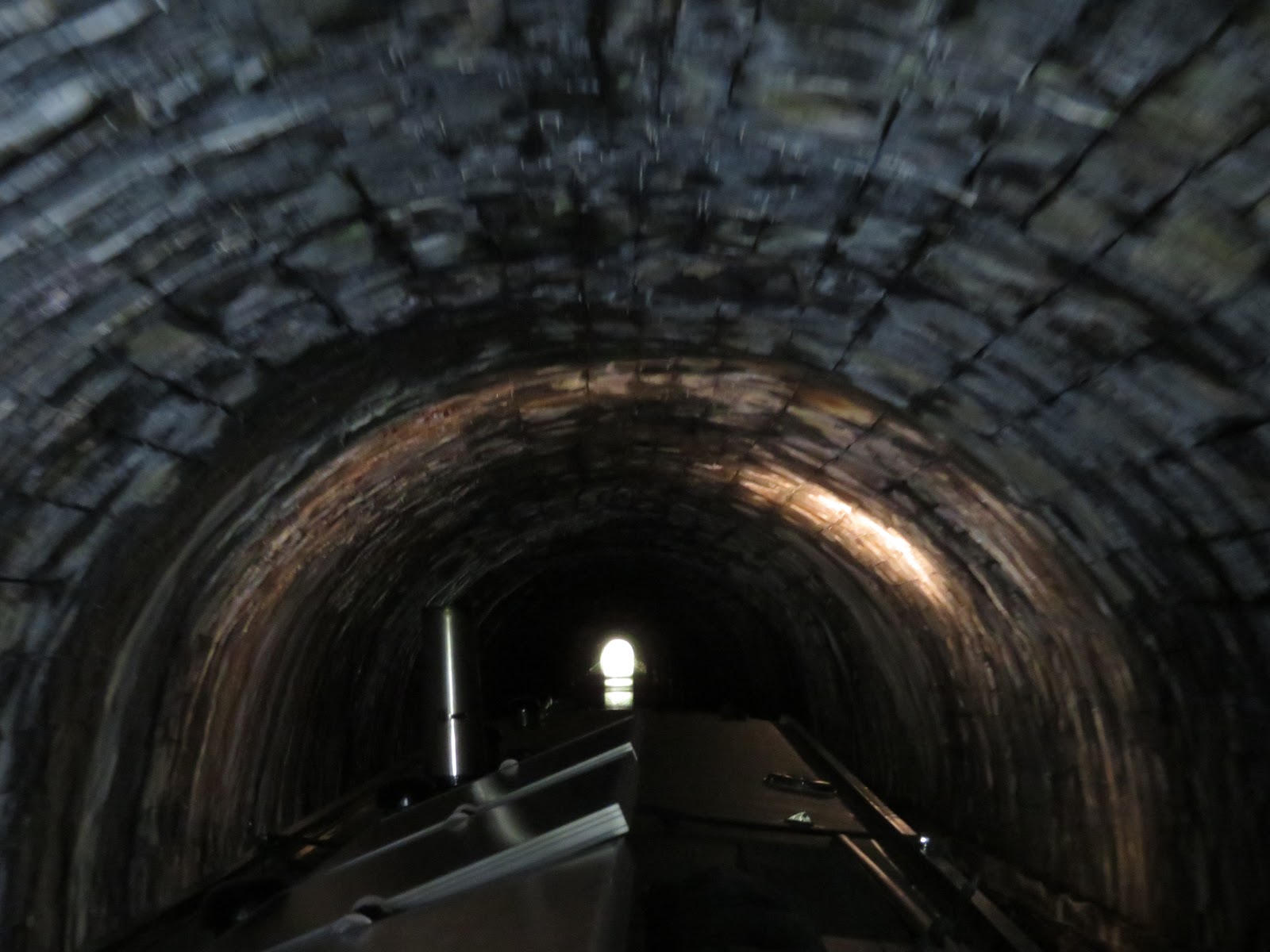
Gannow Tunnel took five years to build and has now towpath. It was pretty dry when we passed through. They started at both ends to build the 511 m tunnel. The boats had to be legged through until the early 1900's when a tug was provided. Richard Draper was the tug master in the tunnel for 40 years and also manged to save several lives with him being on hand to fish them out of the cut.

Apparently the tunnel is a known roost for pipistrelle bats but we didn't see any or anything else as we passed through.

The warehouse at Rose Grove is quite unusual to me as it has cargo doors on two side of the building. Coal was loaded into boats in the 1960's brought down from Hapton Valley Mine by lorry. I'm not sure what the history of the wharf is but the building is substantial.

The swinging rigid crane on the corner of the building is able to reach both sides of the building and the cargo doors, so minimising  work and using the most of the space. I liked the wooden stops to prevent the boom hitting the eaves. The wooden crane is very simple in design and looks as though it was mainly used for one product of a standard size?

Behind the warehouse is the lovely wharf managers house. Rose Grove became known as a railway town and had the last steam shed of British Railways before it was flattened to build the M65.

The Ormerod family were tanners from Hapton. Richard Ormerod had a son, also Richard who lived in Burnley Wood, dies aged 26 but not before marrying in 1778 and having a son, Peter. His widow buys the estate of Lower House in 1789. He lived in Ormerod House that later became overshadowed by the Globe Iron Works and the engine shed and was later demolished. Peter's son Richard built a house close to the canal in 1842 and this is the plaque on the gable. Behind this house is another dated 1739 and each are the best examples of their kind in the area.

When the M65 was built the canal was on the route. They kindly diverted the canal a little and this section is the new section.and makes moorings fro the Knotts Bridge Moorings.

We decided to call it a day when we got to Hapton. Hapton had a castle and a tower that survived until after the Cromwell years and produced coal cotton and chemicals and had a large Tudor deer park. It was the first village in England to be lit by electricity. It was turned off in the homes though at 1030 to ensure they got plenty of sleep for work!

Sunday, 24 September 2017

Weavers Triangle

The weather was nice and we had finally found a leaflet with a guide to the Weavers Triangle so we decided to have a walk after the Archers to see what we could see.

Traflgar Mill was built in the 1840's and was extended in the 1860's and again in the 1870's. A tower was added in 1888 and a water tank added to the top to supply a fire sprinkler system. The one story weaving sheds, behind the mill, were the last to produce cloth in the area before closing in 1990. Happily the mill has been restored and is in occupation.


Walker Hey footbridge was erected 1891/92 to make a more convenient route for walkers to cross the canal. The path crosses the weaving shed as it disappears to the right. You can also see the Trafalgar Mill tower and water tank above. I love the way it cuts a corner of the mill building off

Slater Terrace was built in the 1840's by George Slater. It is an iconic building for the area as eleven four roomed houses were built above a canal warehouse where raw cotton or coal were stored. The front doors came out on to the iron landing over the canal. The end two house were converted to be bolier houses for the newly built Sandygate Mill. A warehouse was added next to the house and later they were altered to be the boiler house and chimney. There is a new foot bridge in the distance that was built in 2012.

This is Oak Mount Mill and was started as a spinning mill in 1830. Ten years later a weaving shed was added. As was common with mills a series of fires caused much rebuilding and the current structure dates from 1887. They installed a steam engine made in Blackburn in the engine shed that is the one to the left that looks like a Methodist Chapel. The engine was a cross compound engine with two cylinders. The cylinders have been replaced several times by Burnley Iron Works, just down the road. The engine shed and working steam engine, along with the 120' high chimney are periodically run under steam by the Heritage Trust who own them.

The Neptune Inn has been saved from further decline as it is one of the oldest buildings in the Weaver's Triangle. 

Just down the Sandygate hill from the Neptune is the old malthouse. Barley was malted here for the local Massey's Brewery. It was a habit of the family to give the names of some of the male side 'Lord Sir', and the brwery was known as Lord Massey Brewery until 1889 when it was Massey's Burnley Brewery. They seemed to buy up all the competitors localy until 1966 when they themselves were purchased by Charringtons.

The first foundry here was built in 1793. It expanded and burned down until this current frontage was built in 1889. It became known as the Burnley Iron Works in 1885 and some of the largest steam engines were built here. The one in the Science Museum in London was built here. Taken there from Harle Syke Mill. It had become the Newtown Steelworks by the time it closed in 1981.

The Plane Tree In became a pub in the mid 1800's. It had originally been built as a private house for William Hopwood who had Oak Mount Mill built. The posh Jacobean frontage was added in 1890's. It looks as if it is been converted to apartments at the moment.

The triangular roofed building in the centre of the picture is an example of a weaving shed. They were usually one story and had these northern facing skylights. The weaving process had to be carried out in moist conditions. This was so that the thread moved round the process more easily with less breaks due to friction and pliability problems. The north lights let light in but did not heat up the rooms.

Across the canal is what is left of Woodfield Mill. It started out in 1889 and in a year had 1440 looms that made it one of the largest mills in the district. Unfortunately much of the mill was burned down in 2008. The engine house with the water tank on top was saved and the name and date or on the water tank.

This is the rear view of Belle Vue Terrace. The smaller ones were built in 1824/25 and the larger one on the end one 1844. The round headed windows are a feature in the area and bring light to the stairway.

This is the front of the Belle Vue Terrace and it can be seen it was a middle class place with a Curate, cotton spinner and calico printer in residence. Interestingly the row is roofed with Cumbrian stone as Welsh Slate was too expensive until the railways arrived in town.

Above is Victoria Mill from Trafalgar Street. The first part, on the left was built by the Massey Brewery family in 1855 as a throstle spinning mill. Throstles, or thrushes were part of Robert Arkwrights patented water frame and was named due to the sound they made in operation. By the 1880's it was greatly extend and on the right a unusual two story weaving shed was added. The mill has survived and has been converted to a technical college that has unfortunately closed down.

An entrance to Traflgar Mill from Trafalgar Street. Just close to here is a drive through chip shop. Well why not. The car park has a great view of the Pendle Hills to eat them in.

Finsley Gate Yard was a maintenance yard for the canal company and right at the end of the Burnley Embankment or 'Straight Mile'. Lock gates and boats were made and repaired here and the buildings were built when the canal was opened to Burnley. I heard that planning had been given for a mini marina here and a Lottery Grant back in 2014 to restore the three warehouses, a cottage, blacksmiths forge and a slipway. I seem to think it would be more like visitor moorings as I don't think they would let them dig into the frontage to make more berths.

The mills are all imposing buildings, but perhaps not quite as large as the woolen mills of West Yorkshire. Cotton weaving sheds were mainly on storey so less bulky. It is a shame that nothing was done 50 years ago to preserve the area, but then one didn't even think of such a thing then. What is left is a bit patchy making it a bit difficult to identify it as a distinct area, but the industrial archaeology and the beautiful buildings are well worth having a walk round. It is great to see what is left been put to use or incorporated into new designe.