Total Pageviews

Wednesday, 13 October 2021

A nice day, despite the weather.

 Once again it was decided that we would set of early so as to be at Bollington in good time

The Gurnett Aquaduct has a nice terrace of houses by it called Hatton Brow Terrace and until recently they would set you back just shy of £300,000 for a 2 bed place!

Just over the aqueduct and the first bridge is a 'snake' as the footpath changed sides. The leaves are just starting to go too. Not many red hues so far this year though.
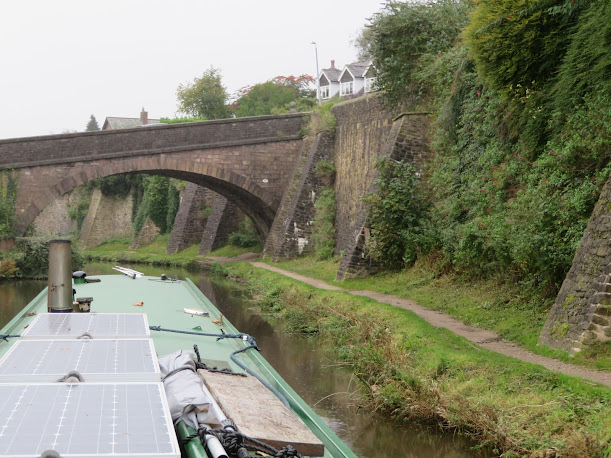
On the approach to Macclesfield there are some serious ground works to keep up the offside slope. I wonder if this was original to the canal, or was added afterwards due to bank slippage. On the map of 1870 it looks like just a slope.

We stopped for water just before the Hovis Mill at Macclesfield Basin. The C&RT yard was once coal yards. The Hovis Mill was built in 1831 and was the mill where Hovis flour was first ground. The name HOVIS for a loaf of bread could be given to any loaf of bread that was baked using the Hovis flour, and this is where the distictive way of grinding the wheat was done to give it the flavour. In 1895 there were a million loaves of Hovis bread being sold every week. The name HOVIS is short for hominis vis which means strength of man!

There are several narrows along the stretch that runs alongside the industrial estate that may have been bridges. I thought that they must have been evidence of past industry as they would mean that local workers could access the 'factory' from the other side of the canal. However when I look at the maps I can see no old industry at all, right up to the 1960's so it was built on green field sites. A large part of the site is now taken up by Astra Zeneca!

This plaque may make you think that this was a previous time when the Conservatives where having a go at 'leveling up', but no Woods Bridge was in the constituency of Nicholas Winterton MP for Macclesfield from 1971 to 2010.

These wellies must have a story to tell as they don't seem that worn either. 

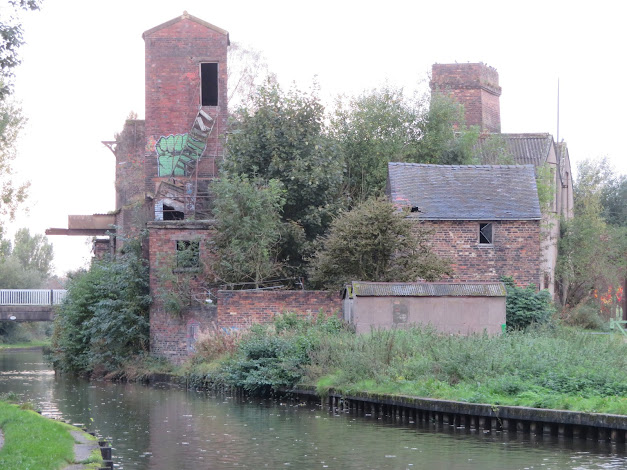
As we approach Bollington there is a collection of boats around Kerridge Dry Dock. This was once the wharf with an inclined railway from the Kerridge Hill behind. There were three quarries there and the stone was loaded into boats here. Kerridge stone is still quarried and is used architecturally. It is a sandstone that comes from the Lower Coal Measures. Whilst stone was quarried on this side of the hill, on the other the coal measures themselves were mined. Through the mist and low cloud I could see a tower in the woods by the quarries. I wondered what it could have been used for. I wondered whether it was some sort of chimney for steam engine driven equipment at the quarries. Some thought that it may have been a ventilation shaft from the coal mines on the other side of the hill. There is no evidence that it was used as any of these as it stands on rock and there is now evidence of soot etc. It seems that it was a folly built in the 1800 by William Clayton who was a very successful industrialist. So much so that he had Endon House and Endon Hall built, but didn't live in either of them!

We passed the Adelphi Mill and should have stopped there as when we got to the aqueduct there was no moorings left so we had to pass Clarence Mill and moor a little way out of town.

We went for a walk after mooring and went round the east side of Bollington. It is a nice little terraced palce with some nice buildings. Here just near the aqueduct is a neat little back garden backing onto to the stream or old mill race.

It maybe just a terrace of stone houses but they command a good wack at £225,000!

We walked up to Clarence Mill. The first mill was built here in 1831 and extended a couple of times. The mills were for cotton spinning, but a little weaving went on in sheds behind. After nearly going bankrupt during the American Revolution they came back and demolished part of the old mill in 1877 and built the present mill.

After meeting my niece and nephew and their various boys in a play park near the aqueduct, cut very short as it teemed it down with rain for the first time in the day, we walked under the aqueduct and through the recreation ground to reach The Vale, the brewery tap of the Bollington Brewery which is just over the road. The Oat Mill Stout and a pint of Best. I liked the Best best. It was dark and gloomy among the trees on top of the very gloomy day. We had high hopes for tomorrow.


Tuesday, 12 October 2021

Bossing Bosley Locks.

 We had decided over night that I would get the boat going at around 0800 to get to the foot of the Bosley Locks before they locked them up for the day. We were under the impression that all boats had to be clear of the flight by 1300, so meaning they would be locked by about 1030. The reality of it appears to be that if you are there just before 1300 they will let you up the flight!

It was a nice morning, with a little mist about, and plenty of walkers, with and without dogs. We were soon over the Canal Road aqueduct and clear.

It seems that things in the skies are getting back to something a little more like normal if the number of con trails in the sky this morning are anything to go by.

It wasn't long before we came to the first iconic turnover or snake bridge. You have to admit that they are quite sensuous, and just plain curvy. Plus the dressed stone just adds some permanence to the whole thing too. I also love the worn cobbles on the ramps that give witness to the many feet that have passed this way.

The glimpse of the hills as we approached the aqueduct is enough the heart to lift. It is always a thrill to be on a canal in hills, rather than plodding through the plains. It is always nice to have a view.

There is a long straight as you approach Buglawton and you can see several bridges down the way. It may not be very sunny today, but it is still, and not cold at all. The reflections are pretty.

The viaduct across the River Dane is impressive seen in the distance and must have been a major engineering feat of its day. It was built in 1841 and has 23 arches. The River Dane flows into the  Mersey and the Irish Sea, but some of its water can be channeled via the canals to Rudyard Lake and then the Caldon Canal, and hence into the Trent and the North Sea. The river is said to be the longest, fastest and cleanest river in Cheshire and has a footpath of 48 miles that closely follows its course.

We got to the foot of the locks at about 0945 and it seemed we were the fourth boat to set off up. Looking back over the aqueduct the Cloud rises like a downy pillow.

The stone for the locks was quarried locally and the first lock seems to have the most undamaged walls. There is something about stone isn't there. As you can see the sun did occasionally made an appearance too. 

We were following a boat up and at the second lock a boat was coming down. I got very confused as one of the down boats crew stayed with us for a while!!. In the next pound was a boat moored with a centre line, heading up, with nobody with it. I went in the empty lock guiltily. It seems he had gone up helping another boat who was struggling. He didn't mind he said. To further cause me to be confused a man from the boat ahead fell back and helped the single hander that we had leapfrogged. That left the boat ahead with two elderly people to struggle on. We lifted paddles as we left each lock and kept going.

There was a bit of a wait at the bridge before the last lock and I was amused by the sparrows using the parapet as a source of grit or minerals as they clung on and pecked at the stone. It seems that birds need a bit of grit in their gizzards to help digestion. They also need calcium carbonate from the rocks and mortar to help with bones and egg laying etc.

Helen had held up three cars at the Fool's Nook electrified swing bridge but as we got to the old bone works bridge she had to do the hard work. Mind you it seemed pretty easy this time. I seem to remember having to lend a hand on previous passages. Whilst I was waiting  got something round the prop that turned out to be a bike inner tube! Why would you throw that in the cut?

As we cleared the railway line and road the canal turns a corner and you have this lovely vista, once again enticing you onwards. To the hills, to the hills!

We found a spot near the Gurnett Aqueduct and settled down for a short while. Helen then decided that we should go and visit the garden centre and ended up buying a pot of sedums, two Christmas baubles and a coffee and a scone to share. Another good day was had by all. It is so nice to come back to the warmth and glow of the stove too.


Monday, 11 October 2021

Back on the Macc. and a beer at Beartown.

 It took us just over 40 mins to come through the Harecastle tunnel. I would have been faster but was held back a little by the boat ahead.

As we popped out we dropped of the tunnel lamp and came out into sunshine. We have been through several times when we have left one end in sunshine and emerged into rain! Thankfully not today. Obviously we also emerged into the iron coloured waters of the north portal. I wonder if the fish are different colours too?

It was a straight turn after a little way to turn up the Macclesfield Canal

The Macc. continues round a sharp bend and past the moorings, we were still following our tunnel companion. The next sharp bend is just ahead.

That takes you over the Trent and Mersey as by this time it has dropped through two locks so is at a lower level.

In the sunshine Hall Green Lock and cottage looked picture postcard like as we dropped the lock the 4" to get us on to the Macclesfield Canal proper, as the Trent and Mersey dug it to the stop lock.

There is something so aesthetically pleasing about the ellipsoid shape of the Macc's bridges, and is certainly a characteristic of this cut.

I also love the shape they give to the higher bridges, like a horseshoe shape. I assume it was to ensure there was a buttress at the lower point where the weight of the bridge and bank will be greatest.

Ramsdell Hall has been standing since 1760 when the central building was built. The two wings were built a few years afterwards. It was owned for many years by Alex Humphreys who played part time football for Port Vale with some success. He also worked for the glue company Evode before sinking all his savings into setting up a supermarket in Kidsgrove. He sold it to Kwik Save in 1978 and was set for life. He had bought Ramsdell Hall and continued to live there whilst devoting his time to charity work and the Variety Club. He was asked to become a director of Stoke Football club in 1968 having been a season ticker holder for a while. The house was on the market in 2018 for £2 Million. It doesn't seem to be on the market at the moment but it looks a little neglected so I am assuming it is empty. It has fantastic views across the Cheshire Plain though.

As we approached Congleton basin/wide we wondered if there would be any room for us, but we slipped in opposite the old warehouse. Once moored up we headed into town for some milk and a paper. Down hill all the way.

As you walk down Canal Road to the toen you are confronted with the Town Hall. It was built in 1866 in the Gothic style. It was the third on the site. The architect was E.W. Godwin who also designed the Northampton Town Hall, and this is similar in several ways. It has a large Assembly Hall that has a timber hammer head roof. From the rear you can see that there also very large windows right in the roof space to bring light to the hall. You can see on the front a statue of Queen Victoria. To either side, and a little lower, were two other statues one of Henry de Lacy, Earl of Lincoln who granted the town a charter in 1272. The other was of Edward I who granted the town a market in 1274. They both had to be removed as bits were dropping of and causing a danger.

We also went for a drink at the Beartown Tap. Congleton is known as Beartown as the story goes that in the 1600's during the Congleton Wake annual holiday the very popular dancing bear died and the locals thought that people would not come and the town would loose revenue. The used the money that had been saved for a town bible to purchase another bear. (Actually they used the money as a loan and paid it back). In these days having a dancing bear as the emblem of the town is not a great idea so they have adopted a Asiatic Black Bear, normally known as a Moon Bear as they have a crescent on their chests. It is like offsetting you carbon as it means that they can still use the bear as the symbol of the town. 


Sunday, 10 October 2021

B,P,T. Basins, Potteries and Tunnels.

 We decided that we would set off a bit earlier than normal to get through the Harecastle Tunnel today. I was up at 0730 to make a cup of tea and get ready for the off at 8am. Helen had a little lay in but didn't take quite as much advantage as I thought she might!

As we left the Caldon Canal we headed up towards the Festival Basin and saw this. I'm not sure whether it is supposed to be a warning to people, or a trophy of what had been fished out of the canal!

There is all that is left of a short arm that seemed to service the Etruria Steel works that dominated the north bank of the canal. The eastern end, including Etruria Hall became part of the Garden Festival site in 1984.

This is what Festival Park looked like before 1940!

And this is what it is like today after the Garden Festival. I'll leave it to you to decide which would the most interesting to pass by, but maybe not the same answer as the greenest or nicest!!

The Burslem Branch Canal was in use from 1805 to 1961 when it was closed following a breach. It was less than half a mile long and once closed was filled in, but luckily the route was not allowed to be built on so is available to open up again. C&RT reckon it would cost about $5 million and there is a society to do just that as a start to regeneration of Burslem.

Newport House at the junction of the Trent and Mersey and the Burslem Branch Canal, and where Anthony Shaw, the owner of the Newport Pottery just to the left of the map,  lived.

This is just up from the Burslem Branch Junction and is what is left of the Newport China and earthenware Potteries. It had been built in 1851 by Anthony Shaw. He was living at Newport House that was on the corner of the Burslem Arm. It was bought out by the Shorter Family that had a nearby factory and it was where Clarice Cliff designed her famous pottery.

Next to it was the Mersey Pottery that made earthenware. It was opened by Anthony Shaw and was part of the Newport Pottery and was opened in 1857. It was called the Mersey Pottery as Liverpool was the port of export of the two potteries as it mainly went to America. It reminds me a bit of Newark Castle on the Trent!

It didn't look that much better in its hey day!!

Middleport Pottery is well worth a visit when it is open. The Pottery Thrown Down programme is filmed here and looks like a museum too.

At Longport Brokerage the buildings at the rear of the properties are old transit sheds for the wharf.

This is on the gable end of the transit shed nearest the road and as you can see it belonged to the London and North Western Railway Company and the Shropshire Union Railway and Canal Co. Wrong canal you may say, but the carriers worked all round the system.

This sort of sums up this are of the Five Towns. In the foreground is one of three basins that led of to service a gas works and two massive tile works. They have already gone, nothing can be seen. On the crest of the hill are the new industries , that look like storage and warehousing. Not quite the same though is it?

We got to the Southern Portal of the Harecastle Tunnel just afer half past nine and went to top up our water. We then moved over and had breakfast and I had just finished the dishes when we were called up to enter. Three or four boats had come south, and it looked like three would be heading back away. We were middle for diddle. This is the old tunnel, built by Brindley, that subsided with all the mining in the area and became unusable in 1914 and had been opened in 1777.

The little boat facing south had just come through and had dropped off a tunnel lamp he had borrowed. We took it back for them to the north portal. The Telford Tunnel in use today was opened in 1827 due to delays caused at the old tunnel. We set off at just after 1030.