Total Pageviews

Friday, 24 August 2018

Bricks and bling.

Today is going to be a cultural day, and not only because our No.1 daughter is gracing us with her presence later, but we are exploring the Jewelry Quarter (JQ).

The first bricks we were going to be looking at was the LEGO Discovery Centre and Shop. The 'experience' was sold out so we had a look round the shop. I was pleased to see that despite many of the offerings were kits that went to make up detailed models for lots of money you could go and still buy a big bunch of bits and pieces and use your imagination to make whatever you wanted. I wonder if they emply students/children to make the models etc?

We walked down half the Farmer's Bridge flight of locks to get to the JQ and passed three boats heading down. I am a sucker for a tiled pub and the Queens Arms is special. It was built in 1870, designed by Joseph Ward for the breweres Mitchel and Butlers, and the Art Nouveau style tile work has meant it being awarded Grade II listing. It was restyled in 1901 when the tiling was added

Just over the road is the old Birmingham Assay Office. Precious metals had to be stamped as 'correct' from the 1300's but Birmingham had to send all their wares to either Chester of London with subsequent delays etc. Matthew Boulton lobbied hard to have an assay office in Birmingham and he was successful in 1773. You can see in the lower windows that the Birmingham Assay mark was the anchor. Apparently Boulton from Birmingham, along with others from Sheffield were staying at a pub called the Crown and Anchor whilst working to their ends in London. Sheffield took the Crown, that changed later to a rose, and Birmingham got the anchor! This building dates from 1877 and was purpose built. It was too small as soon as it was built!

St. Paul's Square is the only surviving Georgian Square in Birmingham and was built between 1770's and 1780's. St. Paul's Church was built in 1779 but the steeple was added in 1823. The graveyard makes a lovely open space to sit and cogitate in the sun, and there are several coffee shops and restaurants around too. We then visited the Royal Birmingham Society of Artists Gallery on Brook Street just off the Square. The Society is the second oldest independent Art Society in the country and had a print exhibition on. The lino prints certainly made me want to pick up a knife and a tile again.

 These are a set of workshops on Mary Street and I just love them. Just out of shot to the right was the owners house that was built in 1818. He later had the workshops built on his land in 1823, and rented them out. One of the first tenants was George Wyon from a well known local manufacturing family from the area. The littel workshops were used for die sinking, modelling and chaser for medals and engravings. The workshops extended over the courtyard at the back.
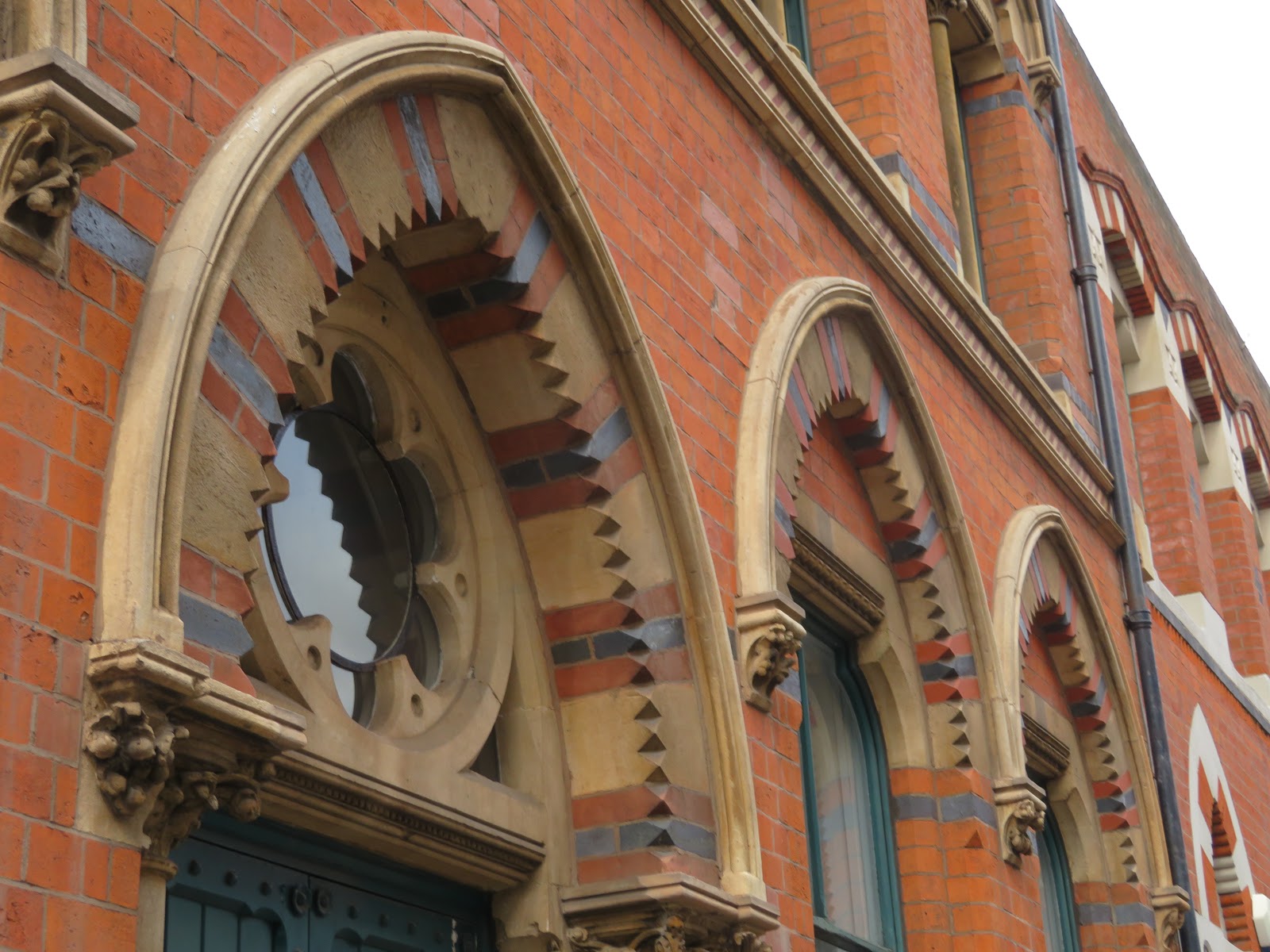
Some of the detailing on the brick work is just stunning and makes the buildings really stand out. It must have really made a statement when first built as everywhere would have been covered in soot and grime making this building very special.

This building shows the use of limited space with the courtyard living, office and workshop space all in one building and in lovely Georgian proportions too.

This monument was raised to commemorate the visit of Joseph Chamberlains visit to South Africa as the Colonial Secretary in 1903 after the Boer Wars. Chamberlain had been the Mayor of Birmingham for 3 years in the 1870's and then elected MP for the City in 1876 until 1914 and was a massive figure in the development of the city.

This was originally the Midland Bank of 1893. The very impressive stone carvings are said to be related to the local Vyse family. Joseph Gibbin was a great help to matthew Boulton in his campaign for a Birmingham assay office when he was working at the local branch of the Bank of England. We wanted to set up his own bank and with the help of his friends he did so in 1891. The upstairs was used as jewelry workshops.

All the lovely buildings are not as old as you may think as this one was erected in 1914/15. It was designed by a company with the great name of Crouch, Butlet and Savage. It replaced an early 1800's house that had been altered for industrial use and had become outgrown by 1890. The ground floor had hearths etc and the first floor then had some offices and many glass partitioned workshops, as did the second floor. In the mansard roof space was the living accommodation for the caretaker and family as he was there to keep and eye out of hours on the building full of precious metals etc. As I said before I love a tiled exterior!

Thomas Fattorini Ltd were another newcomer to the JQ. They were established in Yorkshire in 1827 and only moved to this area in 1919. This building dates from after WWII. They are makers of medals, badges and trophies including swords! They have letters patent from the Queen, obviously, and are still well in business with another factory in Manchester.

I don't know much about this factory on Frederick Street in JQ but it is once again a much more modern building with what looks like Art Deco trimmings. I think it was a much later addition to the Argent Building next door.

Our main objective was the pen museum. It is a sobering thought to think the two thirds of everything that was ever written by hand was done using a pen nib made in Birmingham! It was a huge industry employing thousands of people right up until the end of WWII when the factories had been changed to war work and the biro had started to become popular. This was the Albert Works of W.E. Wiley Ltd makers of high class pens and built in 1862/63 and was styled on a Florentine Palazzi. Their products were high class so the building had to be too. Originally the waste steam was used in a Turkish bath on the top floor for paying customers. It was one of the first buildings that used fire proof techniques. The pen factory closed in the 1890's and was later used for making scientific instruments. The Pen Museum is well worth a visit if for no other reason than to learn that Walt Disney's Empire would not have come about without Birmingham as the 200 artists that drew the original cartoons used nibs made here in Birmingham.

On the way to the Tesco's supermarket we passed the Gatehouse to the Warstone Lane Cemetery. This was the Church of England cemetery and was opened in 1848. Major Harry Gem, the 'inventor' of Lawn Tennis, among others. We are now stocked up with grub for the weekend and are now just awaiting No.1 daughters arrival.

Thursday, 23 August 2018

Loopy visitors.

We were meeting up with a couple of old friends today so were anticipating their arrival this morning.

Here is our mooring on the Oozells Loop close to the Sealife Centre and take note of the red and blue brick style of the walls. It is probably the quietest mooring in Birmingham city centre as the tow path is not a route to anywhere. The private development of apartments on the right is built on land that was once, at the turn of the 1900's was the Albion Tube Works.

Our visitors arrived on time and we were soon taking them for a little cruise up the cut. Stephen and Marva have been out with us before so we thought we would take them to check out the Old Line Loops. We are just arriving at the eastern entrance to the Icknield Port loop. In the 1905 map there is a towing path on the right hand bank of the loop, but there is none now. Part of the towing path had disappeared by 1950's but most was still marked on the map.

As we enter the loop we see some of the buildings that acted as wharfs for the factories that were present. This was still a Brass Tube Works until the 1950's

This cofferdam is installed to allow new shuttering to be put in place. The land to the right and closest to the New Main Line was an old oil, chemical and varnish works in the 1930's but by the 1950's it had already been largely cleared. In the middle of the picture would have been a basin off the canal loop to the Birmingham Corporation Wharf and the buildings still up must have been part of the refuse destructor that narrow boats brought to the site.

On the left bank here were a glass works and a tube works. The tube works later became a cycle factory, and after the refuse destructor was another tube works. It is interesting to see that history has brought a temple to the street view in the distance too.

At the head of the loop is the dam of the Rotton Park Reservoir. This was once a small expanse called Roach Pool but was expanded by Thomas Telford to supply water to the Birmingham level canals between 1824 and 1829. The dam is 330 mts long by 10mts high. It is now normally called Edgbaston Reservoir and amongst the feeders for it is a run off from Titford Pools that is at the head of the Titford Canal near Oldbury. There is also a C&RT depot under the lee of the dam.

In 1905 the next part of the loop was home to metal refineries including nickel and cobalt. There were several bedstead factories as well as a corrugated iron works and more tube mills. By 1950 nickel alloy was still been refined here but metal bashing works had taken much of the factory space I think this was the tube factory space. Near the Main Line was a new paint factory. The area has been largely cleared and the long drawn up plans for an inner city 'village' is starting to be built on the site. With the idustries that were once here it must have cost a bit to clear the site safely and dispose of the soil etc.

As we we approach Rotton Park Junction the date on the over bridge is 1854 so was added later. The New Main Line does not seem very obvious as we approach it to cross straight over on the 'Old' Main Line that is now the Soho Loop.

As wepassed round the loop there were plenty of this type of picture of people and plants. I first thought it was brilliant graffiti but it is actually a paper picture stuck on the wall. She is pointing the way in.

On the left in the early 1900's were a series of smaller tube and rolling mills where as on the right there was a nail factory that was serviced by a small basin below the bridge. By the 1950's before the basin was a non ferrous metal works as well as a bedstead maker called Excelsior which I think may have made some of the beds for the Titanic! Beyond the bridge was a hinge and rivet maker as well as a metal pressings company.

Just before Spring Hill Bridge is this little piece of ghost writing. I can make out 'wire mills' at the bottom but this factory in 1905 was actually a German silver works. German silver is actually not silver but is 60% copper, 20% Nickel and 20% zinc so contains no silver, called nickel silver due to its colour. By 1950 it was more properly termed a nickel silver works!

Behind the walls in 1905 was the Atlas Engineering Works that included a tramway to move items around the site. Next was a wire and rolling mill. The chimney was serving a varnish and colour factory and after that was another bedstead works and then a mineral water maker. By 1950's the Atlas works had become a cardboard box company, bu the wire and rolling mill remained a rolling mill. The chimney still was a varnish and paint works. Bedsteads had given way to toys but mineral water was still being made! Inside the 'island' made by the loop and the new main line. Just on the right was Brookfield Wharf that remained in 1950's.

Further round was the Soho Branch that went up to Soho Wharf that was close to Matthew Boulton's house Soho House. Boulton was one of the big guns of Birmingham's manufacturing with James Watt. His house still stands and is a museum. before the end of the arm are three basins off to the right that were railway transhipment basin, one of the docks was mainly covered and they made up the Hockley Goods Yard.
This is part of Winson Green, or more recently Birmingham Prison that has been in the news recently as a failing establishment. On the right bank is now a lovely open area that in 1905 was the City Fever Hospital and the City Lunatic Asylum. By 1966 they became All Saints Hospital, but is now open area. Above is the third institution in the area, the prison. I'm not sure whether the over bridge was to take prisoners in and out or just to bring coal etc to fire the boilers or other stores. On the left bank was also a place for institutions. It must have been out in the countryside when they were all built as it was the workhouse and infirmary. By 1960 they were called the Dudley Road Hospital and the Summerfield Hospital for the chronically ill.

As we headed back towards Old Turn out from the Icknield Port Loop popped the  tug and tow of Nansen and Leo. It was some promotion of C&RT as they were picking people up at the round house and taking them round the Oozells Loop then the Iknield loop and back again. Mind you it did seem to be a labour intense as there were plenty of volunteers aboard. The pair are the tug Nansen II that was built at Yarwoods Yard in Northwich in 1951. She was built to tow strings of coal butties from the mines to Birmingham factories. The Butty Leo was a small star class butty that was built in the same yard but in 1935.

Wednesday, 22 August 2018

Walking round Brum.

We were going to venture into Birmingham to look at the museums etc, plus a bit of shopping etc.

From our mooring behind the Sealife Centre we walked through Brindley Square, named after the canal engineer, and across the canal. This was the first part of the area that got refurbished, the lower levels, and the red and blue brick, and steel joists are there to evoke the old industrial area that was here previously.

The view in the opposite way looks towards the Broad Street tunnel and Worcester Bar.

We headed for the New Library to see a new exhibition of photography.  Phyllis Nicklin was a local geography teacher who took photos of the quickly changing Birmingham in the 1960's. They are in the City archives. Recently a project has been in place to identify the exact position of the original photos and then take the same photo. I left the Birmingham area in the 1970's so it was of great interest to me. Some places had been flattened completely and some hadn't changed at all. I love the idea of taking pictures of the same place over the years and will try it where I live I think.

We went off to do a little shopping, and I have always been taken with this street off New Street, Colmore Street, due to the number of building types and the curve of the buildings. Helen got some bargains at White Stuff too.

On all the pedestrian areas in the city centre are these barriers that have obviously been placed to prevent the terrorism acts of vehicles driving into pedestrian areas.

 When in the library we saw a leaflet about a walk. We have looked for walks before and there were no regular ones at all. We did the 'normal' walk that had to booked on line. At £9-80 we thought it was a bit steep but you are equipped with a headset and ear buds so that you can hear the guide at all times, which with all the building work going on was useful. You get to keep the earbuds too.

Due to all the work going on in Century Square we went up to the 3rd level garden to look down on the square. The guide had quite a  architectural bent but there was plenty of information that I didn't know too. The 'new' square is going to have a water feature included and the tram is to be extended through to 5 Ways at the far side of the square. The walk took us a bit off the beaten track so it was quite nice, and we learned a fair bit too.

We walked through the International Coference Centre and out onto Brindley Place again. There is the old Brewmaster house preserved on the left and although the Malt House pub is new it was built on the site of an old maly house. It's main claim to fame is that Bill Clinton called in for a pint and some chips during a G7 conference in Birmingham. The USA Secret Service took the glass so that no DNA could be recovered from it! The barge is an adjunct to the nearby Ikon Contemporary Art gallery.

The land based Ikon Art Gallery is in this old Board School from the 1870's. There are beautiful stone carvings and tiles on the frontage and the tower is really a ventilation shaft to get fresh air in for the 'great unwashed' who were taught there!

This church was built in the late 1800's and I wonder if it was built in this blue engineering brick so as not to be 'stained' by the smoke and grime of the time. It was later then bought by the Second Church of Christ Scientists, and is now a night club. The tower is pretty distinctive too.

I loved this tower with a crown above what is now clubs and restaurants. I shall have to do some research to see what the building originally was. Always look up when you are in a city is my best tip.

We walked round to Gas Street basin and this restaurant was was the offices of the Worcester and Birmingham canal. Behind was the actual Worcester bar where the BCN and the W&B met, but did not join. All cargoes had to be discharged and carried over the bar and reloaded.

We visited the cube and I hadn't realised that it had an open atrium in the middle, and this is it. I found it pretty dark on the whole.

We then walked through the Mailbox and all it's posh shops and eateries and then came in to the back of Grand Central/New Street Station. The mirrored external makes for a chaotic imagine but it is just the movement and light that is attractive.

At the end of the walk we were given a hard back book called Positive Birmingham that actually made the cost of the walk seem much more reasonable as it was selling in the shops for about £12-99. After the walk we went for a bit more shopping and then visited the Post Office Vaults just off Queen Victoria Square.

Tuesday, 21 August 2018

We're back in Brum.

We vare back on the boat after a bit of an extended stay at home, and it is very nice to be back. We came down to Hawne Basin on Sunday afternoon and then I drove back to Hull on Monday morning. The trip back via two buses and two trains went very well and to timetable which was good.

This morning we paid our dues, not as much as expected, and said farewell. Well that is after we had pulled out from between two boats and then re-moored the outside boat again. The basin looked good with the forge behind and the slip way. Everybody is very friendly and helpful and it is a lovely quiet spot, surprisingly.

It is also surprising how green the place looks as you approach the Stewart and Lloyds Tube works and Gosty Hill Tunnel.

There is only one airshaft in the 557 yd long tunnel and that turns up on the surface in the garden of a house. When we got to Windmill End Junction we turned left to fill with water. There the connection was not the normal type but I soon sorted it out and were filling up with water so we had plenty for our stay in Birmingham. Whilst filling we had a coffee at the cafe/museum and exchanged a bit of banter with the many folk, and dogs that were enjoying the sunshine. We went down to the Bumble Hole Arm to wind and then headed through the 3027yd Netherton Tunnel. We met two boats in the length of it and it took us 38 mins to transit.

Once at The Dudley Port Junction at the New Main Line we turned towards Brum and the southern towing path was being improved for several miles.

Between the Netterton and the Gower Branches is this roving bridge. In the late 1800's there was a small basin here that served the Rattlechain Brick works that started to expand in the 1890's. On the land around were also Groveland, Waterloo and New England Collieries. The brick works extracted the the marl leaving huge pits that when the works closed sometime around WWII the site was bought by the Chemical Company Albright and Wilson that has a factory close by. They used the pit that had filled with water to dump their waste. The majority was Calcium phosphate but white phosphorous was also dumped. This is highly dangerous and flammable. About 0.1% is white phosphorus and all the waste is kept under the water. I suppose it is why the large area of waste brown field land has not been developed.

Just after Pudding Green Junction are these old basin bridge. The first accessed Hamblet's Blue Brick Works. There was a similar marl pit here but was filled in. The further bridge was to another small basin that lead to either a set of limekilns or the tramway that came down from a colliery called Ireland Green. There were also a couple of other little basins that have been entirely lost.

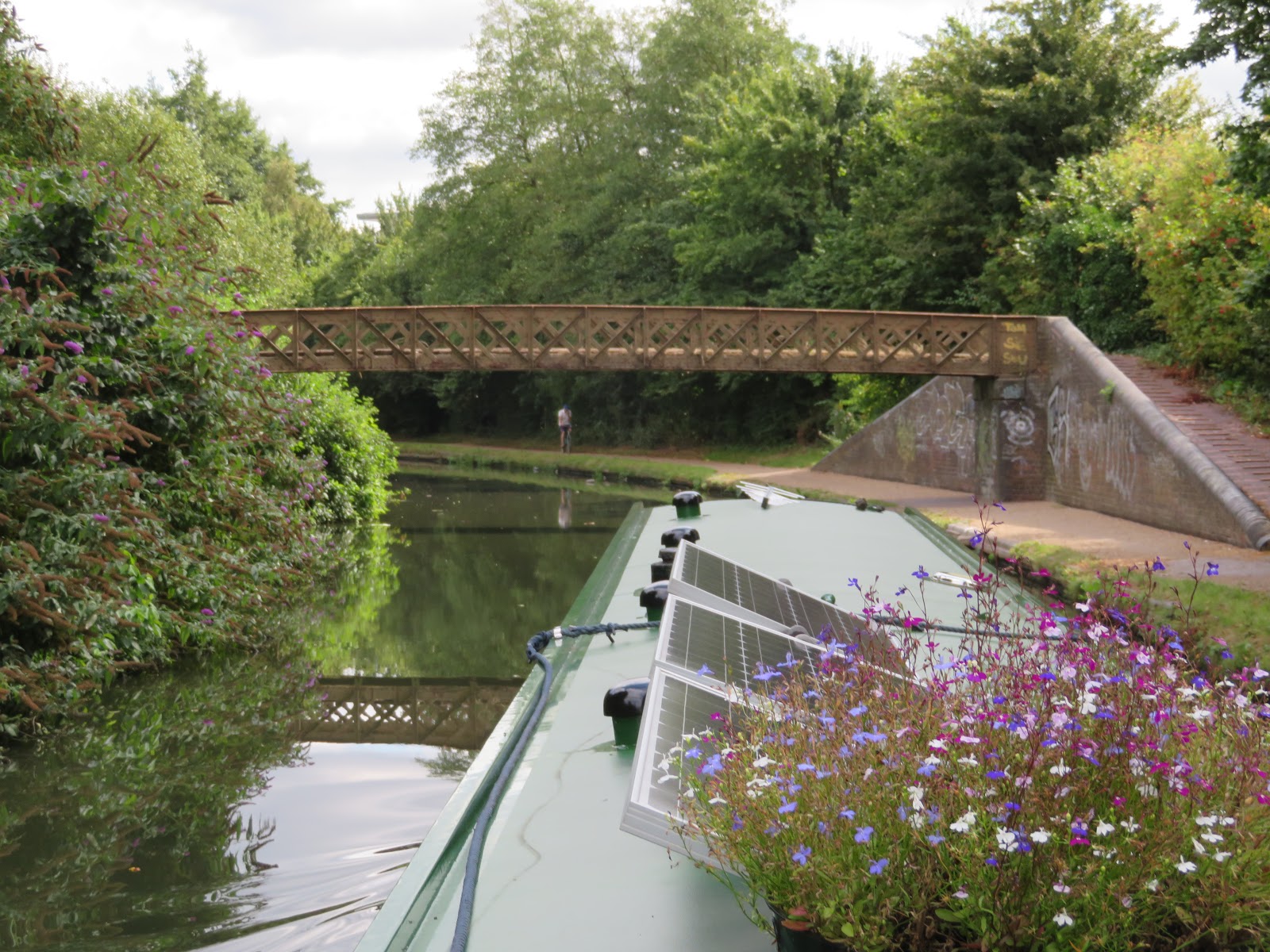
This bridge is natterly called the Lattice Accommodation Bridge and must have been to preserve a footpath right of way as looking at old maps it doesn't seem to connect to anything directly but on the north bank was the Bromford Iron Works.

Looking back to the M5 motorway bridge and the Steward Aqueduct that takes the Old Main Line over the New Main line that was opened in 1837. I though that the closest bridge was also an aqueduct but looking at old maps it looks like a road, but it must have been built at the same time as the aqueduct as it is very similar. It served the massive glass works that started in 1814 as the British Crown Glass Co. and was bought by Robert Chance in 1824 and it was here that they created cylinder blown sheet glass that made them a household name. They went on to make lighthouse glasses too. Pilkington's bought the company in 1954 and glass ceased to be made here in 1976. The glass works is now an industrial heritage site awaiting restoration.

Galton Street Bridge is a gracefully curving structure that spans both the old and new Main Lines and is an ancient monument, then there is the entrance to Galton Tunnel.

The Brasshouse Lane pumping station was built to pump water up from the lower New Main Line up to the old Main Line and the higher pound that was above that too. It has 'in power' days, but never seems to be when we are passing.


On the right is the entrance to the French Walls Basin that serviced the French Walls Munitions and Metal factory. Opposite was the Smethick Gas Works with another basin and in the distance is the roving bridge over the entrance to the basin that served the Soho Foundry that was started in 1795 by Matthew Boulton and James Watt and was pivotal in the Industrial Revolution and theory of management. The site is now owned by Avery that make weighing machines.

A little further on are these three roving bridges. On the left is the one that Pearson's says is the other end of the Soho Loop, through the foundry but on a map of 1890 it is just a basin serving a chemical works. The original loop of the old main line that would have been cut off by the building of the more direct new line occurred in 1837 so it could have been lost in 50 years I suppose. The nearest on the right was another of the Old Line meanders that had been cut off, the Cape Loop that served many industries once it had passed through a short tunnel, the London Works nut and bolt manufacturer, , several iron and brass tube works, a patent screw works and several iron works. Again by 1890 the other end of the arm had been built over by the Phoenix Iron Works. The furthest bridge was to serve a small basin of the Imperial Wire Works.

There was some pretty decent graffiti along this stretch and particularly liked this 'Men in Black' work. 

Just before you get to the city centre there is the Monument Road Canal/Rail transhipment basin. In 1890 there were goods sheds on either side of the basin and with four cranes on the west side. The quays were linked to the main railway using turntables. On the right is the entrance to a basin that served the  Ledsam Street Engineering Works and the Standard Bedstead Works.

As we approached the Round House and the pub, now called the Distillary, everywhere looked very full. We drifted past the entrance to the Oozells Loop and saw there was room down there so we soon reversed in and made fast. back to Brum. We soon were off up the road to get a few bits and pieces from shops that we knew we would find in the City.