Total Pageviews

Sunday, 5 August 2018

Off on a jaunt again.

I will admit to having an extra 30 minutes lay in this morning but my head was clear, a credit to the purity of Batham's beer I'm sure. I went into Kinver for the Sunday paper before setting off about 1030.

A boat had just gone up Kinver Lock, but by the time we were penning up there was one waiting to go down. There was somebody on the water point to we continued onwards. At Hyde Lock Helen got talking, as she does, to a father and son cyclist. It is a nice house above the lock but they don't seem to be very hospitable.

By the lock keepers cottage next to the lock was this little window and the boundary marker.

We didn't stop at Stewponey services either but turned up the Stourbridge Canal at Stourton Junction. The first two locks of the flight of four have a great outlock over the junction with the sign post at the bottom.

The pound before the last lock was quite low but the gardens were well kept and had a nice outlook too.

The canal is narrower and shallower than we have been used to for a while. This old wooden barge hasn't moved for a while, and wont be floating anywhere again. I wonder how long it will be before it is removed.

The Stourbridge is a surprisingly rural canal and has plenty of reeds along the banks. The tow paths are well used by walkers and cyclists but we only met two other boats.

The weather has obviously taken it toll and the news is full of wild fires around the world. They have obviously had their own experience here in the old grounds of Prestwood  Hall. The Hall dates from the 16th Century but was greatly remodeled in the 19th. It was owned by the Foley Family, iron masters of the Stour Valley, from around the 1650's. It was sold off in 1920 and became a sanatorium, than later maybe a TB clinic as there were outside wards with verandas. It is now a residential home for the disabled elderly or sufferers of dementia. 

As the canal contours around the Stour valley in a surprisingly steep valley it  retains it's rural air with views across the sward of New Wood Hill.
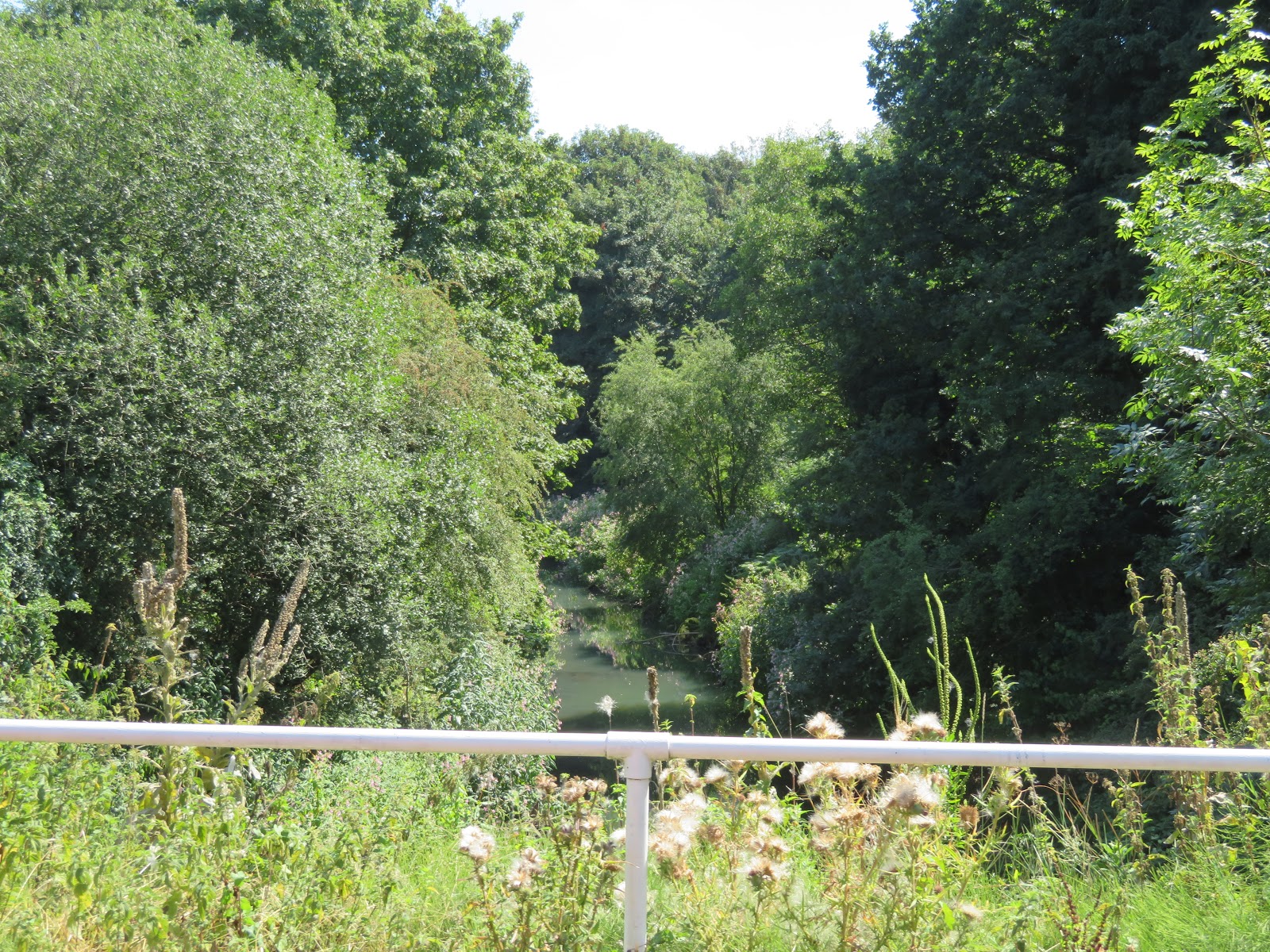
The river rises up to meet the canal as we move further east and then just before Wordsley Junction it passes under the canal. From the aqueduct we can see that there is still a good amount of water in the river so it must have a good catchment area.

There were lots of fishermen at the junction who were somewhat reluctant to move their tackle but we didn't entangle anybody and we were soon round and heading up the Stourbridge Town Arm. The channel had a clear lane down the middle but was otherwise covered in lilies and arrow head. There is a glimpse from the canal of the Dial Glass works. A glass cone has been here since at least the early 1700's when the made bottles. From 1922 it was the home of the Stourbridge Glass Company who were the owners of the Tudor Glass brand. The site is now owneed by Plowden and Thompson and they use borosilicate and soda lime glass to make blown and pressed items, largely tubing with capilary tubing down to tiny bores that are used in the nuclear, radiation, aviation, auto and rail industries and many more.

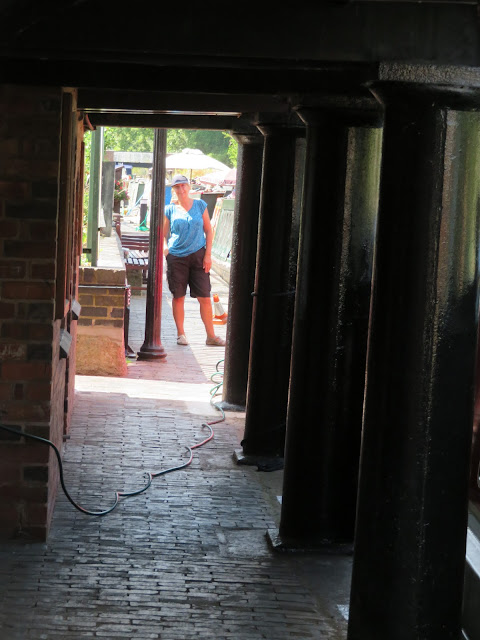
The winding hole is right at the very end of the arm through the permanent moorings of the Stourbridge Navigation Trust. You feel as though you are intruding but the trip is worth it. We winded and then landed alongside to dump the rubbish and then take water. The cast iron columns hold up the Bonded Warehouse

The canal was opened in 1779 and the original bonded warehouse was opened in that year as a two story building with the rounded end. In 1849 it was raised to adde another floor and extended out over the wharf supported on iron columns. The rounded end was continued up too. It held high value goods that were held until the excise was paid on them so that the small windows are heavily barred and the walls are up to 13" thick. They also rebuilt the crane that can be seen. The Stourbridge Navigation Trust had fully restored the building by 1986. The Stourbridge Town Arm is a remainder waterway so is not really maintained by the C&RT I believe so the Trust do a great job in keeping it navigable etc.

A pleasure trip.

Our visitors arrived on time and after finding a parking place were aboard and the talking didn't stop from then on. After getting the kettle on we set of on a pleasure trip for the day.

We were soon through Whittington Lock and with no time to visit the pub about a 1/4 mile from the lock that dates from 1310 and was home to Dick Wittington's grand father and Lady Jane Grey. Then we curved round the hills in the Stour Valley and Clay House Bridge.

Cookley Tunnel soon appears and once more it is a short one, only 65 yards. The fact that there are houses probably makes this definitely a tunnel and not a bridge!

Just through the tunnel is the little arm that once accessed Cookley Forge that had been there since about 1670 when a forge was added to what had been a mill. It remained until 1886 but remained an industrial site. Presently it is Titan Steel Wheels that employ about 450 people and make wheels for heavy earth movers and cranes etc.

Debdale Lock appears to be carved out of the sandstone cliff. The house next door, which may well have been the lengthsman's house.

In the face of the cliff is a cave. It used to have a door on but now is just open to reveal like a self round the walls at about stool height

We left the lock and the canal takes a sharp turn round the sandstone outcrop. We only went as far as the next winding hole to turn as we had to be back for a deadline. We moored up for lunch in the sun and were then soon off again.

Austcillf Holiday Homes have a lovely outlook across the canal and they look beautiful maintained. For some reason there was a set of signals by the canal too.

Cyd had to leave us but Chris remained and we adjourned to Kinver and the Plough and Harrow where the only beer they had was Batham's Bitter and Mild. What a shame, my favourite brewery!

We set the world to rights and caught up the last few years, and even made a few plans. It was great to catch up with them both, and all oiled by a few pints of Bathams. Thank you both for a really great day.

Friday, 3 August 2018

Keeping on to Kinver.

Birthday tea at the navigation was not posh nosh, but pub grub, and as Helen said,'anything that saves me cooking is fine!'. We had a lovely sleep and it was another very quiet mooring.

This is the mill that ended up as a sharpening mill for bladed items. It has been converted to apartments and it looks like each occupies a floor, so will have windows in just about every direction.

By the time we left there had been a couple up and down, but the lock was against us but we were soon heading out of the lock. I love these old horse tunnels and it is noticeable that the their height is very low showing that they weren't huge great cart horses that did the work but mules and ponies. The boaters themselves must have been pretty short too, compared with today.

Just a little further on from Greensforge Lock is Ashwood marina. This was a transhipment basin that was built in 1829 to bring cola and bricks from Pensnett. It was the Shutt End Railway and it had two inclined planes that were worked by the weight of the full wagons, always heading down hill, pulling up the empties. In between the two inclined planes was an almost level section and the wagons were worked by an engine called ' Agenoria' who was the sister engine to the 'Stourbridge Lion' that was the first steam enging in America in 1829. They were both built in Stourbridge. 'Agenoria' worked on the Shutt End Line from 1829 to 1864.

This is whats left of a round house that was similar to the one still standing by Gailey Lock. This one below Gothersley Lock was built by an old wharf that served an Iron works that closed in the 1880's. The round house looks to have been taller than Gailey's but was in a poor state when it fell down in a storm in 1991.

The canal is tree lined with either the Smestow Brook or Dawley Brook running alongside. I love the dappled light when the sun finally came out, but never seem to get it right in a picture.

The River Stour crosses under the canal on an aqueduct. It is quite understated but then is by a lily covered pool just afterwards.

Next is the Stourton Junction where we will be heading in a day or two. These finger posts do make a great feature of the canals and must be very well photographed.

Another thing appearing in many photographs is this octagonal at the Stewponey Lock. The place of Stewponey is actually named after a pub that was knocked down in 2001 after several names. Some say it was a corruption of the name Estapona, where a early landlord had been based, and is wife came from. Others say it was a corruption of  'Stouri Pons' bridge over the River Stour.

We stopped for water before moving down the lock and helen brought 'Holderness' into the lock passed the lovely house/warehouse jut by Stewponey lock.

When does a bridge become a tunnel? Or is it what is on top that qualifies it as a tunnel. Dunsley Tunnel is only 25 yds long and  is not as long as just about all motorway bridges, yet they are not tunnels?

Down to the left was the site of yet another iron works by Hyde Lock. I love the lock gate gates at the cottage and had a nice chat with these ladies who were fascinated by the lock procedure.

As we approached Kinver we heard a loud noise and then, like in a war film, this helicopter rose up from behind some trees and hovered kindly for me to take a picture. It is a quick way of checking the electricity cables and pylons. I think they have a heat detector that can pick up areas where the cables are hotter than normal and that would indicate a problem area. Much quicker than having to swing about up in the wires themselves.

We dropped down through Kinver Lock and tagged on to the end of the visitor moorings. The permit holder only moorings above the lock seem to go on for a 'Golden Nook' mile or so. We had lunch then went into town to prepare for visitors tomorrow.


Thursday, 2 August 2018

A lovely drop down the locks.

What a lovely nights sleep we had at a nice mooring, but the time had come to go and there wasn't very far to go to the first lock of the day.

Today is Helen's birthday and as we are going down hill as well Helen was driving. Dimmingsdale Lock was done and we are off on the 12 locks of the day.

I love these Midland locks as they have all the little steps and stuff. It was interesting that this canal also has the split bridges at the foot of the lock like the Worcester and Birmingham Canal. This one had a scaffolding hand rail so I wonder if there had been an accident associated with it.

We were soon at the top of Bratch Locks. There was a boat coming up so we only had about 15mins to wait. The lock cottage has obviously been extended but is a lovely spot. These locks used to be a staircase when originally built by Brindley. They were 'opened' out by having a short pound put in between each lock. to save time and water

The toll house is a real feature of the flight. It isn't in the picture but the St. George's Cross was at half mast and I had to ask if somebody had died! Fortunately not so they should hoist it fully to the fly. You can see the blue paddles at the head of the lock. These open the lock up to the side pound that saves water. They have to be open before you start lowering the lock above.


The side pounds are terraced around the hillside that the canal is dropping down.

With the two voluntary lock keepers it doesn't take long. They were saying that it has been a very quiet season so far, and this agrees with what we have seen, both on the Shropshire Union and the Staffs and Worcester.

At the foot of the Bratch Locks is the Bratch Pumping station. It makes you feel that you are in Bavaria or similar with the Gothic castle style. The brick detail is also beautiful. It was built in 1895 to pump water up from a deep bore hole by Bilston Corporation, to a reservoir near Wolverhampton. It was powered by two triple expansion steam engines named 'Victoria' and 'Alexandria'. They were replaced by electric pumps in 1960 and they fell into disrepair until 1991 when Severn Trent had 'Victoria' restored over five years. It is run under steam a few times a year. 

Bumblehole Lock was next and although this is not one of the classic circular weirs I am full of admiration for the folk that designed and built these as getting the levels right to ensure that there is an even flow all round the weir is great. In fact the water management on the canal is fantastic when you think of the surveying tools they had.

Also today we passed through the Botterham Staircase Locks with no trouble.

The land around here looks rural with a bit of housing and industrial estate so you can be forgiven in thinking that the canal was dug to provide a through route from Birmingham to the Severn, and onwards. In fact the route down the Stour valley was selected as it passed through an industrial area of it's own. This valley rang to forges and iron works that demanded raw material and provided finished products to added to the canal companies coffers.

You wouldn't know it now but where the houses are was once and iron and steel works. It started life as a fulling and corn mill as far back as 1600's. It started as a finery forge around the 1620's, and has continued on through several companies and eventually the British Steel Corporation, until closing 1976. The tow path crosses banks between the locks to avoid passing through the works.

At the foot of Hinksford Lock is another pumping station. Not quite at ornate as that at Bratch and was built a bit later, sometime after the South Staffordshire Water were given permission to build it, and others, in 1901.

The canal is dropping down the valley and the sides are starting to draw in so that the line of the canal actually had to be cut through the sandstone, leaving lovely little bare formations that have ferns and trees taking hold after all these years. We stopped just before the services at the top of Greensforge Lock. As you may have guessed by the name there was another forge in the area, but the area was used for Roman Forts from the earliest days of the Roman Occupation with two large forts close to the east. They were sited to take advantage of the defensive features of the rivers in the valley. The forge dating from the early 1600's progressed to be a blade mill by the 1680's, and later still altered to a corn mill in the 19th Century. It has recently been converted to apartments.

Wednesday, 1 August 2018

Happy Yorkshire Day to all.

We had a quiet night and were up and about at the normal time, but before heading off we decided to go for a walk to the Morrison's supermarket to top up. Helen bought a bottle of wine too, as it is Yorkshire Day today!!

This is the outlet from the Wolverhampton Water works. As Wolverhampton's industry developed and the population increased more water was required. The council set up a company and they wanted to drill bore holes to extract water at Tettenhall, where we are moored. This was 1845. The canal companies strongly objected as they were worried that somehow it would rob them of water. In they end they were only allowed to drill 18' below the level of the canal which didn't provide enough water and more schemes had to be included. It is obviously a sewage farm now and this is the treated water gushing out to add to the canal. I bet that C&RT are pleased to have it now.

We passed Aldersley Junction and thr 21 locks up to Wolverhampton. I always like doing these locks as they are easily worked and not too much walking between them on the whole.

Double Pennant arm once had a stone yard that loaded narrow boats to carry. It seems that it now has nothing much to do with boats now where as previously there were moorings, gas, licences repairs etc etc.

Below Compton Lock, the first of the day, is this little dock that once was Limekiln Chandlery. They moved on to Stourport about 9 years ago. Just by the lock is Limekiln Wharf, hence the name, which has now had apartment on.

The country side soon takes over from the outer suburbs of Wolverhampton and you could be anywhere on the system. I have noticed a bit more Himalayan Balsam on the Staff and Worcester than the 'Shroppie'. I only saw any on there either side of Brewood. Still there does seem to be less than I have seen in past years. Is this to do with work to eradicate it, or climate? 

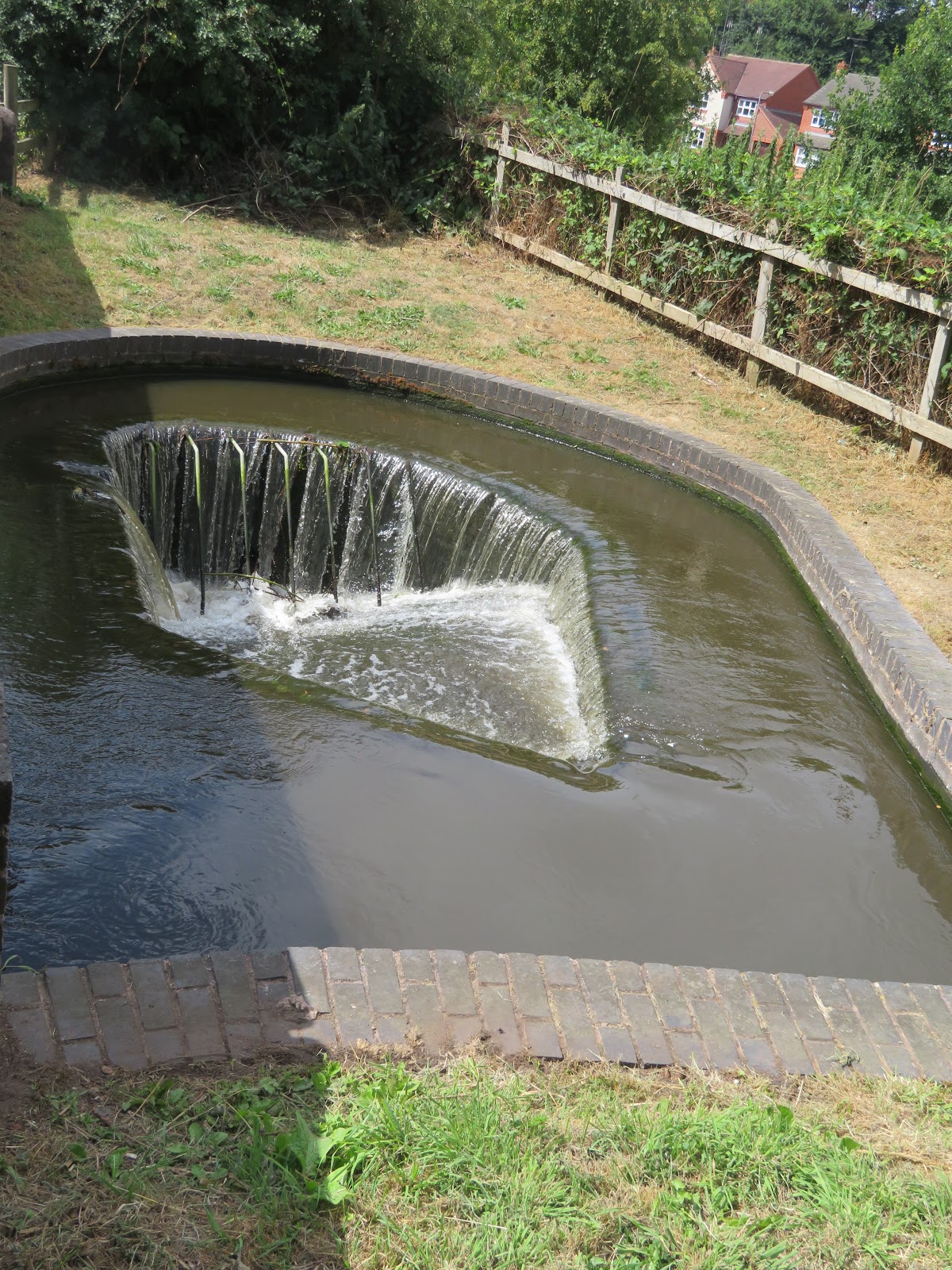
Near to Wightwick Mill Lock is one of the circular weirs that are only found on this canal. They do add a touch of class to the scene.

There are nice little steps down to board the boat at the locks so I took advantage and took a snap of Helen bringing 'Holderness' out of the lock.

The next, and last for the day for us, is Wightwick Lock. Helen has just brought the boat in. I took the photo not to show how Helen can perform this feat even when looking the wrong way, but to show off the boat as I polished the boat yesterday.

Again this photo is not to show how nonchalantly Helen takes the boat out, but to show the top of the bridge arch. It almost looks like stalactites but is in actual fact the wear caused by the tow ropes of the horse drawn boats that were passed under the bridge to pull the boats out.  

This old wharf makes a great moorings but is also home to a traditional boat painter.

We moored up above Dimmingsdale Lock, on the offside moorings. I took this picture to see the shine. I therefore had to get busy with the other side to match it. It certainly looks better for doing.

At the foot of the lock there are some heavily laden damson trees that tempted me to pick them and I see a jam session coming on. I may bottle some too. At the mouth of the by-wash there seems to be a popular spot for fisherman, judging by the amount of rubbish that was knocking about. I went down with a bag and a picker and cleaned it all up.