Total Pageviews

Friday, 4 September 2015

Guest steerer.

We went in to town to get a few supplies in as we were having a guest steerer for the next few days. As we passed through the ICC it was obvious that it was graduation day for Birmingham University. All the students and parents looked very smart in their caps and gowns and in the Sunday best. We went back into town to meet Chris from his train at New Street and head back to the boat for a bite to eat.

Chris thrown in the deep end as he leaves our berth and heads round the Oozells Loop with the Barclaycard Arena in the background.

Rather than make the tight turn at the northern end we continued up the New Main Line to find a spot to wind. We were soon back at the top of the Farmer's Bridge Locks. We stopped to top up with water and dump the rubbish. There was a C&RT work boat moored in the mouth of the lock so I went down to see what was what. I was fearing the worst when I saw a pound empty. It seems that a paddle raiser had broken and was being replaced. You can just see the new steel in place.

This is the drained pound. Apparently they had started at about 1200 and as I arrived they had just about finished the job. By the time I had got back to the top they followed and started filling the pound.
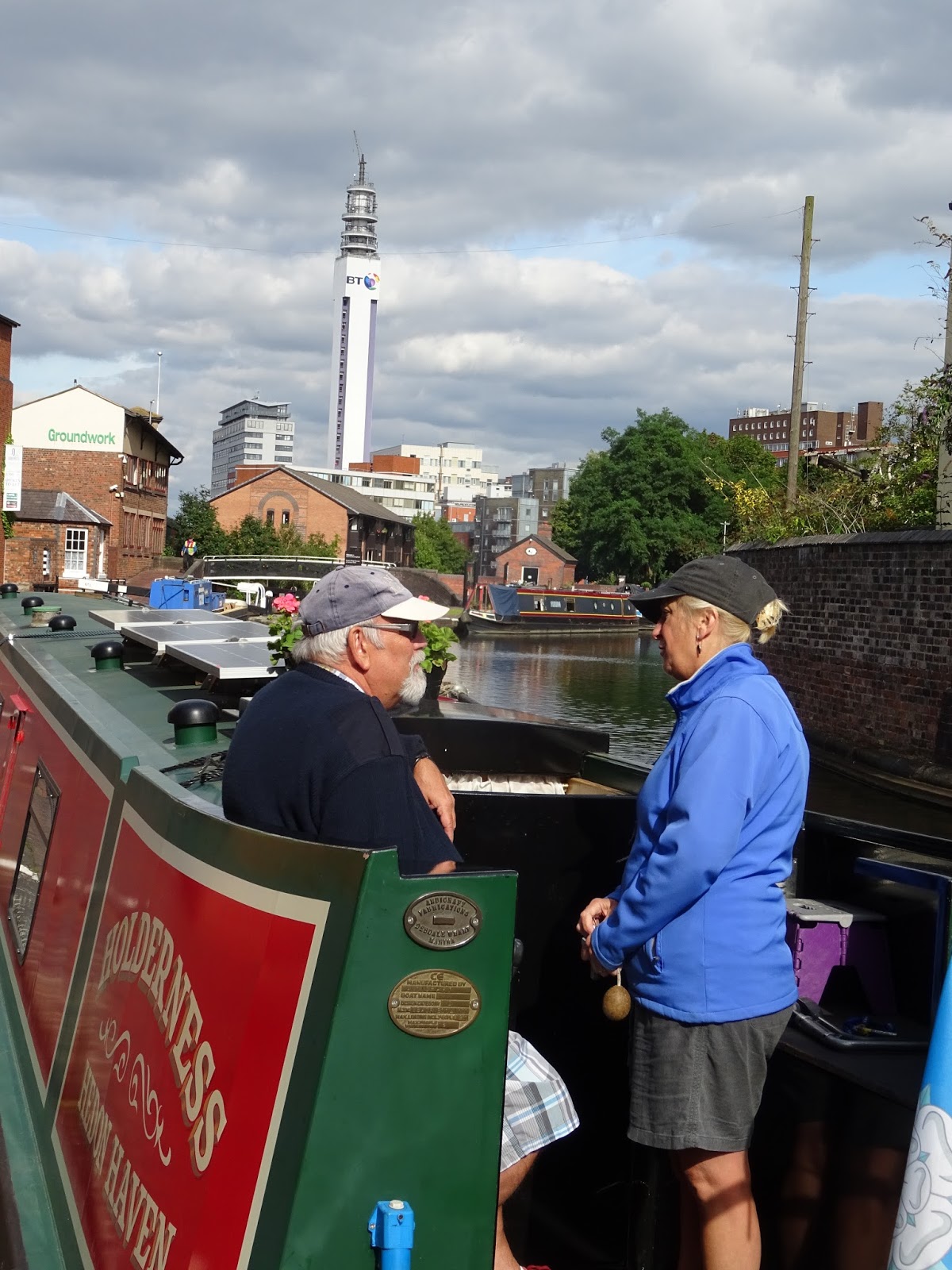
By the time we had finished taking water etc we only had about 20 minutes wait before we were able to head down. Enough time for Chris and Helen to catch up with months of gossip though.

Here we are heading down and about to burrow under the BT Tower etc. We met four boats coming up in the end so I think we had every lock but the second our way.

We are just about half way here.

Of course it was always going to be that we would meet another boat under the building, but it just goes to show that there is enough room!

I had never noticed this bit of wall art before but is pierced metalwork.

Out the other side and nearly there with one lock to go.

I'm not sure how they manage to paint these things on such a large scale. Do they protect it on and then fill in with paint. it seems a little wasted as there can't be that many people that can see it.

At Aston Junction we turned right and moored again at Aston University. We had good luck with the lock repairs and the weather so fingers crossed it will hold for the next few days.

Thursday, 3 September 2015

Slasher, Smethwick and Soho on the route.

We were politely asked to leave our berth at the Black Country Museum this morning as they were having a delivery of equipment for the new Dudley Canal Tunnel and Limestone Caverns Trust visitor centre. We didn't go far as we moored up between the bridges at Tipton to do a little shopping. We were next to a little park where there is a statue of William Perry, better known as the 'Tipton Slasher'! William was the pugilistic World Champion 1850 to 1857. He was born on a canal boat and used to fight for the right to be first down the Factory Locks nearby. His boxing headquarters were at the Fountains Inn next to the park. When he retired he ran a pub but died of alcoholism. Unusually his remains were removed from the church where he was buried in Dudley and interned under the statue.

Willaim Perry. The Tipton Slasher 1819 - 1880.
Pugilist Champion of the World 1850-1857

This is the Malthouse Stables at Tipton that were built in the early 19th Century. There was room for 14 horses on the ground floor and feed ect on the second floor. It is now an Activity Centre.

The old guaging dock at the top of Factory Locks where the connection to the New Main Line drops down three locks. You can see the arches where the boats were taken in to check there ballast and loaded weight so that they could be easily checked for charges at the toll islands around the BCN.

Helen getting busy at the first lock of the day. Tipton Green was also the site of a battle during the English Civil War in 1644 when the Royalist arrived to relieve the siege of the Earl of Denbigh at the Castle at Dudley. The King's forces won on this occasion.

Some may not believe me but the waters on this apart of the BCN are extremely clear and the growth on the top lock gate show that. It shows the single gate and the cill protector.

This is the new main line and shows how it managed to cut seven miles of the distance by canal from Birmingham to Wolverhampton by 7 miles! Thomas Telford was able to use more modern structural techniques to build cuttings and embankments to build in straight lines.

The Old Main Line wound along the contours and crossed the New Line in several places the low bridge here is the Old Main Line crossing. The one above is the M5.

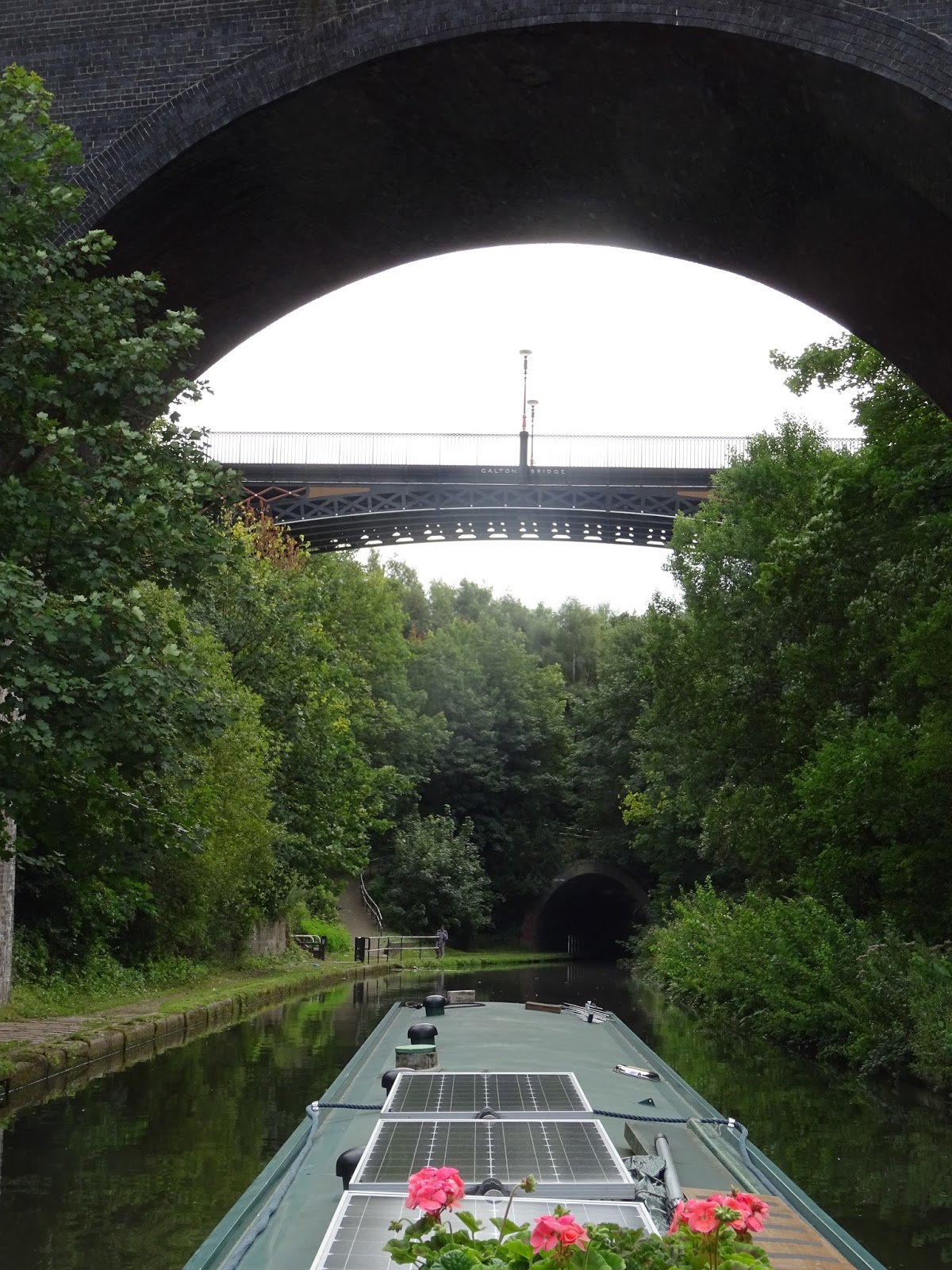
This is the deep Galton Cutting. Above is the Old Line and between is an island of green.

The cuttings were spanned by many large bridges with Galton Bridge built by Thomas Telford in 1829 being one of the finest. The nearest bridge has a station on it and in the distance can be seen Galton Tunnel.

With having the two canal levels close a pumping station was installed to pump water up to the higher pound. It is the New Smethwick Pumping Station and was opened in 1892. It housed a steam beam engine and ran until 1920. It reopened in 1980 and regularly is open to the public when in steam.

The bridge over the New Main Line carries the Engine Arm that connects with the Old Main Line at the top of Smethwick locks. The Arm was a feeder for the canal at first. We were lucky enough to have a boat going over as we passed. The other side of the bridge is a toll island and gauging dock.

The gauging and toll island had narrow passages on either side so that waybills etc could be checked as boats passed in a two way manner. If there was a doubt about the correct loading the boat would be directed through the centre channel that can be seen between the two jettys. This was covered and here the gauge of the height of the gunwhale above the water line could be taken at the four corners. they would be averaged and then compared with the tables to get the correct charges. The commodity carried also varied the tolls.

The roving bridge marks the Soho Loop that was once the old route of the canal until cut off by the Telford built canal. In 1795 on the banks of the canal down that loop the Soho Foundry was built by Matthew Boulton and James Watt to build steam engines. They built the engine used in the pumping station earlier. It was one of the first factories as each operation was broken down to smaller tasks. The engines for Brunel's 'Great Eastern' ship were also built there. The foundry was taken over in 1895 by W & T. Avery Co who still make weighing equipment there.

As we approached Old Turn Junction we passed north end of Oozells Loop, another bight of the old main line that remains after being dissected by the new canal. The loop creates a little island that seems to be popular for apartments.

We went to see if there was any room at Cambrian Wharf but there was non. After winding we headed back to the south end of the Oozells Loop and moored up there with the Barclaycard Arena in the background. It isn't a bad spot here as it isn't on the walking routes so is quiet. I think we will go and check out the Fiddle and Bone pub tonight.

Wednesday, 2 September 2015

Dawdling to Dudley.

We decided to set off a little earlier than normal as the rain was due to start about 1500. However we just moved over to the the sanitary station to dump the rubbish we had picked up from our moorings (three bags), fill up with water and then we decided to empty the loo too. We were soon of though and heading round the junction where the Wyrley Branch used to head off but was closed in 1954.

Once round the bend the cut runs through green banks that used to house collieries and brickworks. Rough Wood Chase is a wild park with many footpaths but few places to moor.

After Holly Bank Basin we passed a few damsons trees heavy with fruit and we couldn't resist so backed up. It was a matter of minutes to fill three punnets but took a lot longer to clear the rubbish off the prop we had accumulated with going heavily astern. Still it was only about 10 minutes stop so well worth it.

We couldn't resist the mirrored bridge at Heath Town once more and I don't think that I am getting any better looking!

Just by Horseley Fields Junction with the Main Line are these bridges that were the Midland Railway Basins and the site of rolling mills and other heavy industries. On the main line towards Birmingham is another transhipment basin for the LNWR with covered berths and overhead cranes who bought it from Birmingham Canal Navigations in 1902.

The northern portal of Coseley Tunnel. It had been closed earlier in the year due to land slips at the southern end but all had been cleared and the bank netted to prevent movement in the future.

We had never moored up by the Black Country Museum before so decided to see if there was room. There were a couple of spots and we chose right by the museum. Over the way is the new visitor centre for the Dudley Canal Trust which looks like it isn't too far from completion.

We decided to take advantage of the tunnel trip boats and made for the last but one tour. This is the east portal of the Dudley Canal Tunnel and we wouldn't fit in even if we wanted too. Apparently the Dudley Canal Tunnel was built much later than the tunnels for the mines by Lord Dudley and at a different level to preserve water. There was a a stop lock underground but didn't ever really work. There was a problem with legging in one direction though as there was a current through it.

Helen looking very fetching in her protective equipment.

This is part of the Dudley Canal Tunnel that was opened in 1792 which was started in 1785. It is brick lined and is now covered in calcite.

This is Flooded Mine as it was often three feet deep in water despite pumping and was one of Lord Dudley's tunnels. This branched off from Shirts Mill Basin that was originally underground but had the roof taken off later.

This is Castle Mill Basin, again originally underground but later opened out. It is now the junction of four tunnels. This one is the Wrens Nest tunnel and was opened in 1815 to serve limestone mines about a mile away. It is hoped to reopen this tunnel to add to the tour.

This again is the Dudley canal Tunnel that heads for Park Head and Windmill End. The boat is the second trip boat as they use a one way system as there are so many tunnels.

The largest cavern now visited is the Singing Cavern. It was about half a mile long with seven of the big pillars holding up the roof. The largest one underground was Dark Cavern that was much larger so that it had over thirty pillars! To get to this cavern from Castle Mill Basin a new tunnel was cut in 1989.

Via another new tunnel constructed in 1984, the first cut in the UK since the Netherton Tunnel, and with it's own Blue Peter Badge, you leave Singing Cavern to access the Dudley Canal Tunnel. In this brick lined section we got a chance to do some legging. I had actually helped leg right through the tunnel in my teens.

This is Castle Mill Basin again and this is the 1989 tunnel to the Singing Cavern with the trip boat heading inwards. The trip takes about 45 mins and the information is very interesting and is worth the £6-40.

There is an access into the Black Country Museum from our berth so as it was close to closing time I wandered in for a quick look see. Again we had been with the kids about 17 years ago. It did look like it would be rewarding to have another looks see.

Parallel to the Dudley Tunnel Line is this branch in the museum with some historic boats adding to the scene with the foundry and forge in the background.

Another part of the 'town' with wires for a trolley bus.

Looking back over the canal bridge the roof lines and buildings really do make it all look like a living landscape. We must come back at sometime.


Tuesday, 1 September 2015

Wandering on Walsall canal.

After a bit of administrative work we were off quite late, and just as a C&RT work boat wanted to moor. We backed out of the Oker Hill Tunnel Arm and headed off past the Tame Valley Junction and headed towards Walsall.

Along the way there are many banches that have been filled in, along with roving bridges over factory arms. This one is still obvious as it was the  Bradley Branch that used to lead to the Wednesbury Oak Loop up nine locks and so to the Wolverhampton level.

The Walsall Canal has many long straights and these bridges are the start of the Black Country Spine Road that runs parallel to the canal. However it is well screened and above the canal so doesn't seem to intrude too much.

This photo illustrates much of the Walsall Canal. Green but obviously old industrial land but never far from new industrial buildings and housing.

A few relics of the old working canals still survive. This is an old warehouse in Pleck.

There is plenty of green spaces on the route as well as plenty of brown field sites for development.

We headed up the Walsall Town Arm where the bank had been transformed by many new apartment buildings. The basin at the end is protected by a boom. We stopped to see what was what and realised that it was not made fast at one end and on a spring on the other so it was designed to push out of the way on passage and return afterwards to keep the rubbish. We went for a walk round the town for a look see and to find the post office.

Sister Dora was a heroine of Walsall. She came from a large family in Yorkshire with a depressed and violet Father. She couldn't make her mind up about a marriage partner and fled to be a school teacher. She later joined the Sisterhood of the Good Samaritans and became sister Dora, her real name was Dorothy Pattison. She arrived in Walsall in 1865 and worked in hospitals there. She worked continuously through a smallpox epidemic and eventually got known for helping the injured from industry, especially those on the railways and canals. The railway workers raised money for her to get a pony and trap to visit the sick at home. She died at 46 from cancer and at her funeral the whole town turned out to see her coffin carried by eight railway workers in uniform. She died in 1878 and in 1886 the statue was raised for her. It is said to be the first statue of a woman not of Royal blood to be erected in the UK.

The third Guild Hall on the same site was the civic centre of Walsall. It was refurbished in 1986/7 and is now a restaurant. 

'Holderness' on a pontoon at Walsall Town Basin. 

The Town Arm joins the Walsall Canal at the foot of the eight Walsall Locks. Above the first lock is the old Albion Flour Mill that was built in 1849. It has now been changed to apartments.

Looking down the flight from the second from the top. They are all single gates, except on and are  easy to work on the whole.

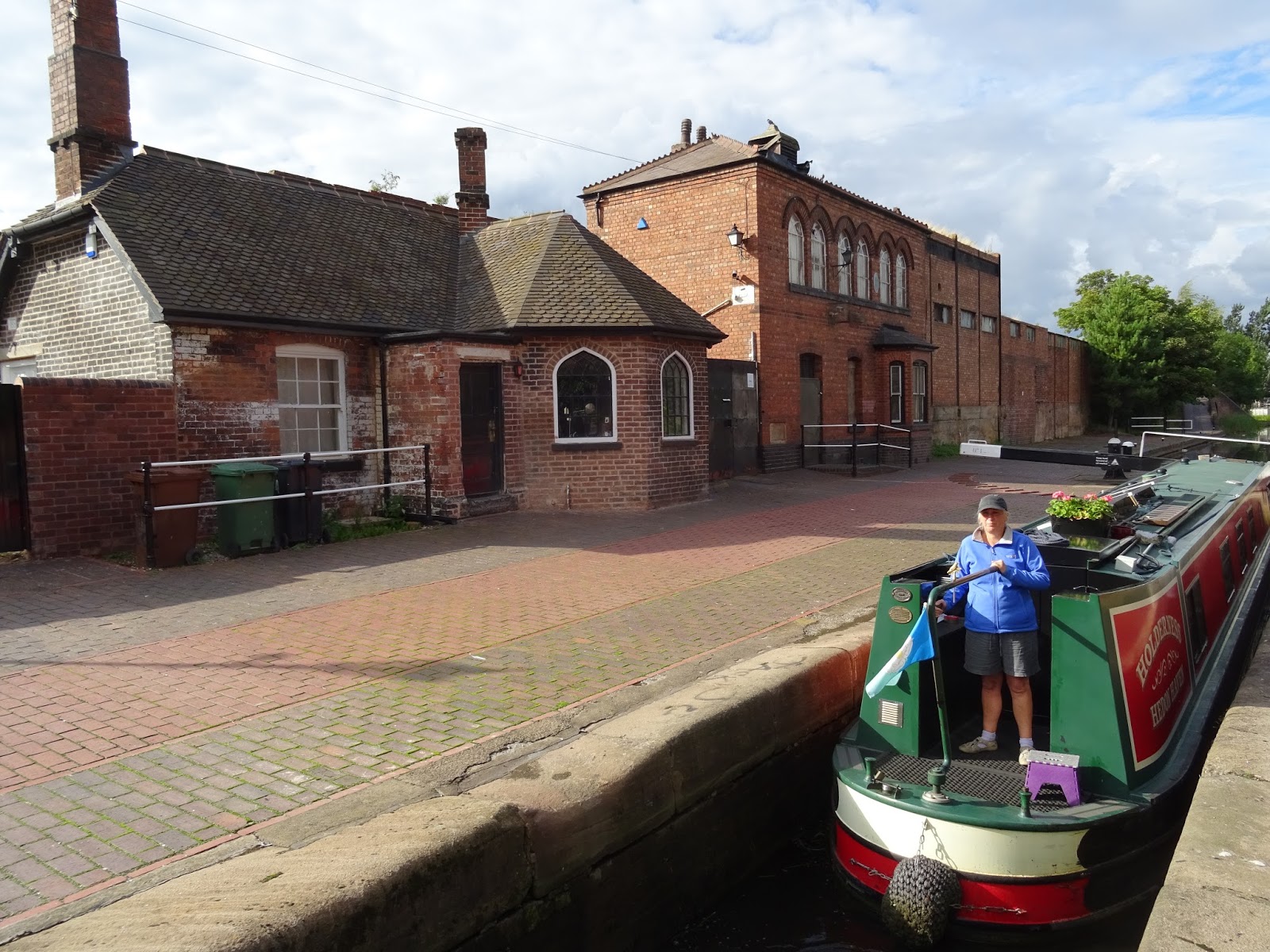
At the top of the flight at Birchills is the Incorportaed Seaman and Boatmen's Friendly Society, or the Boaten's Mission or rest. Here they could get a bed for the night, food, somebody to write letters etc. That is the building with the arched upper windows. These were for the dormitory. At one time the Mission was a Canal Museum but now is boarded up and looking for another use. The building closer to the the camera was the toll office for the canal.

We continued to Birchills Junction and then turned on to the Wyrley and Essington canal towards Wolverhampton. We stopped at Sneyd Wharf for the night. We saw one boat on the Walsall Arm and then another turned up later and moored on the water point by the buildings in the picture.